What Is 4D Chess?
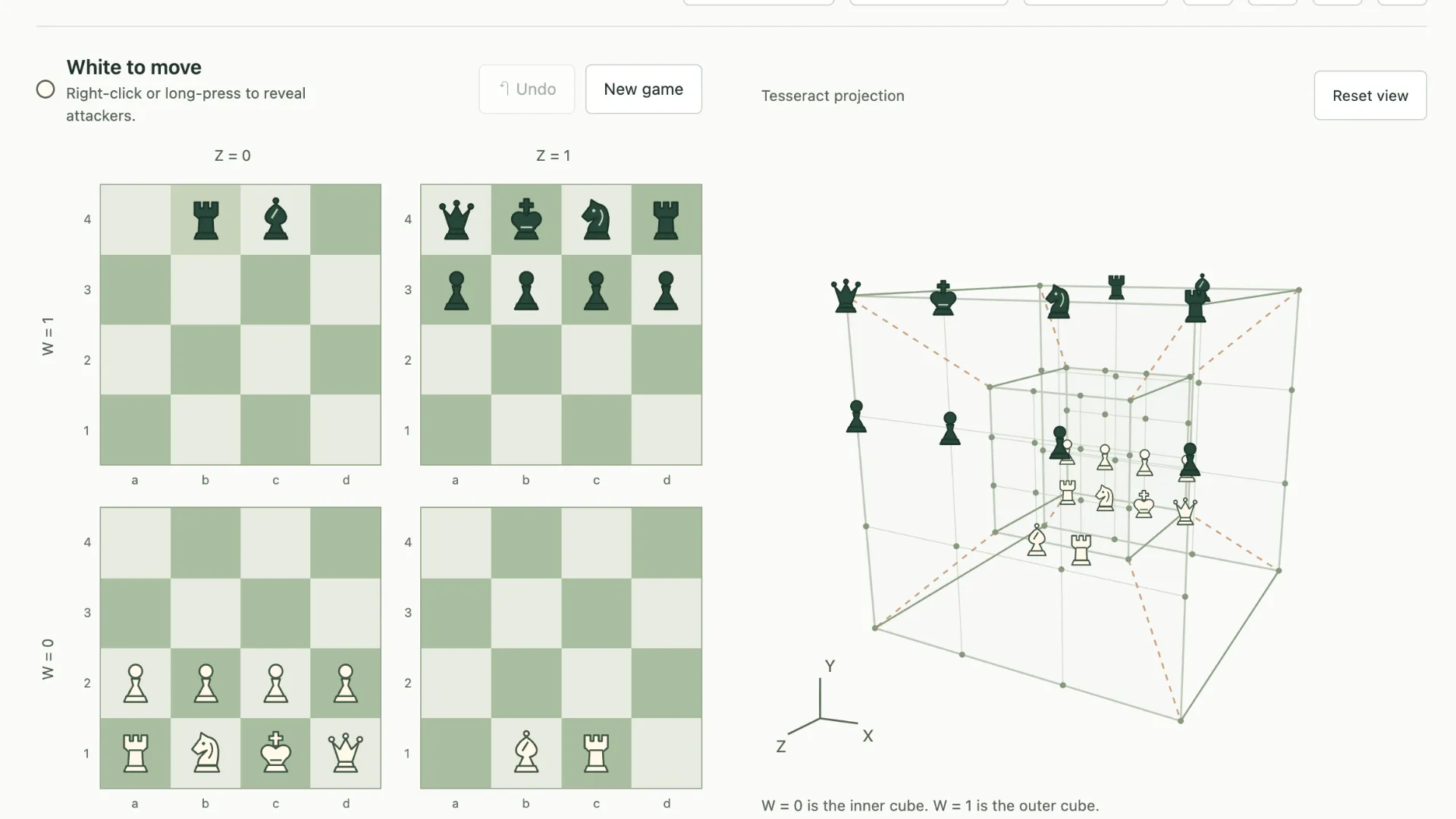
4D Chess is a playable browser-based chess variant that extends the board across four coordinates: X, Y, Z, and W. X and Y behave like the files and ranks of a normal board, while Z and W connect additional layers of the playing space.
Instead of treating the visible boards as separate games, you need to imagine them as slices of one connected four-dimensional chessboard. A piece can move from one board to another when that movement is legal along the relevant coordinate.
The objective remains familiar: checkmate the opposing king. The challenge comes from attacks that can arrive from directions that do not exist in standard two-dimensional chess.
The Core 4D Twist
Each square is defined by four coordinates instead of two. A position can therefore share the same familiar file and rank while occupying a different Z or W layer.
The major pieces adapt standard chess movement to this four-axis space:
- Rook: moves along one coordinate while the other three remain unchanged.
- Bishop: moves diagonally by changing two coordinates together.
- Knight: combines a two-step change on one coordinate with a one-step change on another and can jump over pieces.
- Queen: combines rook-like and bishop-like movement across the available dimensions.
- King: moves one step through the connected multidimensional space but cannot move into check.
- Pawn: advances forward and captures using diagonal combinations that can involve additional dimensions.
The result is that two pieces displayed on different boards may actually be directly aligned. A rook, bishop, or queen can sometimes attack your king from another layer even though the threat looks distant on the flat screen.
How to Play 4D Chess
Understand the board layout. Treat the visible boards as connected sections of one larger space rather than independent chessboards. X and Y represent familiar board directions, while Z and W connect the different layers.
Select one of your pieces. The interface shows the legal destinations available from its current four-dimensional position. Use these highlights to learn how familiar chess movement changes across layers.
Start with simple cross-layer moves. Rooks are easiest to understand because they move along one coordinate at a time. Try moving a rook to a corresponding square on another connected board to see how movement through an extra dimension works.
Check the entire position before moving. Do not inspect only the board containing your king. Enemy pieces on other layers may have direct lines of attack through Z or W.
Checkmate the enemy king. As in ordinary chess, the goal is to place the opposing king in check with no legal move, capture, or block that can remove the threat.
Rules and Differences From Regular Chess
4D Chess keeps the recognizable identity of chess pieces while changing the geometry in which they operate. This makes standard concepts such as material advantage, king safety, forks, discovered attacks, and controlling important squares useful, but their application is much harder to visualize.
The additional dimensions dramatically increase the number of possible relationships between pieces. A square that looks isolated in the two-dimensional interface may actually connect to several strategically important positions on other boards.
Because of this, learning the coordinate system is more important than memorizing openings. The game rewards players who can gradually build a mental picture of how the layers connect.
Strategy Tips
The most common beginner mistake is thinking of the display as several separate chessboards. Always treat the boards as different views into one position.
Start by studying rook movement. Since a rook changes only one coordinate at a time, it provides the clearest introduction to movement between dimensions. Once those relationships feel natural, bishops and queens become easier to understand.
King safety deserves extra attention. Before committing to a move, scan corresponding squares and diagonals across every layer. An apparently harmless enemy piece may already be aligned with your king through an extra dimension.
Do not rely entirely on how lines look in the visual projection. Four-dimensional relationships can appear distorted when displayed on a two-dimensional screen. Legal movement is determined by the underlying coordinates, not by whether a path appears visually straight.
If ordinary chess has started to feel predictable, 4D Chess is worth trying for the novelty alone. Familiar pieces and checkmate rules provide an accessible starting point, but the extra dimensions quickly turn even simple positions into challenging spatial puzzles.