What is Color Guesser?
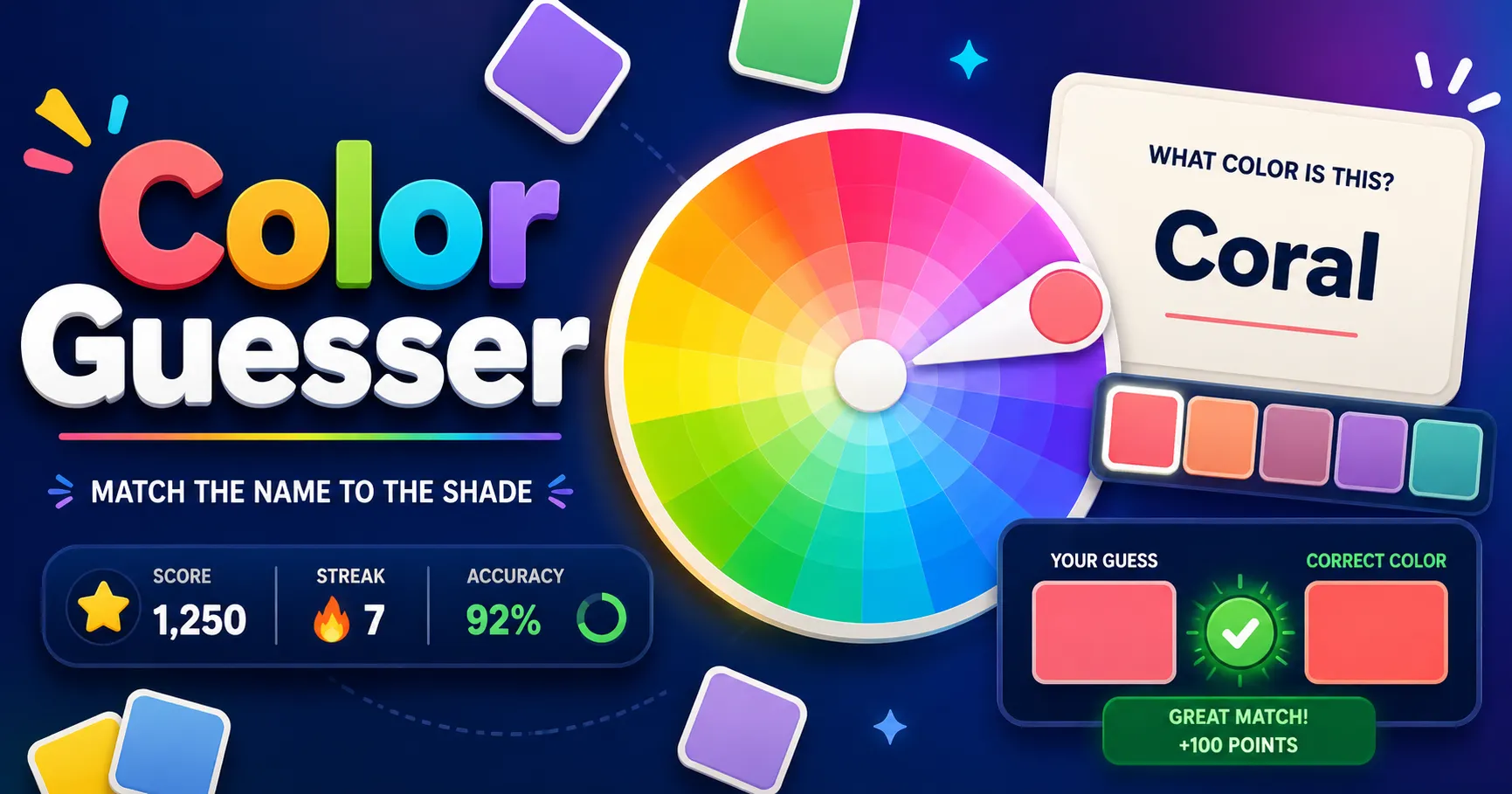
Color Guesser is a daily visual puzzle about matching color names to actual shades. Instead of guessing a word, country, song, or movie, you see a color name and use a color wheel to choose what you think that color looks like.
The twist is that color memory is less reliable than it feels. Names like coral, sage, lavender, or crimson may sound obvious, but one small shift in hue, brightness, or saturation can cost you points. Color Guesser is simple to start, but it quietly tests your eye for detail.
Color Guesser Game Rules
Color Guesser is built around visual accuracy:
- You are shown a color name.
- You must choose the closest matching shade on a color wheel.
- After each guess, the game reveals how close you were.
- Each round can award points based on accuracy.
- A daily puzzle includes multiple color names to guess.
- Your total score depends on how precisely you match every shade.
The catch is that you are not just choosing a general color family. Picking “red” is not enough if the answer is closer to brick red, cherry red, or rose. The better your eye, the higher your score.
How To Play Color Guesser?
Step 1: Read the color name
Player Action: Look at the color prompt, such as Uluru Red or another named shade.
Game Response: The game gives you the name, but not the exact color.
What You Learn: Your first job is to imagine the shade before touching the wheel.
Step 2: Pick a spot on the color wheel
Player Action: Move around the color wheel and choose the shade that feels closest.
Game Response: The wheel lets you fine-tune the hue and visual position of your guess.
What You Learn: The difference between a good guess and a great guess often comes down to tiny color adjustments.
Step 3: Reveal the result
Player Action: Submit your chosen color.
Game Response: The game compares your guess with the correct shade and gives you a score.
What You Learn: You can see whether your guess was too bright, too dark, too warm, too cool, or simply in the wrong color family.
Step 4: Build your daily score
Player Action: Continue through the remaining color names in the daily puzzle.
Game Response: Each round adds to your total score.
What You Learn: Consistency matters. One near-perfect match can help, but every color affects the final result.
Strategy & Tips
Start by identifying the basic color family before worrying about precision. Decide whether the name suggests red, orange, blue, green, purple, brown, or gray, then adjust the shade from there.
Pay attention to saturation and brightness. Many wrong guesses happen because the hue is close, but the color is too neon, too muted, too pale, or too dark.
Use real-world associations carefully. A color name may refer to a place, object, plant, mineral, or design term, but your mental image may not match the exact target shade.
If you are unsure, avoid extreme edges of the wheel. Many named colors sit in softer, more natural ranges rather than pure digital primaries.
Color Guesser FAQ
Is Color Guesser free to play?
Yes, Color Guesser is available to play online for free.
What kind of game is Color Guesser?
Color Guesser is a daily visual guessing game where you match color names to shades.
How do you play Color Guesser?
Read the color name, choose the closest shade on the color wheel, reveal the answer, and try to score as many points as possible.
Is Color Guesser like Wordle?
It has a similar daily puzzle habit, but the gameplay is visual instead of word-based. You guess colors rather than letters or words.
Who should play Color Guesser?
Color Guesser is a good fit for players who enjoy visual puzzles, design games, color challenges, and quick daily browser games.
Final Take
Color Guesser is a clever daily puzzle for anyone who enjoys colors, design, and visual challenges. It is easy to play in a few minutes, but hard to master because every shade asks the same question: do you really know what that color looks like?