What is colorfle?
A single mysterious shade stares back at you. Your job? Rip it apart and rebuild it using exactly three unique colors in the right order and proportions — all in just six guesses. Colorfle is Wordle reimagined as color theory warfare: no letters, just pure hue combat where one wrong pigment can send your entire mix spiraling into muddy disaster.
What makes it brutally addictive is the surprise. Your brain thinks it “sees” the color instantly… until the feedback hits and you realize you were mixing the right colors in the completely wrong recipe. Every day the target changes. Every day the battle restarts. Survive six rounds or taste defeat in glorious RGB glory.
colorfle Game Rules (The Catch / The Trap)
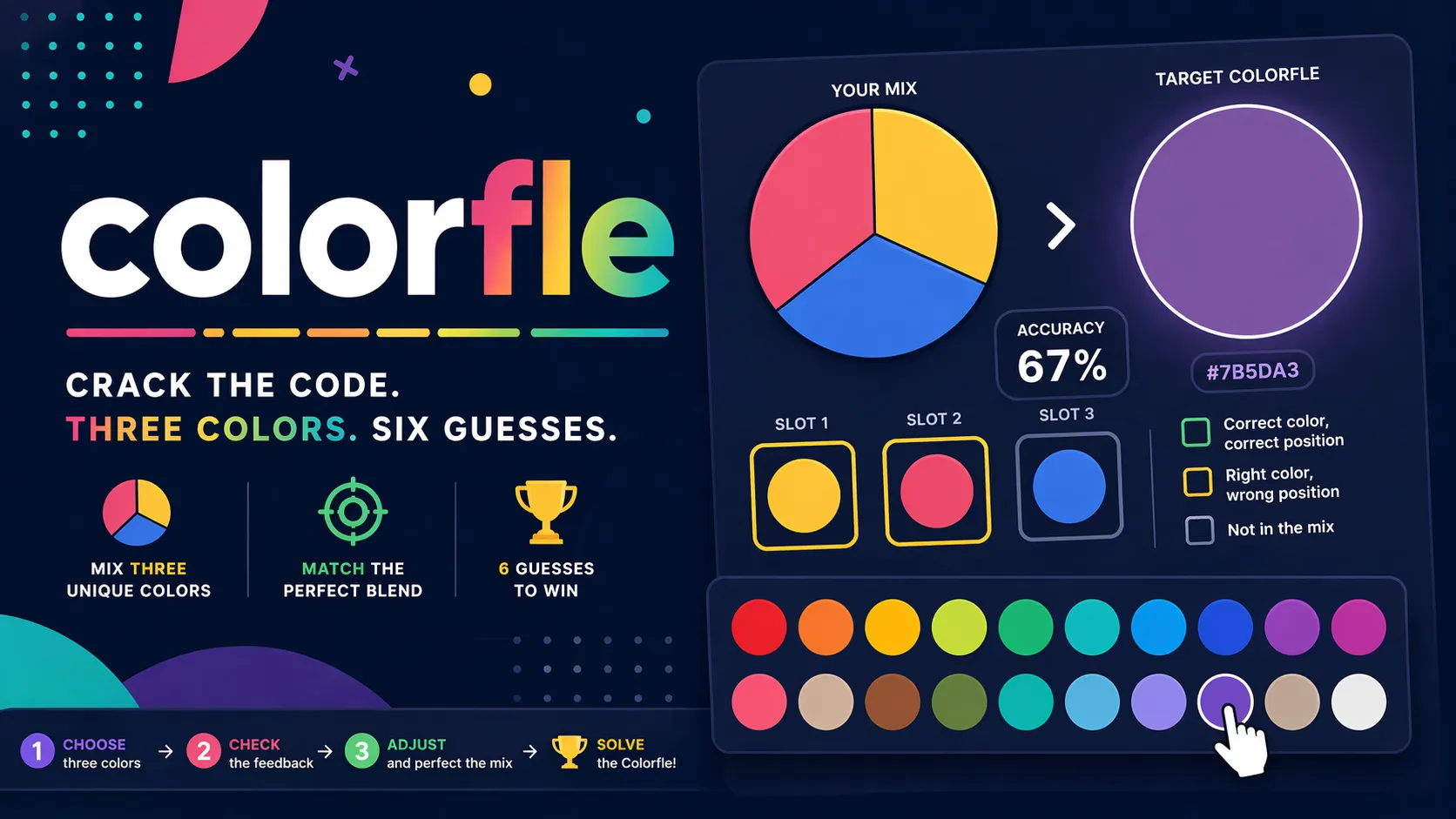
The target Colorfle is locked as a precise blend of exactly three unique colors — no repeats allowed, ever. You submit a three-color composition each turn. The mixer instantly reveals the truth with ruthless Wordle precision:
- Green border = That exact color is LOCKED IN the correct position in the secret recipe.
- Yellow border = That color belongs in today’s mix… but it’s in the wrong slot.
- No highlight = That color is FORBIDDEN. It is not part of today’s Colorfle at all.
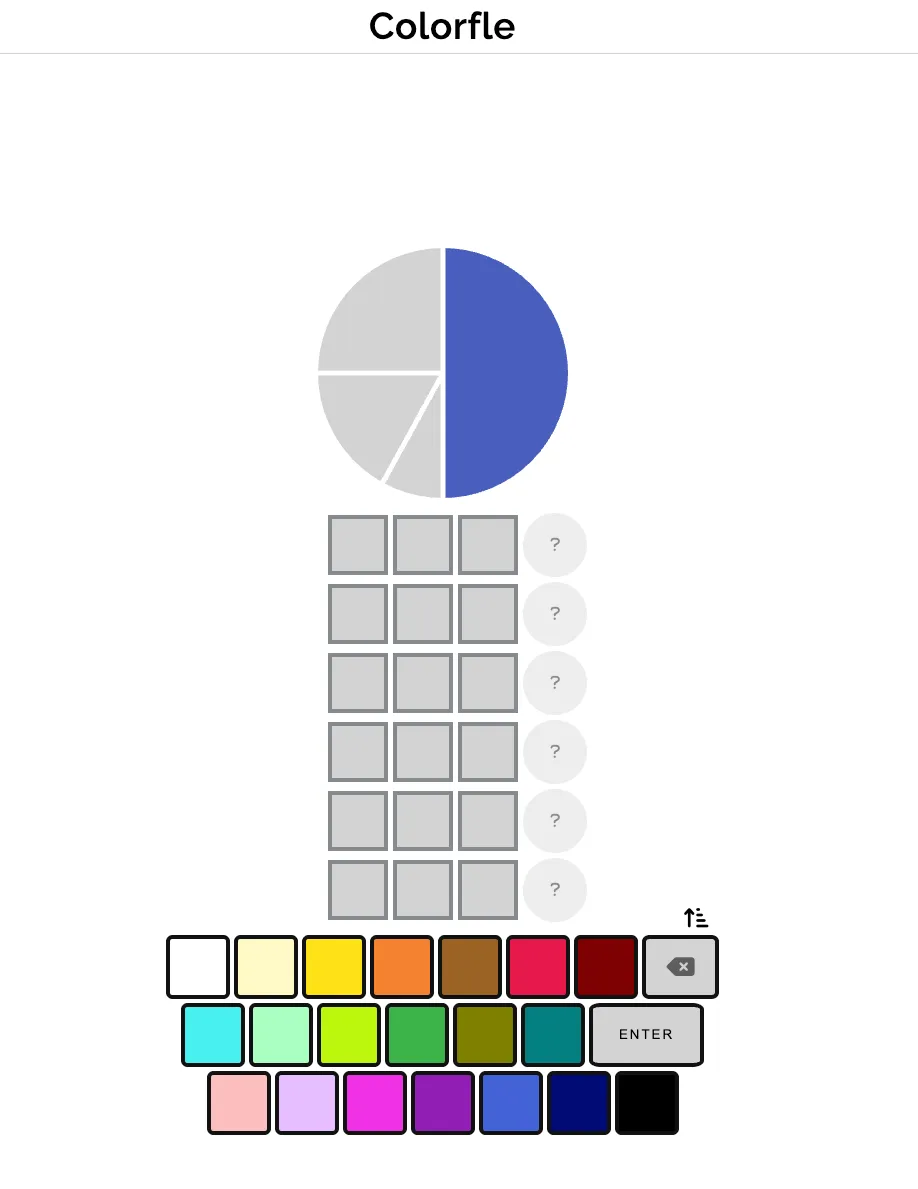
Your guessed blend appears as a pie chart on the left (sector size = proportion). The target pie on the right shows the real ratios. An accuracy percentage tells you how close your overall mix got. Get all three colors green with perfect proportions and you win. Anything less and you keep fighting.
How To Play colorfle?
Step 1: Face the Target
A vibrant mystery shade appears on the right. Study it hard. The keyboard below lights up with dozens of possible colors.
Step 2: Build Your First Composition
Player picks: 🔴 🟡 🔵 (Red + Yellow + Blue)
Game shows: Your pie chart forms on the left. Accuracy: 67%.
Feedback: 🟡 🔴 ⚪ (Yellow in wrong spot, Red correct but wrong position, Blue eliminated)
Step 3: Refine with New Intel
You now know Red and Yellow are in the mix (just swapped), Blue is dead.
Player adjusts: 🔴 🟡 🟢 (Red + Yellow + Green)
Game shows: Pie sectors shift. Accuracy jumps to 89%.
Feedback: 🟢 🟢 🟡 (Red and Yellow now locked in perfect positions, Green is right color but wrong slot)
Step 4: Nail the Proportions & Final Slot
Player locks it: 🔴 🟡 🟣 (Red + Yellow + Purple — adjusting pie sizes mentally from the visual clues)
Game explodes: All three slots flash green. Accuracy: 100%.
Victory screen lights up. You just cracked today’s Colorfle.
Step 5: Share or Practice
Copy your score, check the global leaderboard, or jump into Practice Mode for unlimited revenge rounds.
Strategy & Tips
Start aggressive with primary colors (red, blue, yellow) to force early eliminations. Watch the pie sectors like a hawk — they betray proportion secrets even before the borders do. If you’re stuck at 90%+, the final tweak is almost always a tiny hue shift or position swap. And remember: the game is color theory disguised as a puzzle — the more you play, the sharper your mixing instincts become. Good luck, color alchemist. Today’s shade is waiting.