What is Daily Shikaku?
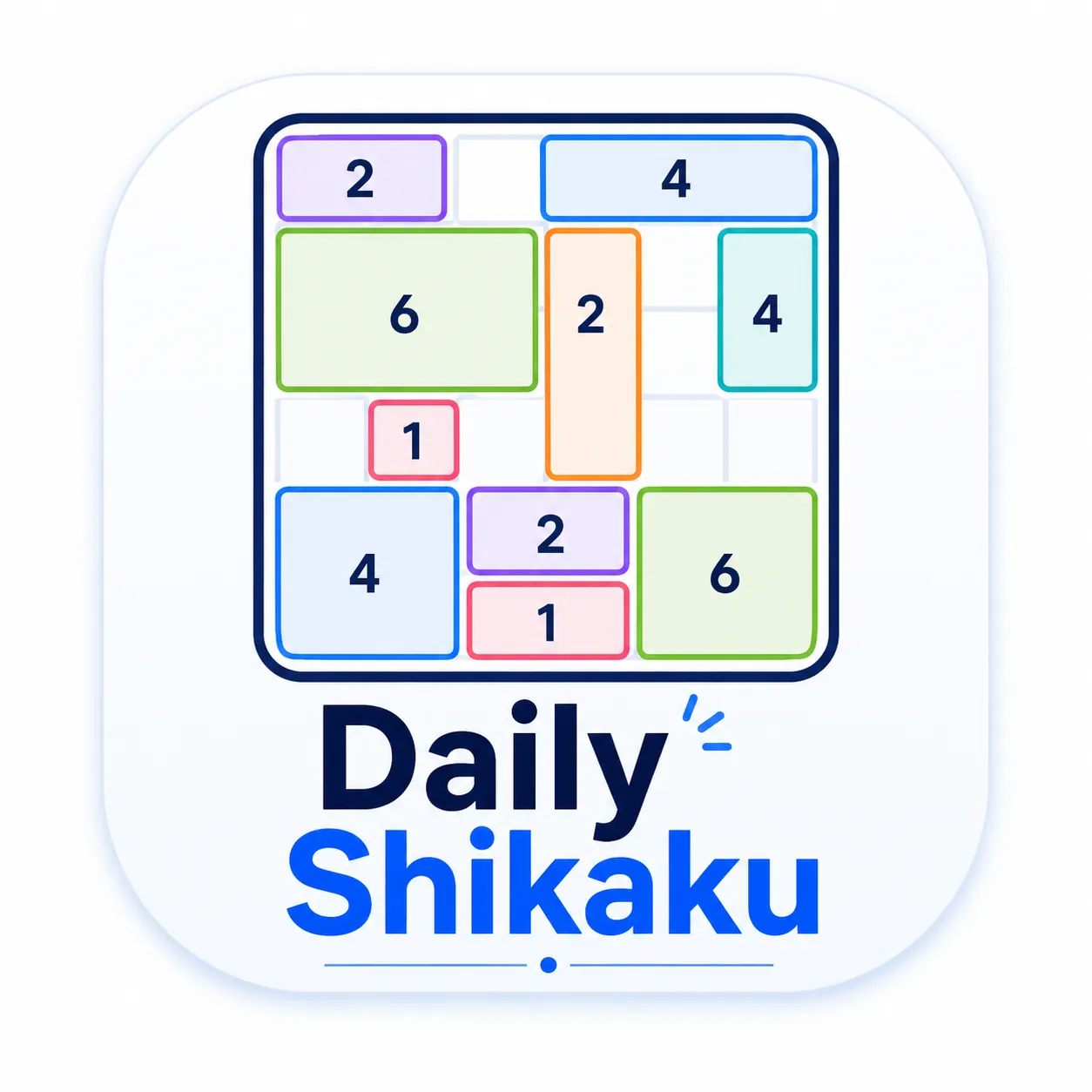
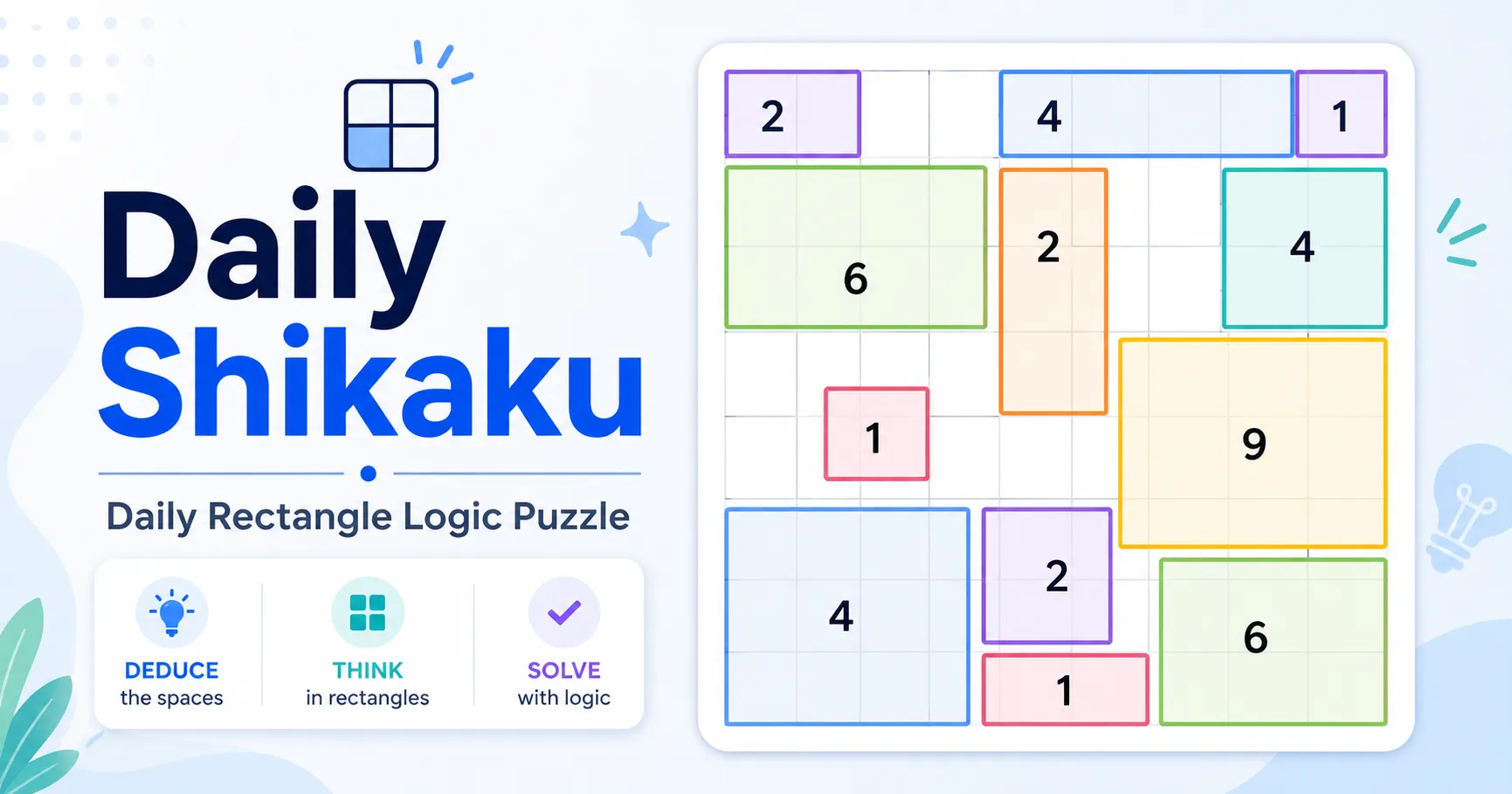
Daily Shikaku is a daily number logic puzzle where you divide a grid into rectangles. Each rectangle must contain exactly one number, and that number tells you how many cells the rectangle must cover. A 4 must cover 4 cells, a 6 must cover 6 cells, and every square on the board must belong to one valid region.
The puzzle looks calm at first, but the challenge comes from space control. One rectangle may fit by itself, yet still be wrong if it blocks another clue or leaves an impossible empty cell. Daily Shikaku rewards patient deduction, careful shape testing, and the satisfying moment when the whole grid finally divides cleanly.
Daily Shikaku Game Rules (The Catch / The Trap)
Daily Shikaku uses simple area rules, but every rule matters:
- Each rectangle must contain exactly one number. A rectangle with no number is invalid, and a rectangle with two numbers is also invalid.
- The number must match the rectangle area. If the clue is
5, its rectangle must cover exactly 5 cells. - Rectangles can have different shapes. A
6may be 1×6, 2×3, 3×2, or 6×1 if the board allows it. - Rectangles cannot overlap. A cell can belong to only one rectangle.
- The entire grid must be filled. No gaps, stray cells, or unused spaces can remain.
- The trap: a rectangle can be mathematically correct but strategically wrong. If it leaves nearby cells with no possible region, the shape must be changed.
Visual area example:
A clue of 4 can be solved in different rectangle shapes:
1 × 4 → [ ][ ][ ][ ]
2 × 2 → [ ][ ] [ ][ ]
4 × 1 → [ ] [ ] [ ] [ ]
All three shapes cover 4 cells, so all three are possible in theory. The correct one depends on the surrounding clues and available space.
How To Play Daily Shikaku?
Step 1: Scan the grid
Player Action: Look at all the numbered cells before drawing rectangles.
Game Response: Each number shows the required size of one region.
What You Learn: Small numbers are often easier to solve first, while larger numbers may have several possible shapes.
Example clue options:
1= one single cell2= 1×2 or 2×14= 1×4, 2×2, or 4×16= 1×6, 2×3, 3×2, or 6×1
Step 2: Start with forced rectangles
Player Action: Solve clues near corners, edges, or crowded areas first.
Game Response: Some numbers have fewer legal directions, making their rectangles easier to identify.
What You Learn: Border clues are powerful because they cannot expand outside the grid.
Step 3: Test possible shapes
Player Action: Draw a rectangle around a number and count the cells.
Game Response: A valid rectangle matches the clue number, avoids other numbers, and does not overlap existing regions.
What You Learn: Area alone is not enough. The rectangle must also fit the rest of the puzzle.
Step 4: Check for trapped cells
Player Action: Look for blank cells that no nearby number can legally cover.
Game Response: If a blank cell is trapped, at least one rectangle shape is wrong.
What You Learn: Shikaku is solved by eliminating impossible layouts, not by guessing randomly.
Step 5: Complete the full board
Player Action: Adjust the remaining rectangles until every clue has the right area and every cell is filled.
Game Response: The grid becomes a clean set of non-overlapping rectangles.
What You Learn: A solved Shikaku puzzle has no unused cells, no overlapping regions, and no rectangle with the wrong area.
Strategy & Tips
- Start with
1s,2s, and3s. Small clues often create fixed regions that guide the rest of the board. - Use corners and edges. These clues have fewer expansion options and are easier to confirm.
- Think in factors. A
9may be 1×9 or 3×3, while a7usually forms a long strip. - Avoid creating isolated cells. If a leftover cell cannot join any valid rectangle, your layout needs revision.
- Do not lock big rectangles too early. Large clues can block smaller regions if placed carelessly.
- Use elimination. When most shapes for a number collide with other clues, the remaining shape is often correct.
Daily Shikaku FAQ
Is Daily Shikaku a math game?
Yes, Daily Shikaku is best categorized as a math and logic puzzle. It uses numbers as area clues, but the main challenge is spatial reasoning rather than calculation.
What is the goal of Daily Shikaku?
The goal is to divide the entire grid into rectangles. Each rectangle must contain one number, and the rectangle area must match that number.
Is Daily Shikaku like Sudoku?
Daily Shikaku is similar to Sudoku in that it is a logic puzzle, but the mechanics are different. Sudoku is about placing digits, while Shikaku is about drawing rectangles based on area clues.
Do I need to guess in Daily Shikaku?
Good Shikaku puzzles can usually be solved through deduction. If you feel forced to guess, look again for corners, edges, small clues, and trapped-cell situations.
Is Daily Shikaku good for beginners?
Yes. Daily Shikaku is easy to understand because the rules are simple, but it becomes more challenging as the grid gets larger or the rectangle options become less obvious.
Final Take
Daily Shikaku is a clean, satisfying logic puzzle for players who enjoy Sudoku-style thinking, grid puzzles, and number-based deduction. Its rules are simple enough to learn quickly, but each board becomes a careful battle for space. If you like daily puzzles that are calm, visual, and genuinely strategic, Daily Shikaku is worth playing.