
What Is Does Monday Work?
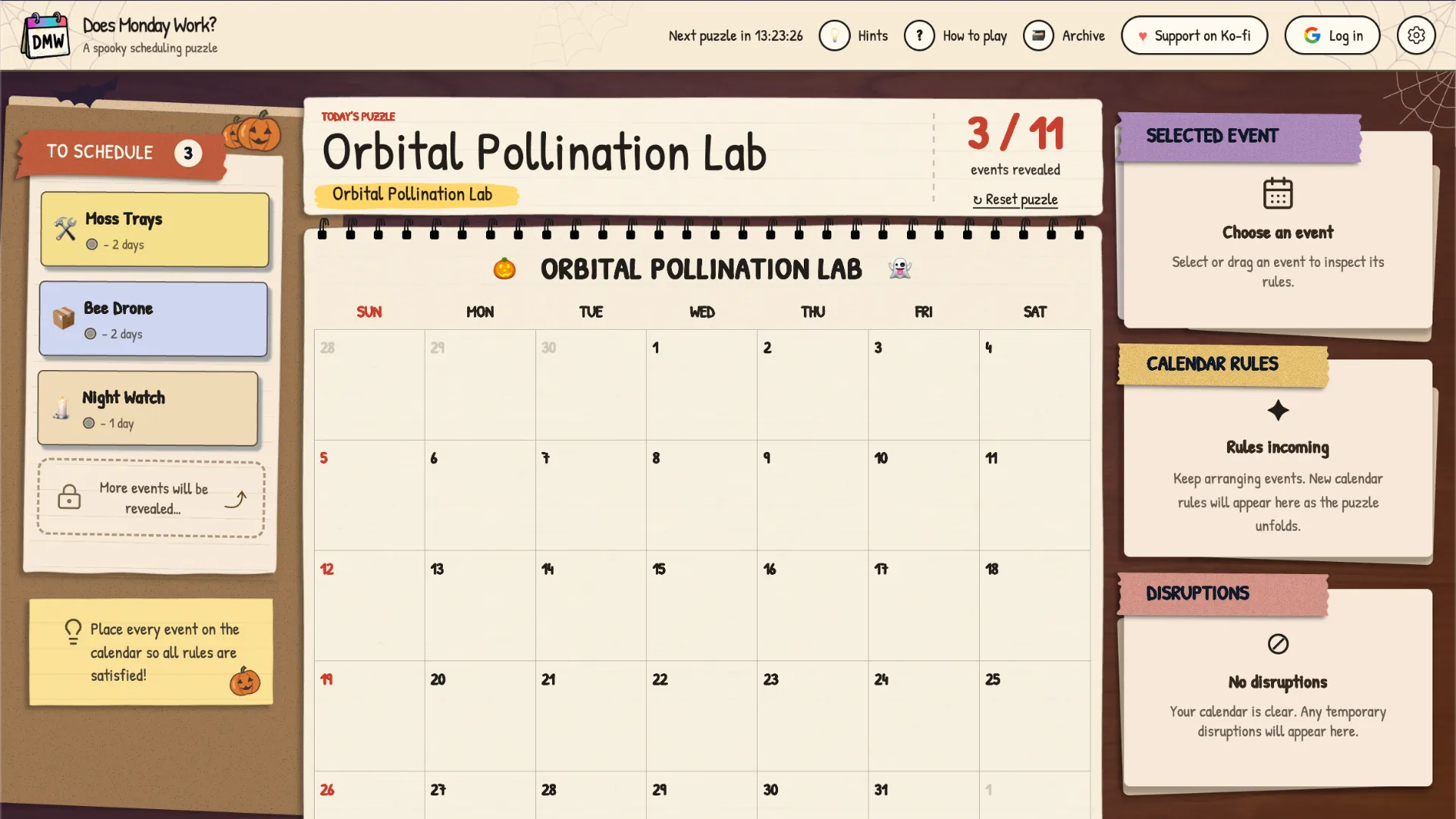
Does Monday Work? is a free daily browser-based logic puzzle that turns the familiar frustration of organizing a calendar into an entertaining deduction game. Your objective is to place a collection of events onto a monthly calendar while satisfying every scheduling restriction.
The challenge sounds simple until the rules begin to accumulate. One event might need to happen on a particular weekday, another must occur after a different appointment, and certain dates may need to remain completely empty.
The game's defining twist is that you do not receive every event and rule at the beginning. As you successfully arrange events, additional appointments and constraints appear. A schedule that initially seemed perfect may need to be completely reorganized to accommodate new requirements.
Each daily puzzle features a themed fictional scheduling scenario. Themes can involve mysteries, unusual historical settings, fictional emergencies, or other situations that make arranging a calendar more entertaining than ordinary appointment planning.
The game was created by independent developer Raymart Pamplona, also known online as pikamart. It launched in August 2026 and was inspired by the appeal of short daily puzzles such as those offered by NYT Games.
Unlike Sudoku or Wordle, Does Monday Work? does not require you to guess numbers or words. Instead, it challenges you to solve a constraint-satisfaction problem using a familiar calendar interface.
Does Monday Work? Rules and Core Mechanics
The objective is to place every required event on the monthly calendar while obeying all event-specific and calendar-wide rules.
Events Have Their Own Scheduling Restrictions
Each event comes with conditions that determine where it can be placed. These may include:
- Specific weekdays: An event may need to happen on a Monday, Friday, or another particular day of the week.
- Date restrictions: An appointment may need to fall within a certain part of the month or after a specified date.
- Event dependencies: One event may need to occur before or after another event.
- Spacing requirements: Two events may need a minimum number of days between them.
- Free-day requirements: A particular day or the day following an event may need to remain empty.
- Event duration: Some events occupy more than one calendar day.
You must consider these requirements together. A date can satisfy one event's conditions while creating a conflict with another.
Calendar-Wide Rules Apply to Multiple Events
In addition to the rules attached to individual events, the puzzle can introduce restrictions affecting the whole calendar.
For example, a calendar rule might limit the number of events that can occur during one week or require particular dates to remain free.
These conditions can eliminate seemingly reasonable arrangements and force you to distribute events across the month more carefully.
New Rules Appear as You Progress
Does Monday Work? does not reveal the complete puzzle immediately.
You begin with a smaller group of events in a To Schedule area. As events are placed correctly, the game unlocks additional events and reveals new restrictions.
This creates a changing puzzle in which early decisions may need to be revisited.
For example, you might place two appointments on consecutive days because their initial rules allow it. Later, a newly revealed condition may require one of those dates to remain free.
The challenge is to adjust the earlier schedule without violating the other rules.
Every Event Must Fit
The puzzle is complete when all required events have been placed and every revealed condition is satisfied.
There can be more than one valid arrangement for a puzzle. The important objective is satisfying the constraints rather than reproducing one predetermined sequence of dates.
The game has featured puzzles with approximately 11 events, although the precise number and combination of rules can vary.
How to Play Does Monday Work?
The game runs directly in a browser using a calendar and drag-and-drop controls.
- Open today's puzzle. Visit Does Monday Work? and start the current daily challenge. You will see a themed monthly calendar and a collection of events waiting to be scheduled.
- Read the event rules. Select an event from the To Schedule list to inspect its duration and restrictions. Identify any required weekdays, date ranges, spacing rules, or relationships with other events.
- Drag events onto the calendar. Place each event on a date that satisfies its current conditions. Start with appointments that have the fewest possible dates, then use the remaining space for more flexible events.
- Respond to newly revealed constraints. As you progress, additional events, calendar rules, or disruptions may appear. Check whether your existing arrangements still work, and move previously scheduled events when necessary. Use a hint if you become stuck on today's challenge.
- Complete the entire schedule. Continue until every event is on the calendar and all restrictions are satisfied. Review your completion result, including the number of moves, and share it with friends if you wish.
The game also provides a How to Play guide and an option to reset the puzzle if you want to reconsider your approach.
Example: Solving a Scheduling Puzzle
Imagine a simplified fictional puzzle with four events:
| Event | Scheduling Rule |
|---|---|
| Team Briefing | Must happen on a Monday |
| Project Review | Must occur at least two days after the Team Briefing |
| Workshop | Must happen on a Friday |
| Equipment Delivery | Must occur before the Workshop |
Suppose another calendar-wide rule states that no more than two events can occur in the same week.
A possible solution could be:
| Date | Scheduled Event |
|---|---|
| Monday, May 3 | Team Briefing |
| Wednesday, May 5 | Project Review |
| Thursday, May 13 | Equipment Delivery |
| Friday, May 14 | Workshop |
This arrangement satisfies the conditions because the briefing occurs on Monday, the review is two days later, the delivery precedes the Friday workshop, and neither week contains more than two events.
Now imagine the game reveals an additional rule: the day immediately before the Workshop must remain empty.
Your existing plan no longer works because Equipment Delivery occupies Thursday, May 13.
You would need to move the delivery to another date before the workshop, perhaps Tuesday, May 11, assuming that date satisfies all its other requirements.
This example is illustrative rather than an actual daily puzzle. It demonstrates the central gameplay loop: build a valid schedule, discover a new restriction, and revise the arrangement without breaking existing rules.
The Main Twist: The Calendar Keeps Changing
The gradual introduction of rules is what makes Does Monday Work? different from a conventional scheduling puzzle.
In many logic games, all the clues are visible from the beginning. Players can study the entire problem and systematically work toward a solution.
Does Monday Work? changes that structure by revealing new information during play.
An appointment you placed earlier might become inconvenient because a new event needs a particular weekday. A previously available date might become blocked, or a fresh rule might prevent two appointments from sharing the same week.
This means the puzzle rewards two complementary skills:
- Deduction: Understanding which dates satisfy the currently visible conditions.
- Adaptability: Revising earlier decisions when new information changes the available options.
Rather than finding one correct placement at a time, you are maintaining a schedule that must remain flexible enough to handle additional requirements.
That changing structure gives the game a distinctive sense of progression. The calendar becomes more crowded, the constraints become more interconnected, and the eventual solution feels like untangling a complicated series of appointments.
What Types of Rules Appear?
Does Monday Work? includes several kinds of scheduling constraints that players should recognize.
Day-of-Week Rules
These restrict events to particular weekdays.
For example, an event might need to occur on Tuesday. If the calendar contains four Tuesdays, you initially have four possible starting dates.
Other conditions can narrow the choice further.
Before-and-After Rules
Some events depend on the timing of other events.
For example, a rehearsal might need to occur before a performance. You cannot finalize the performance date without considering the rehearsal's available dates.
Minimum Spacing Rules
These conditions require a gap between events.
For example, if one appointment must happen at least three days after another, placing the events on consecutive days would be invalid.
Pay attention to whether a rule means exactly a certain number of days or at least that many days.
Restricted or Empty Dates
Some rules require particular dates to remain unused.
A condition might require the day after an event to remain free. This effectively makes the event occupy additional scheduling space even though the appointment itself lasts only one day.
Weekly Event Limits
Calendar-wide restrictions can limit how many events may occur during a week.
A schedule might satisfy every individual event condition but still fail because too many appointments are concentrated in one week.
Newly Revealed Disruptions
Additional restrictions may appear after earlier events have been scheduled.
These can force you to move existing appointments to different dates or rethink how several related events fit together.
The exact combination of rules changes between daily puzzles.
Does Monday Work? Strategy Tips
1. Schedule the Most Restricted Events First
Begin with appointments that have very few valid dates.
An event restricted to a specific weekday and date range may have only one or two possibilities. A flexible event that can occur almost anywhere is easier to place later.
This approach reduces the risk of using a critical date for an event that could have been scheduled elsewhere.
2. Read Every Rule Before Dragging
Avoid treating the game as a simple calendar-filling exercise.
A condition that appears minor can have a major effect on the entire arrangement. For example, requiring the following day to remain empty can effectively block two dates instead of one.
Read the selected event's rules and consider how they interact with the visible calendar restrictions.
3. Work Backward From Dependent Events
When one event must occur before another, it can help to consider the later event first.
If a final performance must happen on a particular Friday, identify which earlier dates could accommodate its preparation or rehearsal.
Working backward is especially useful when several events form a chain of dependencies.
4. Reserve Space for Future Events
Because additional appointments appear as the puzzle progresses, avoid filling every convenient date immediately.
Try to preserve flexible gaps in the calendar so that newly revealed events have somewhere to fit.
A schedule with some breathing room is easier to revise than one where every open date is already occupied.
5. Track Weekly Limits
If a rule limits the number of events in a week, count scheduled appointments before adding another.
This is particularly important for multi-day events and calendar-wide restrictions that affect several appointments simultaneously.
6. Treat Empty Dates as Constraints
An unused day is not always available for another event.
Some dates must remain blank because of another appointment's rules. When planning, distinguish genuinely available days from days that are intentionally reserved or restricted.
7. Reevaluate Earlier Moves After New Rules Appear
The game expects you to revise your schedule.
If a newly unlocked event seems impossible to place, the issue may not be that event itself. One of your earlier appointments may be occupying a critical date.
Look for a flexible event that can be moved without breaking its conditions.
8. Use Hints When You're Stuck
The developer introduced hints to make difficult daily puzzles more approachable.
The hint system can narrow the possible dates for an event before revealing an exact placement. This allows you to receive some guidance while preserving part of the deduction challenge.
Hints are intended for the current daily puzzle and are not available in the archive.
9. Minimize Unnecessary Rearrangements
Completed results can report the number of moves used to solve the puzzle.
Before moving an event, consider whether the change actually improves the schedule. Repeatedly shifting appointments without understanding their dependencies can make the puzzle harder to follow.
A more systematic approach may help you finish with fewer moves.
10. Use the Archive to Practice
If you enjoy the daily game, previous puzzles offer opportunities to encounter different combinations of constraints.
Practicing older challenges can help you recognize recurring scheduling patterns and become more comfortable with unexpected rule changes.
Does Monday Work? Hints Explained
Does Monday Work? includes an optional hint system for players who become stuck while arranging events.
The developer introduced hints in late August 2026 and subsequently improved them based on player feedback.
Rather than always revealing an exact answer immediately, hints can first provide a narrower selection of possible dates. Further assistance can reveal a specific valid placement.
This progressive approach is useful because players may need only a small clue to resolve a complicated chain of scheduling dependencies.
Importantly, the developer has explained that individual puzzles can have multiple valid solutions. A revealed placement represents one valid solution path rather than necessarily being the only possible date for that event.
Hint availability: The developer states that hints are available for the current daily puzzle but not for archived puzzles.
If you prefer solving without assistance, you can ignore hints and continue rearranging events independently.
Is Does Monday Work? a Daily Game?
Yes. Does Monday Work? publishes a new calendar puzzle every day.
Each edition presents a different themed scheduling scenario with its own combination of events and restrictions.
Puzzles are shared across players, making it possible to compare approaches and completed results with friends.
The game has featured creative themes involving fictional mysteries, emergencies, and unusual historical scenarios. These themes provide context for the events but do not change the central objective: arrange the entire month while satisfying the rules.
The game's daily reset is reported as midnight US Eastern time. A countdown on the website helps players see when the next puzzle becomes available.
Since Eastern Time observes daylight saving time, the corresponding reset time in UTC can change during the year.
Can You Play Previous Does Monday Work? Puzzles?
Yes. The game includes an archive of earlier daily puzzles.
The developer added the archive in August 2026, shortly after the game's initial launch.
The archive allows players to return to previous dates and attempt scheduling scenarios they may have missed.
A later update added indicators showing which archived puzzles had already been completed, making it easier to identify unfinished challenges.
The archive is particularly valuable because each daily puzzle can introduce different combinations of event restrictions, dependencies, and calendar-wide rules.
One limitation is that the current hint feature is not available inside archived puzzles, so previous challenges need to be completed through independent reasoning.
Is Does Monday Work? Free to Play?
Yes. Does Monday Work? is a free browser game available at doesmondaywork.com.
You can play the current daily puzzle without purchasing anything or installing a separate application.
The developer originally stored results in the player's browser and later introduced optional Google sign-in for account-based features.
Registration is not required to begin playing.
The game is designed as a single-player logic challenge, although players can share completed results and compare their solutions with friends.
Does Monday Work? Scoring and Results
Does Monday Work? tracks the number of moves used to complete a puzzle.
Players can share a text-based summary of their completed calendar, including the puzzle number, themed title, a representation of scheduled dates, and their move count.
The result may also include a playful completion title, such as Schedule Strategist.
For example, the game's community has shared results showing completed calendar grids alongside totals such as 20 or 23 moves.
These results allow friends to compare how efficiently they solved the same daily challenge.
Because puzzles can have multiple valid arrangements, two players may finish with different schedules while still satisfying every rule.
The most important objective remains successfully fitting every event onto the calendar. Move counts offer an additional challenge for players who enjoy finding more efficient solutions.
Does Monday Work? vs. Other Daily Logic Games
Does Monday Work? belongs to the daily logic puzzle category, but its evolving calendar constraints distinguish it from several familiar games.
| Game | Main Objective | Key Difference |
|---|---|---|
| Does Monday Work? | Schedule events while satisfying changing calendar rules | New events and restrictions appear during play |
| Sudoku | Fill a number grid while satisfying row, column, and box rules | All core constraints are known from the beginning |
| Queens | Place queens or crowns while following grid restrictions | Uses spatial placement rules rather than calendar dates |
| Murdle | Solve a mystery through logical deduction | Focuses on suspects, locations, and evidence |
| Calendar Puzzle | Arrange pieces on a calendar-shaped board | Primarily involves geometric placement rather than scheduling dependencies |
The main difference is that Does Monday Work? turns a familiar real-world task into a dynamic constraint puzzle.
Instead of filling predetermined spaces with numbers or symbols, you make decisions about dates, dependencies, and available scheduling capacity.
The gradual introduction of new information means the challenge is not only finding a valid arrangement but also adapting your plan as the puzzle develops.
Who Should Play Does Monday Work?
Does Monday Work? is especially suitable for players who enjoy structured reasoning and hands-on puzzle solving.
It is a good choice for:
- Logic puzzle enthusiasts who enjoy deduction, constraints, and planning several moves ahead.
- Daily puzzle fans looking for a fresh alternative to Wordle, Connections, or Sudoku.
- Calendar and scheduling enthusiasts who enjoy organizing information into an efficient arrangement.
- Strategy players who like adjusting plans when new rules appear.
- Casual players seeking a free browser game with familiar controls and a clear objective.
- Completion-focused players who enjoy solving archived puzzles and improving their move counts.
No advanced mathematical knowledge is required. The challenge comes from reading rules carefully, comparing possible dates, and understanding how individual decisions affect the complete calendar.
Who Created Does Monday Work?
Does Monday Work? was created by independent web developer Raymart Pamplona, known online as pikamart.
The game was publicly introduced in August 2026. According to the developer, the idea came from thinking about everyday activities that could become entertaining puzzles, particularly the familiar difficulty of organizing a schedule.
The project was inspired by daily browser games, especially the short, repeatable puzzle format associated with NYT Games.
The developer created the puzzle mechanics, interface, and web implementation independently and has continued adding features based on community suggestions.
Updates following the initial release included additional events, an archive, hints, progressive hint improvements, and optional account login.
The developer has also invited players to suggest new types of calendar rules and restrictions for future puzzles.
For more information about the game's origins, see the developer's original announcement and the hint update discussion.
Frequently Asked Questions
What is the goal of Does Monday Work?
Place every event on a monthly calendar while satisfying all event-specific and calendar-wide scheduling rules.
Is Does Monday Work? a guessing game?
No. It is a logic and deduction puzzle about finding a valid schedule, rather than guessing a hidden word, number, or answer.
Does the game reveal all the rules immediately?
No. New events, restrictions, and disruptions appear as you progress, sometimes requiring you to rearrange previously scheduled appointments.
How many events are in each puzzle?
The game has featured puzzles with around 11 events. The exact number can vary with the daily scenario and future updates.
Can an event last more than one day?
Yes. Events can have different durations and must be placed in accordance with their scheduling rules.
Can there be more than one correct solution?
Yes. The developer has confirmed that some puzzles have multiple valid schedules. Any arrangement satisfying all required constraints can solve the puzzle.
Does Monday Work? have hints?
Yes. Hints can narrow the possible dates for an event and provide more specific placement assistance. They are available in the current daily puzzle rather than the archive.
Can I restart a puzzle?
Yes. The game includes a reset option that allows you to begin arranging the events again.
Can I play older puzzles?
Yes. An archive provides access to previously released daily challenges.
When does a new puzzle appear?
A new puzzle is released daily, with the reset reported as midnight US Eastern time. The website provides a countdown to the next challenge.
Is the same puzzle available to everyone?
Yes. Players receive the daily scheduling challenge assigned to the same date, enabling comparisons of completed results.
Do I need to create an account?
No. You can play without registering. Optional Google sign-in is available for account-related features.
Is Does Monday Work? free?
Yes. The browser version is free to play without a required purchase.
Who developed Does Monday Work?
The game was created by independent developer Raymart Pamplona, also known as pikamart, and publicly launched in August 2026.
Conclusion
Does Monday Work? transforms ordinary calendar planning into a surprisingly engaging daily logic puzzle. Its challenge comes from balancing individual appointment restrictions, calendar-wide conditions, and newly revealed rules that can disrupt an otherwise valid schedule.
The gradual introduction of information makes the game distinctive. Rather than solving a static board, you continually adapt your plan as the calendar becomes more complicated.
With themed daily puzzles, drag-and-drop controls, optional hints, an archive of previous challenges, and shareable results, Does Monday Work? offers plenty of reasons to return.
It is particularly appealing to players who enjoy deduction and constraint-based puzzles but want something different from traditional number grids or word guessing.
Think you can make the whole month work? Visit Does Monday Work?, start today's calendar, and see whether you can schedule every event without breaking a single rule.