What Is Electle?
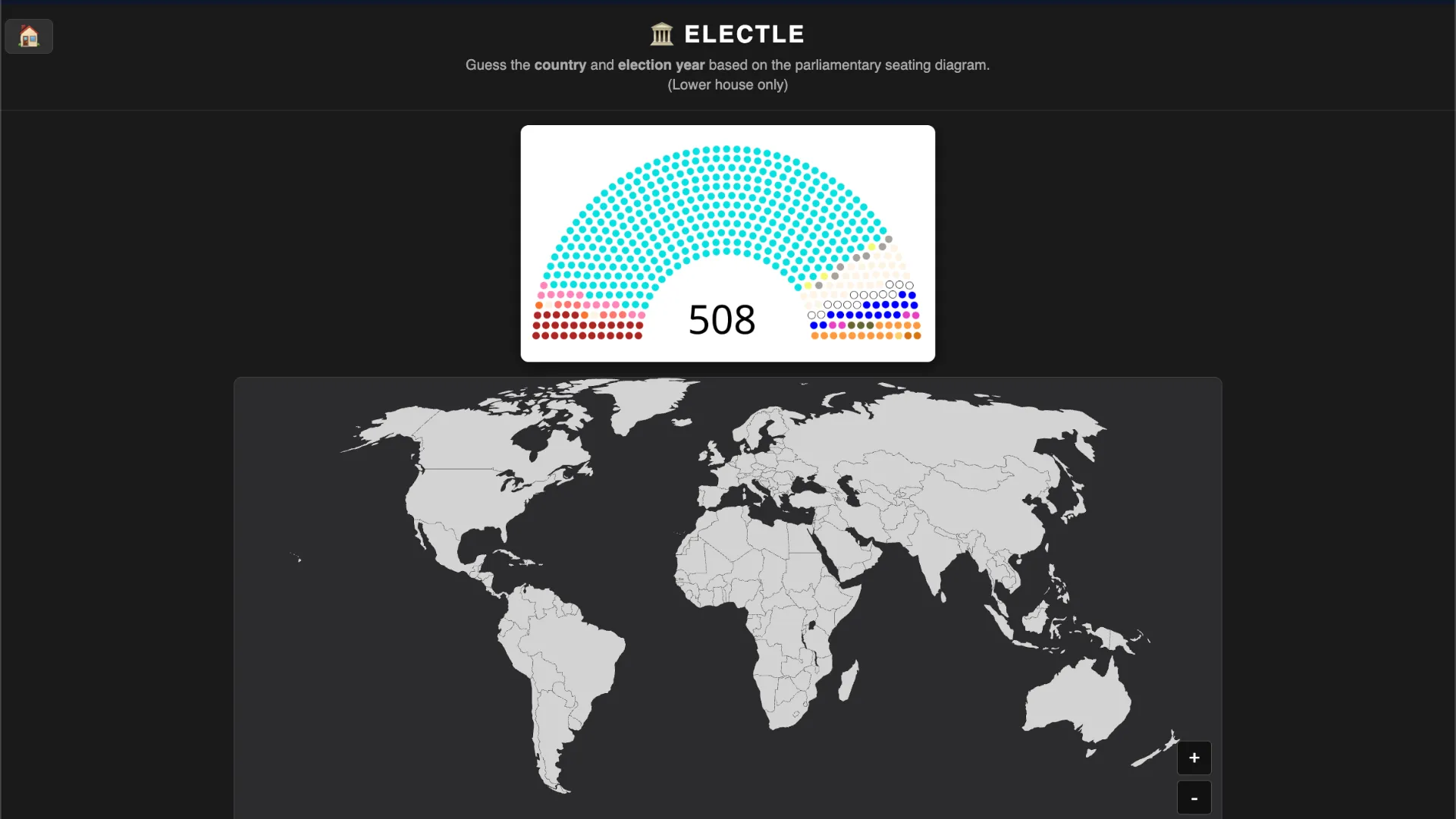
Electle is a browser-based geography and political trivia game where you identify a country and election year from a parliamentary seating diagram.
Instead of showing a flag, map outline, or capital city, Electle gives you the composition of a country's lower house of parliament. The colored groups of seats represent the chamber produced by a particular election, and your job is to work out both where it is and when that election happened.
The game includes Daily, Endless, and Easy modes, so you can solve one shared daily parliament or continue playing additional rounds.
The Core Electle Rules
Each puzzle displays a parliamentary seating diagram without immediately telling you the country or election year.
To submit an answer, you need to provide two pieces of information:
- Country: select it directly from the interactive world map.
- Election year: enter the year that produced the displayed parliament.
Both parts must be correct to complete the puzzle.
Your attempts are counted as you play. Unlike a game that gives you a fixed six-guess limit, Electle is primarily about identifying the parliament efficiently and seeing how many attempts it takes.
How to Play Electle
- Study the seating diagram. Look at the chamber's size, the number of party groups, the relative size of each bloc, and whether one group dominates or several groups are closely balanced.
- Choose a country. Use the zoomable world map to select the country you think matches the parliament.
- Enter an election year. Type the year of the election that you think produced the displayed lower house.
- Submit your guess. If the country-year combination is incorrect, reconsider the chamber pattern and try another combination.
- Solve both parts. The round ends when you correctly identify the country and the election year.
Example of the Electle Mechanic
Imagine the diagram shows one very large party bloc, a medium-sized opposition group, and several much smaller parties.
A useful thought process might be:
Chamber size -> Party fragmentation -> Largest bloc -> Likely country -> Possible election period
You might recognize that the number of seats and the overall structure resemble a particular country's lower house. You can then test an election year from a period when that country's party balance looked similar.
If that combination is wrong, your next guess should come from comparing the diagram with another plausible election rather than choosing a completely random country.
Reading the Seating Diagram
The seating chart is essentially the entire puzzle, so learning how to read it makes Electle much easier.
Chamber Size
The total number of visible seats can be a useful clue. National legislatures vary greatly in size, so an unusually small or large chamber can eliminate many possibilities.
Number of Political Groups
Some parliaments are dominated by a few large parties, while others contain many smaller parties. The amount of fragmentation can point you toward particular electoral systems and countries.
Relative Seat Shares
Look at how much of the chamber each colored bloc occupies. A single overwhelming majority creates a very different pattern from a chamber where several parties hold similar numbers of seats.
Coalition-Like Patterns
Several medium-sized groups may suggest a more fragmented parliament, while one or two dominant blocks may indicate a different political structure. You do not necessarily need to know every party by name; the overall arithmetic can still be useful.
Daily, Endless, and Easy Modes
Electle provides three main ways to play.
- Daily Mode: solve the shared parliament of the day and wait for the next daily puzzle.
- Endless Mode: continue through additional parliament puzzles without waiting for the next day.
- Easy Mode: play a simplified version intended to provide a more approachable starting point.
Endless mode is especially useful if you want to learn recurring chamber shapes and become better at recognizing countries from their parliamentary structures.
Electle Strategy Tips
- Estimate the chamber size first. Even a rough seat count can eliminate countries with legislatures that are much larger or smaller.
- Count the major blocs. A parliament dominated by two groups should lead to different candidates than one containing many similarly sized parties.
- Separate country deduction from year deduction. First try to determine the likely country, then focus on which election produced that exact seat distribution.
- Look for unusual compositions. A landslide, fragmented election, or unusually strong third party can make a particular election easier to recognize.
- Use the map carefully. Make sure the country shown as selected is the one you intended before submitting the year.
- Practice in Endless mode. Seeing many parliament diagrams helps you build pattern recognition faster than playing only one puzzle per day.
- Do not rely only on current politics. The displayed chamber can come from an earlier election, so historical election knowledge can be just as useful as familiarity with recent results.
What Makes Electle Different?
Most country guessing games rely on visual geography: borders, flags, satellite images, landmarks, or distance clues. Electle approaches country identification through parliamentary structure instead.
You are effectively reading a data visualization and asking two questions at once: Which country produced this chamber, and which election created this exact distribution?
That makes Electle a more specialized challenge than a traditional geography game and gives players who follow international elections, political history, or parliamentary systems a very different kind of daily puzzle.
Who Should Play Electle?
Electle is best suited to players who enjoy geography, election history, political data, maps, and difficult deduction games. It can be challenging if you rarely follow international elections, but Endless and Easy modes provide ways to learn the patterns without being limited to one daily attempt.