
What is Factle?
What if knowing the answer wasn’t enough—you had to rank reality itself? Factle flips traditional trivia on its head by asking you not just what, but which comes first. Every puzzle is a battle of estimation, logic, and real-world awareness.
You’re given a list of familiar items—countries, movies, companies—and a hidden rule like population, revenue, or timeline. The twist? You must arrange them in the exact correct order. It feels easy… until you realize how tricky relative comparisons really are.
Factle Game Rules (The Catch / The Trap)
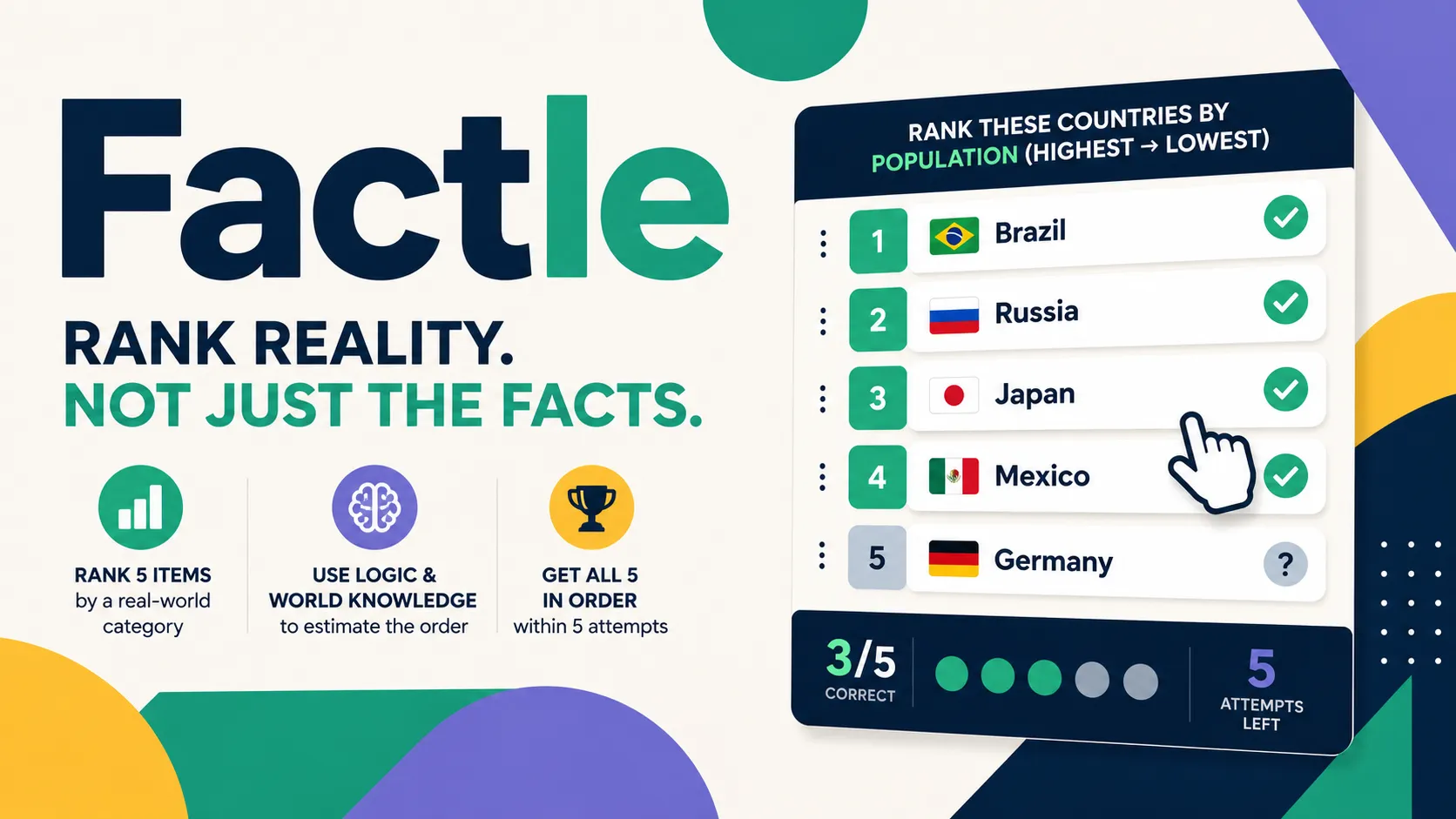
You are given 5 items and one factual ranking rule.
- 🎯 Objective: Arrange all items in the correct order (e.g., highest → lowest, earliest → latest)
- 🖱️ Drag & Drop: Reorder items freely before submitting
- 🔁 5 Attempts Total: You must solve it within 5 tries
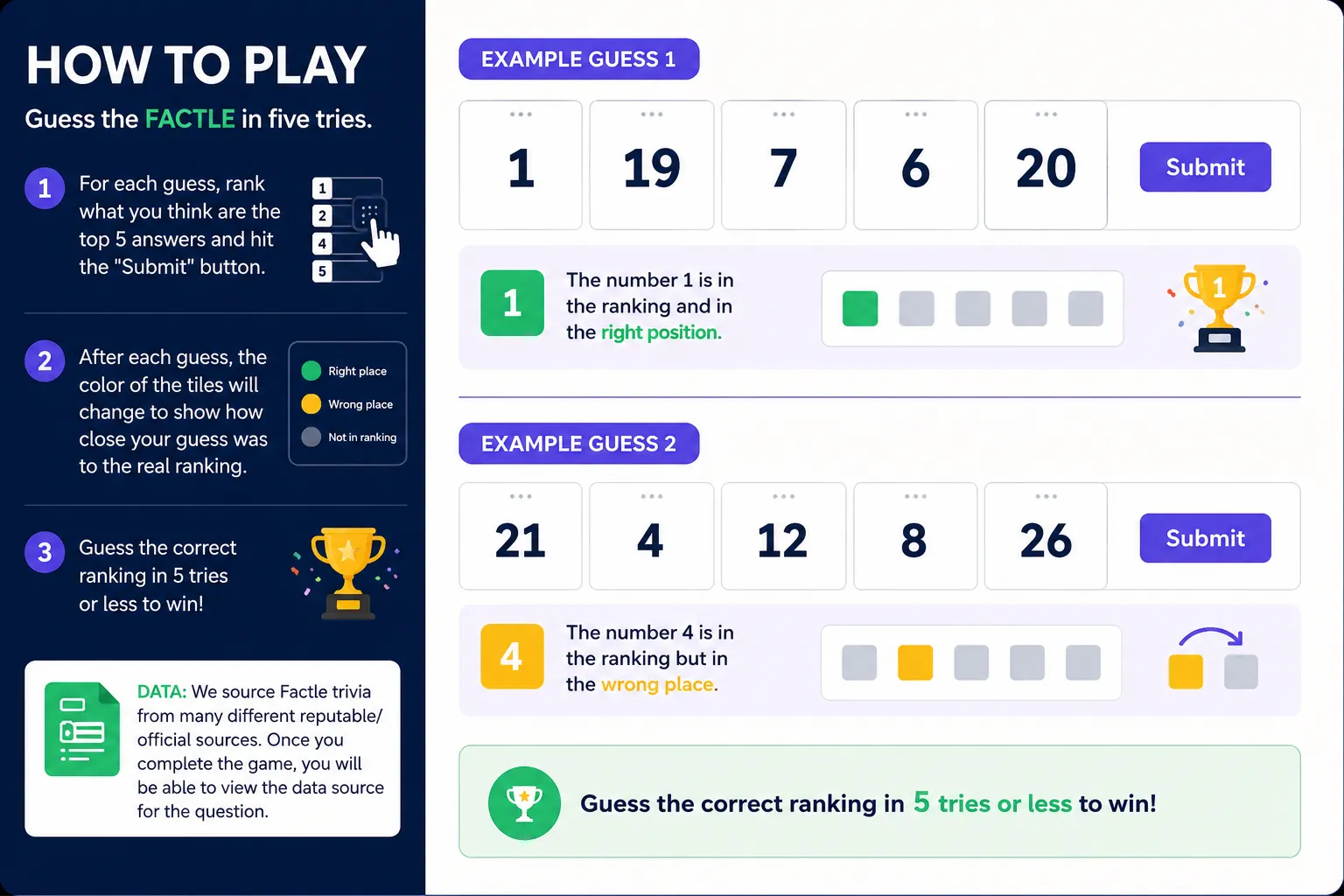
After each attempt, you receive precise feedback:
- ✅ Correct position → LOCKED IN mentally
- ❌ Wrong position → needs adjustment
- 📊 Score shows how many positions are correct (e.g., 3/5)
Key constraints:
- You MUST get the entire order correct to win
- Partial correctness helps—but can mislead if misinterpreted
- The same puzzle is shared globally each day
WIN CONDITION: Arrange all 5 items in the exact correct order within 5 attempts.
How To Play Factle?
Step 1: Read the Challenge
Prompt: Rank these countries by population (highest → lowest)
Items: Brazil, Russia, Japan, Mexico, Germany
What This Means: You need relative size knowledge—not exact numbers
Step 2: Make Your First Guess
Player Order: Russia → Brazil → Japan → Mexico → Germany
Result: 3/5 correct
What This Means: Some anchors are right, but top positions are off
Step 3: Adjust Based on Feedback
Player Order: Brazil → Russia → Japan → Mexico → Germany
Result: 🎉 5/5 correct
What This Means: You’ve perfectly ranked all items
Step 4: Learn the Truth
Correct Order:
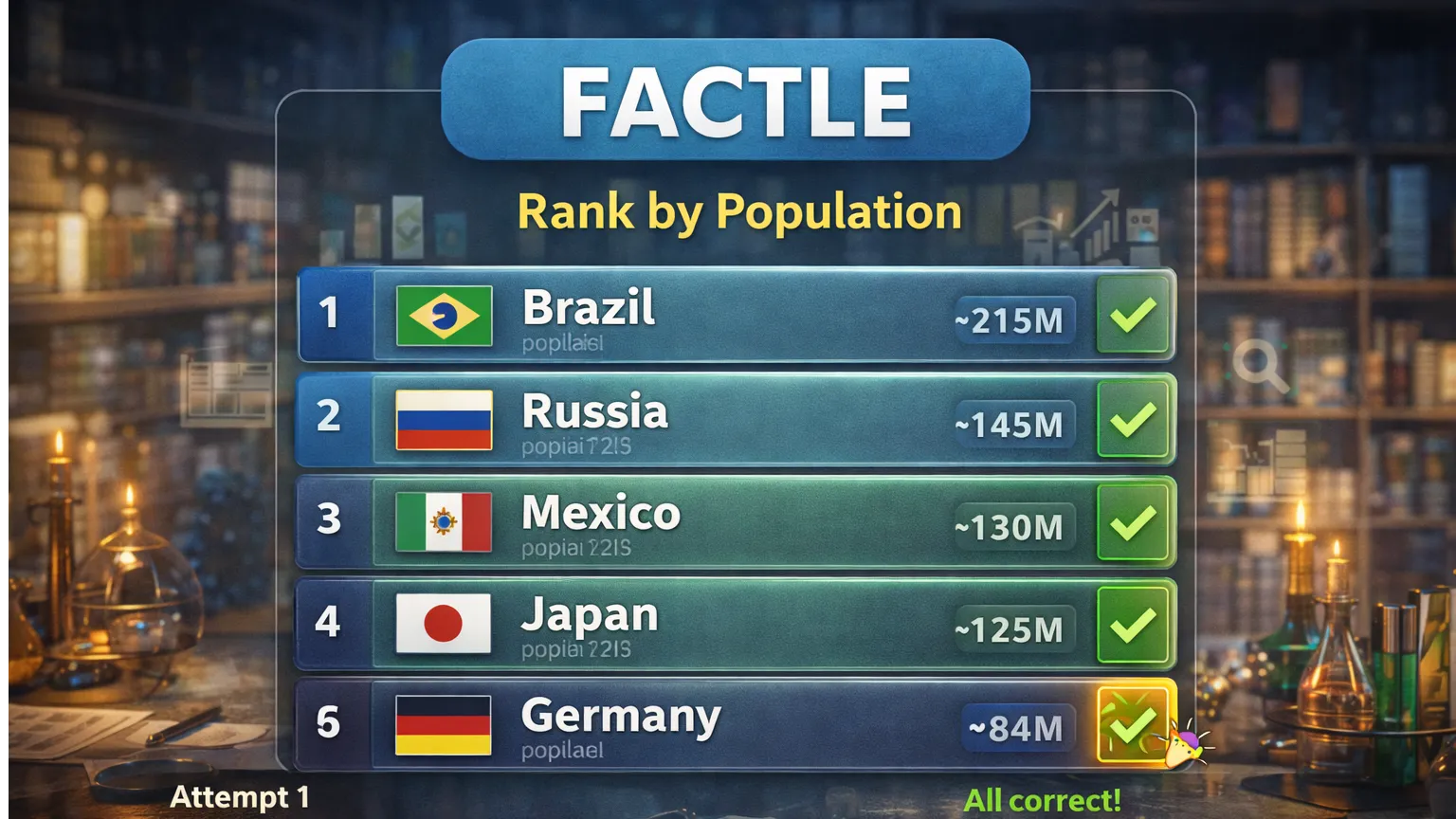
Brazil (~215M) → Russia (~145M) → Mexico (~130M) → Japan (~125M) → Germany (~84M)
Strategy & Tips
- Think in orders of magnitude, not exact numbers
- Lock in the extremes first (biggest / smallest)
- Use feedback to make small adjustments, not full reshuffles
- Watch for close values—these are the real traps
- Trust common knowledge, but verify with logic
Factle isn’t about memorizing facts—it’s about understanding how the world compares. And that’s where the real challenge begins.