
What Is Flagdle?
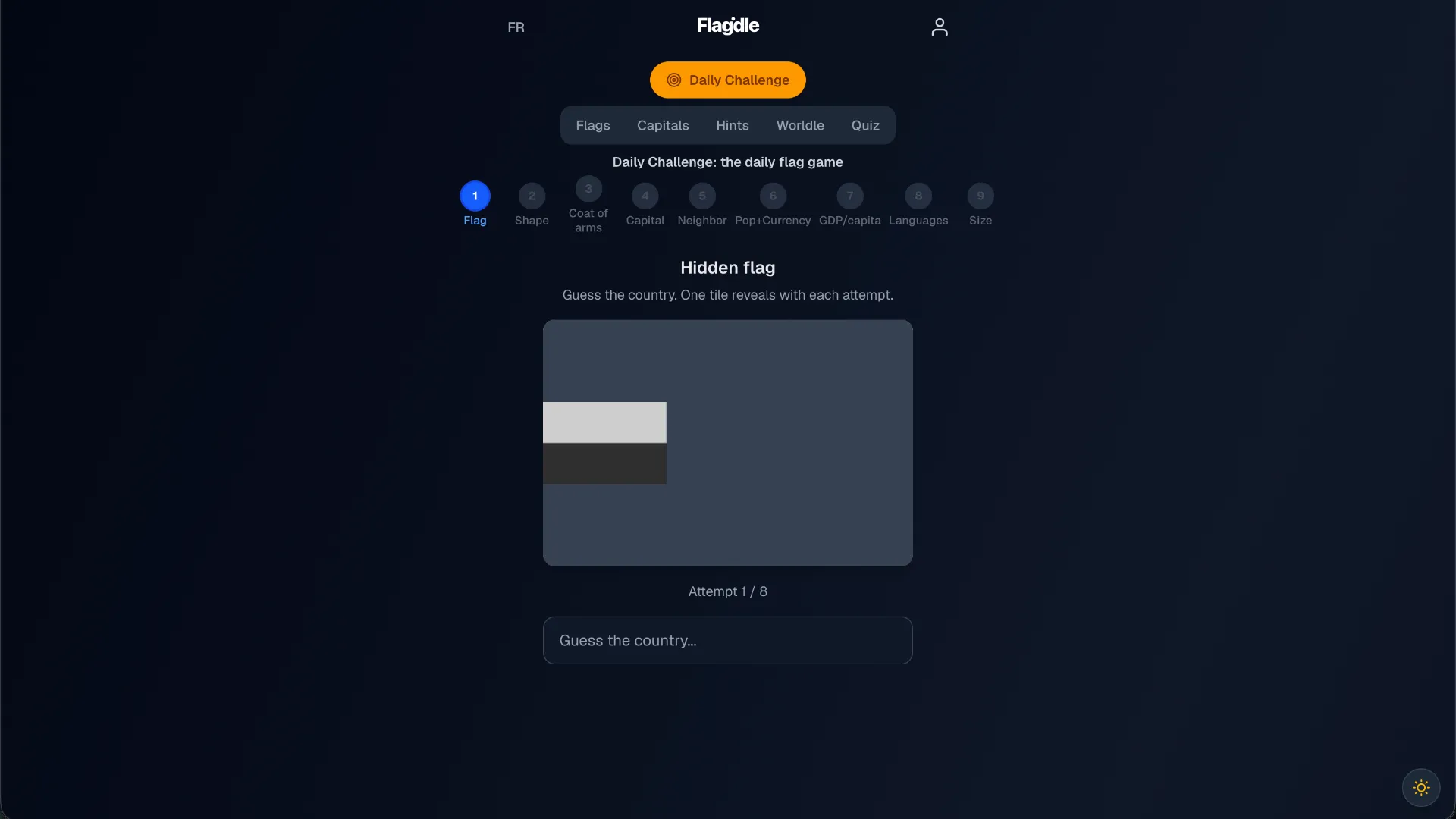
Flagdle is a daily geography guessing game built around national flags. Each puzzle gives every player the same mystery country, but instead of showing its entire flag immediately, the flag begins partially hidden behind a 3×3 grid of nine tiles.
Your goal is to identify the country in three guesses or fewer. A wrong answer does not give distance, direction, or Wordle-style letter feedback. Instead, three more sections of the flag are revealed, giving you a clearer view before your next attempt.
The Flags mode includes the 195 countries in Flagdle's country set, ranging from instantly recognizable flags to much harder designs. A new daily puzzle appears each day, and after completing it you can use replay mode to practice with additional random flags.
The Nine-Tile Reveal Mechanic
The defining feature of Flagdle is its progressive reveal system.
The mystery flag is divided into nine rectangular sections arranged in a 3×3 grid. At the beginning of a round, only part of the flag is visible. Every incorrect guess uncovers more tiles, so later attempts contain significantly more visual information than the first.
This creates a simple risk-versus-information decision. Recognizing a distinctive color combination or symbol from the first visible pieces can produce a one-guess win. If the opening view is ambiguous, you can make an educated guess and use the additional revealed sections to narrow the possibilities.
Unlike games based on geographic proximity, the clue is entirely visual. You need to pay attention to colors, stripe direction, crosses, stars, crescents, coats of arms, triangles, and other flag elements.
How to Play Flagdle
- Study the visible parts of the flag. The mystery country's flag starts partially covered by nine tiles. Look closely at any exposed colors, shapes, borders, or symbols.
- Enter your first country guess. Type a country name into the search field and choose the matching suggestion.
- Use the newly revealed tiles. If the guess is incorrect, more of the flag becomes visible. Compare the new sections with your first impression and reconsider similar-looking flags.
- Identify the country within three attempts. You have a maximum of three guesses. Solve it as early as possible, then share your result or continue practicing in replay mode.
For example, suppose the first visible sections contain red and white but do not reveal enough of the layout to distinguish between several countries. After an incorrect first guess, another set of tiles may expose whether the design contains horizontal bands, a cross, a central emblem, or a differently colored section. That new visual information can dramatically narrow the answer before guess two.
Flagdle Rules
- The main Flags mode gives you three attempts to identify the country.
- The flag is divided into nine tiles and begins partially hidden.
- An incorrect guess causes additional tiles to be revealed.
- The daily flag is the same for players worldwide, making scores easy to compare.
- A new daily puzzle becomes available each day.
- Flagdle covers 195 countries in its flag rotation.
- After finishing the daily puzzle, you can use replay mode to practice with random flags.
- No account is required to play the standard browser game.
Flagdle also includes other geography modes, but the original Flags game is specifically about recognizing progressively revealed national flags.
Strategy Tips for Flagdle
Use the first visible pieces carefully. A one-guess solve often depends on recognizing an unusual color arrangement or distinctive symbol before most of the flag appears.
Identify the layout before the exact country. Ask whether the flag uses horizontal bands, vertical bands, a Nordic cross, a triangle at the hoist, a canton, a centered symbol, or another recognizable structure.
Watch for commonly confused flags. Several countries have extremely similar designs. Chad and Romania use almost identical blue-yellow-red vertical tricolors, while Monaco and Indonesia both use red over white. Ireland and Côte d'Ivoire use similar green, white, and orange vertical designs in opposite orders.
Use wrong guesses strategically. If several countries remain plausible, guessing one of them can be useful because an incorrect answer reveals more of the target flag. The additional visual information may make the next attempt much easier.
Pay attention to small symbols. A star, crescent, coat of arms, sun, cedar tree, or other emblem may only become visible after another section is uncovered, but it can immediately identify the country.
More Than a Single Daily Puzzle
Flagdle has expanded beyond its original flag game. The site also includes a Daily Challenge made up of several country-related mini-games, plus modes focused on capitals, progressive country hints, country silhouettes, and themed quizzes.
For players who specifically want a quick daily flag challenge, however, Flags remains the simplest place to start. Each round takes only a few minutes, while replay mode makes it possible to keep practicing after the daily answer is complete.
Who Should Try Flagdle?
Flagdle is a strong fit for players who enjoy geography, flags, visual recognition, and short daily guessing games. Experienced flag enthusiasts can chase first-guess solves, while beginners benefit from the progressive reveal mechanic because difficult flags gradually become easier instead of ending with a simple wrong answer.
It is particularly useful as a casual way to become familiar with national flags: repeated daily play naturally exposes you to designs, color patterns, and easily confused country pairs from around the world.