
What Is Flagdoku?
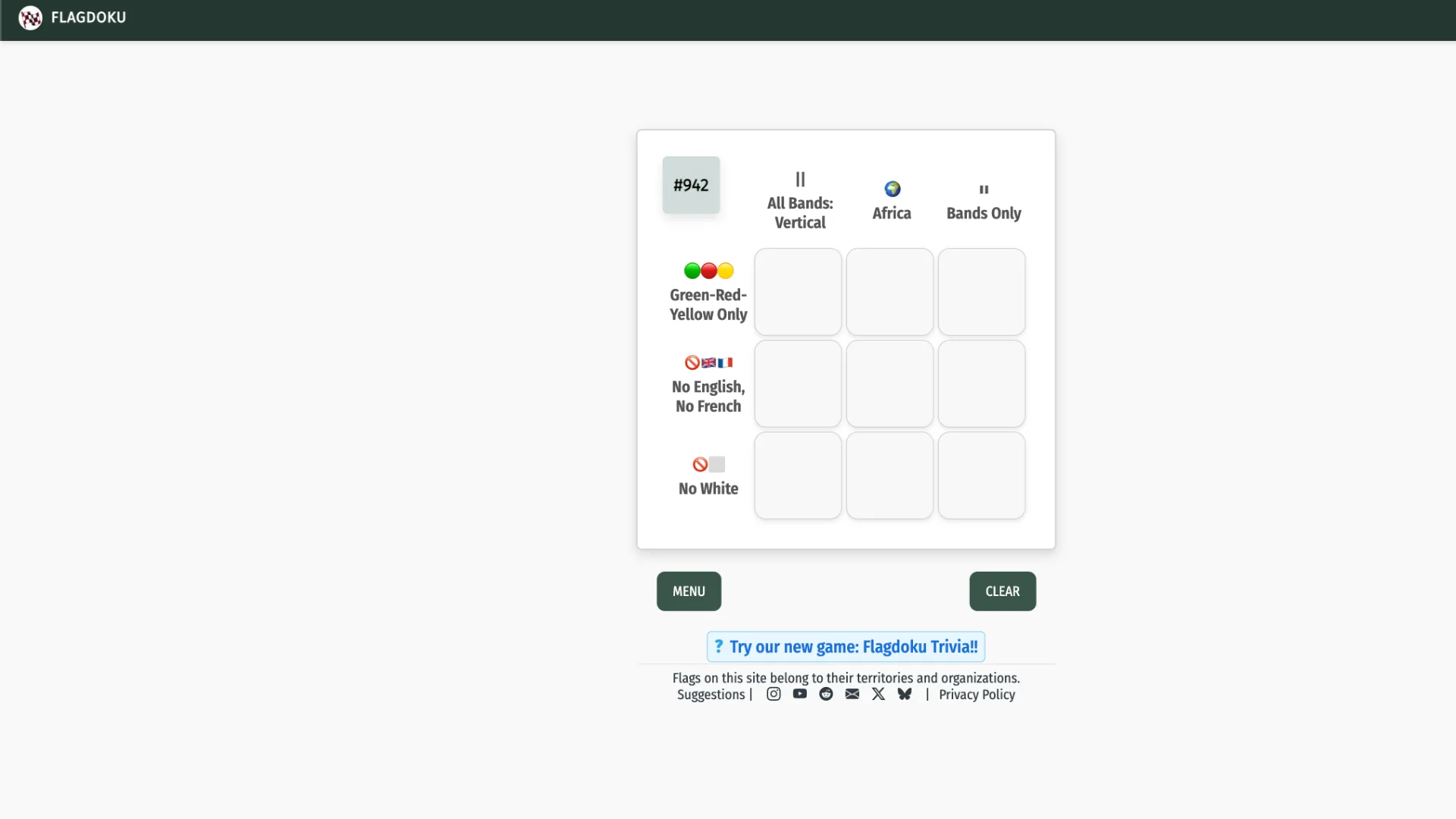
Flagdoku is a daily browser geography game built around a 3×3 grid of flag clues. Instead of identifying a country from a single flag, you must choose a flag that satisfies two conditions at the same time: the criterion for its row and the criterion for its column.
There are nine cells to solve in the main puzzle. Each correct guess earns one point, giving the daily grid a maximum score of 9 points. A new Flagdoku puzzle is released every day, and previous puzzles can also be revisited through the archive.
Despite the name, Flagdoku is closer to an Immaculate Grid-style deduction game than traditional Sudoku. The challenge comes from finding flags that belong at the intersection of two categories rather than arranging numbers without repetition.
How the Flagdoku Grid Works
Every cell sits at the intersection of a row clue and a column clue. The flag you choose must satisfy both criteria.
For example, imagine one row asks for flags from Africa and one column asks for flags containing green. The cell where those clues intersect needs a flag that meets both conditions: it must belong to an African location and contain green.
Other criteria can relate to characteristics such as geographic region, colors, flag design, shapes, symbols, or flag type. This makes visual flag knowledge especially useful because simply knowing country names is often not enough.
A wrong answer does not earn a point, while every successful guess adds one point toward the maximum score of nine.
How to Play Flagdoku
- Read all six grid criteria. Check the three row categories and three column categories before making your first guess. Looking at the whole board can reveal which intersections are likely to be easiest.
- Choose one cell and combine its clues. Think of flags that satisfy both the row condition and the column condition rather than treating either clue independently.
- Search for and select a matching flag. Submit the flag you believe belongs in that intersection. A correct guess earns one point.
- Work through the remaining eight cells. Use the categories you have already solved to help organize your thinking, especially when several flags could potentially fit a clue.
- Try to find the Flag of the Day. Flagdoku also includes a special challenge asking you to identify a flag that fits all of the day's categories.
Example Flagdoku Puzzle
Suppose part of a fictional grid looked like this:
| Contains Green | Has a Symbol | Three or More Colors | |
|---|---|---|---|
| Africa | ? | ? | ? |
| Asia | ? | ? | ? |
| Europe | ? | ? | ? |
For Africa + Contains Green, you would need an African flag featuring green. For Asia + Has a Symbol, you would need an Asian flag containing an emblem, star, sun, moon, or another qualifying design element.
The real daily categories vary, but the underlying idea stays the same: every answer must satisfy the two clues surrounding its cell.
Flagdoku Strategy Tips
- Start with obvious intersections. If one pair of clues immediately suggests several flags, solving that cell can help you build momentum.
- Think about flag features, not just countries. Colors, horizontal or vertical bands, stars, crosses, animals, text, emblems, and other design elements can all matter.
- Use elimination. When one category feels difficult, solve the surrounding cells first and return to it with a smaller set of possibilities in mind.
- Look beyond famous national flags. Flagdoku's broader flag database includes many regional and historical flags, so experienced players can benefit from knowing more than current sovereign-state flags.
- Check unusual combinations carefully. The hardest cells are often intersections where both criteria are broad individually but produce only a small number of convincing answers together.
- Do not rush speculative guesses. Wrong answers do not score, so it is better to think through whether a flag truly satisfies both criteria before submitting it.
The Flag of the Day
Alongside the nine-cell grid, Flagdoku includes an additional Flag of the Day challenge. The goal is to identify a flag that fits all of the categories appearing in that day's puzzle.
This is often more difficult than solving an individual grid cell because the answer must satisfy several properties simultaneously. Players who finish the main grid can use the categories and successful answers as clues while searching for the all-in-one flag.
Flag Search and Archive
Flagdoku also provides a substantial flag search tool that can be useful for exploring flags outside the daily puzzle. Flags can be filtered using properties such as colors, shape, region, words, and type, and the database contains national, regional, historical, city, state, naval, and other types of flags.
The archive lets players return to previous Flagdoku puzzles instead of being limited to the current day's challenge. This makes the site useful both as a daily game and as a larger flag-learning resource.
Who Will Enjoy Flagdoku?
Flagdoku is a good fit for players who enjoy flags, geography, GeoGuessr-style knowledge games, and grid-based trivia puzzles. It is particularly satisfying if you already recognize many national flags and want a game that tests deeper details such as colors, layouts, symbols, regions, and lesser-known flags.
The basic rules take only a few seconds to understand, but obscure category combinations and the Flag of the Day can make a perfect solve surprisingly difficult.