
What Is Flagpie?
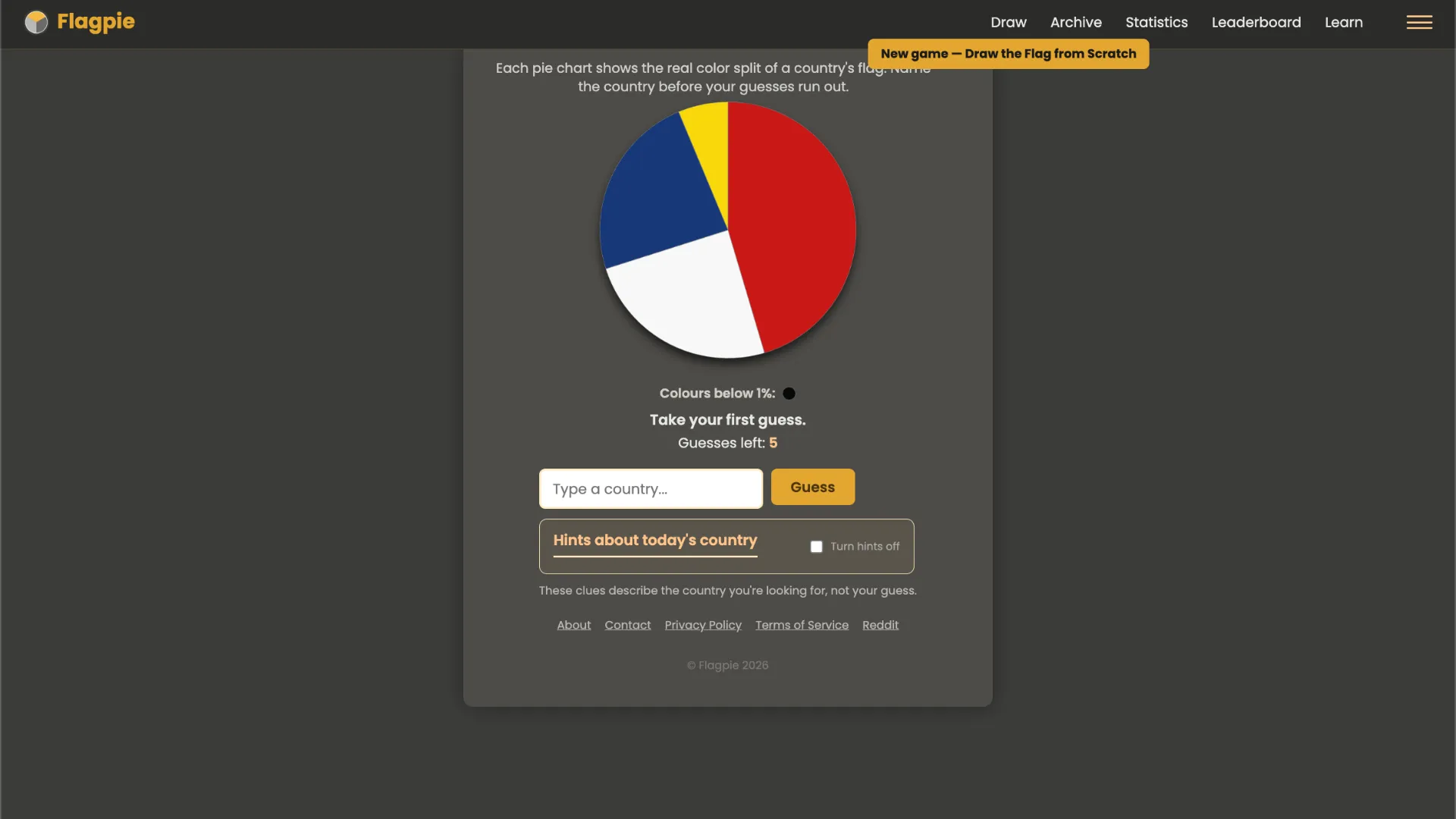
Flagpie is a daily flag-guessing game with an unusual twist: you never see the actual flag at the start. Instead, the game converts the mystery country's flag into a pie chart showing the exact proportion of each color used in its design. Your job is to work out which country the colors belong to.
The color breakdown is not an approximation. Flagpie measures the official flag design pixel by pixel, so the proportions shown in the chart reflect the real distribution of colors. Very small details representing less than 1% of the design can appear as separate color dots below the main chart.
You receive five guesses each day. Every incorrect answer unlocks another hint about the mystery country, making the puzzle gradually easier if the color chart alone is not enough.
How Flagpie Works
A new puzzle begins with a circular chart divided into colored slices. Each slice represents one color from the target country's flag, and its size indicates how much of the flag that color occupies.
For example, imagine the chart contains one very large white section and a much smaller red section. That immediately suggests flags dominated by white and red, but you still need to consider how those colors are distributed across real national flags. A three-way chart containing roughly similar red, white, and blue sections would create a completely different set of possibilities.
Unlike a normal flag quiz, you cannot rely on remembering stars, crosses, stripes, coats of arms, or other shapes. Flagpie removes those visual structures and leaves you with only color and proportion, turning flag recognition into a deduction puzzle rather than a straightforward memory test.
How to Play Flagpie
- Study the pie chart. Count how many major colors appear and compare the relative size of each slice. Also check for any tiny color dots shown below the chart.
- Think of flags with a similar color balance. A chart dominated by one color points toward a different group of countries than a flag divided almost evenly between three colors.
- Enter your first country guess. You have five attempts, so the first guess can be based primarily on your interpretation of the chart.
- Use the unlocked hints after a miss. Incorrect guesses progressively reveal neighbouring countries, population, size, and finally continent, in that order.
- Combine the chart with the hints. Narrow the remaining possibilities and identify the country before the fifth guess is used.
If you fail all five attempts, Flagpie reveals the answer and shows the actual flag. Guessing correctly on the first attempt is recorded as a hole-in-one.
Understanding the Color Pie Chart
Flagpie becomes much easier once you stop looking only at which colors appear and start thinking about how much space each color occupies.
Suppose two countries both use red, white, and blue. One might have the three colors distributed fairly evenly, while another could contain a huge white field with relatively small red and blue elements. The list of colors is identical, but their proportions provide very different clues.
Small colors can be particularly useful. Some flags contain a tiny emblem, outline, star, or decorative element that accounts for less than 1% of the design. Flagpie removes these tiny amounts from the main pie chart so the primary percentages remain readable, but displays up to five of those colors as small dots underneath.
Flagpie Strategy Tips
- Look for dominant colors first. If one slice occupies most of the pie, begin with countries whose flags are heavily dominated by that color.
- Compare proportions, not just palettes. Dozens of flags use red, white, and blue, but far fewer use those colors in approximately the proportions shown.
- Count the colors carefully. A tiny fourth or fifth color can separate otherwise similar candidates.
- Remember emblems and coats of arms. Even though you cannot see the design, unusual colors may reveal that the original flag contains a detailed crest or symbol.
- Use the first geographic hint aggressively. Neighbouring-country information can reduce a large group of similar flags to only a few realistic candidates.
- Combine population and size. Later hints can distinguish between neighboring countries whose flags contain similar colors.
- Do not ignore proportions after hints appear. Geographic clues help narrow the answer, but the original color distribution is usually the best way to choose between the remaining candidates.
What Hints Does Flagpie Give You?
Flagpie unlocks hints progressively after incorrect guesses rather than providing everything immediately. The order is:
- Neighbouring countries
- Population
- Country size
- Continent
Your fifth attempt is the final guess, so there is no additional hint afterward.
This structure means the game changes as a round progresses. The opening is primarily a flag-color puzzle, while later guesses become a combination of flag knowledge and conventional geography deduction.
Flagpie: Draw
Flagpie also includes a separate daily mode called Flagpie: Draw. Instead of identifying a country from color percentages, Draw asks you to recreate the day's flag from memory using a color wheel and drawing tools.
Your drawing receives a score out of 100 based on three components: Color Accuracy, Color Proportion, and Placement. These scores evaluate whether you selected the right shades, used approximately the correct amount of each color, and positioned them correctly.
Draw is free to play alongside the main daily Flagpie puzzle, giving flag enthusiasts a second challenge that tests a very different kind of memory.
Daily Puzzles, Streaks, and Archive
Flagpie provides one new mystery country per day. The standard daily puzzle, player statistics, result sharing, and public leaderboard are free and do not require an account. Guest statistics can be stored in the browser, while a free account allows progress and streaks to follow you across devices.
Past puzzles are available through the Archive, which is a Premium feature. Archive access covers previous puzzles for both the standard game and Flagpie: Draw.
Who Will Enjoy Flagpie?
Flagpie is particularly good for players who already enjoy flags, Worldle-style country games, geography trivia, and visual deduction puzzles. Knowing national flags helps, but the game tests them from a completely different angle because familiar patterns and symbols are deliberately hidden.
That makes Flagpie surprisingly challenging even for players who can normally recognize flags instantly. Instead of asking whether you remember what a flag looks like, it asks whether you understand its design well enough to recognize it from nothing more than its colors and proportions.