
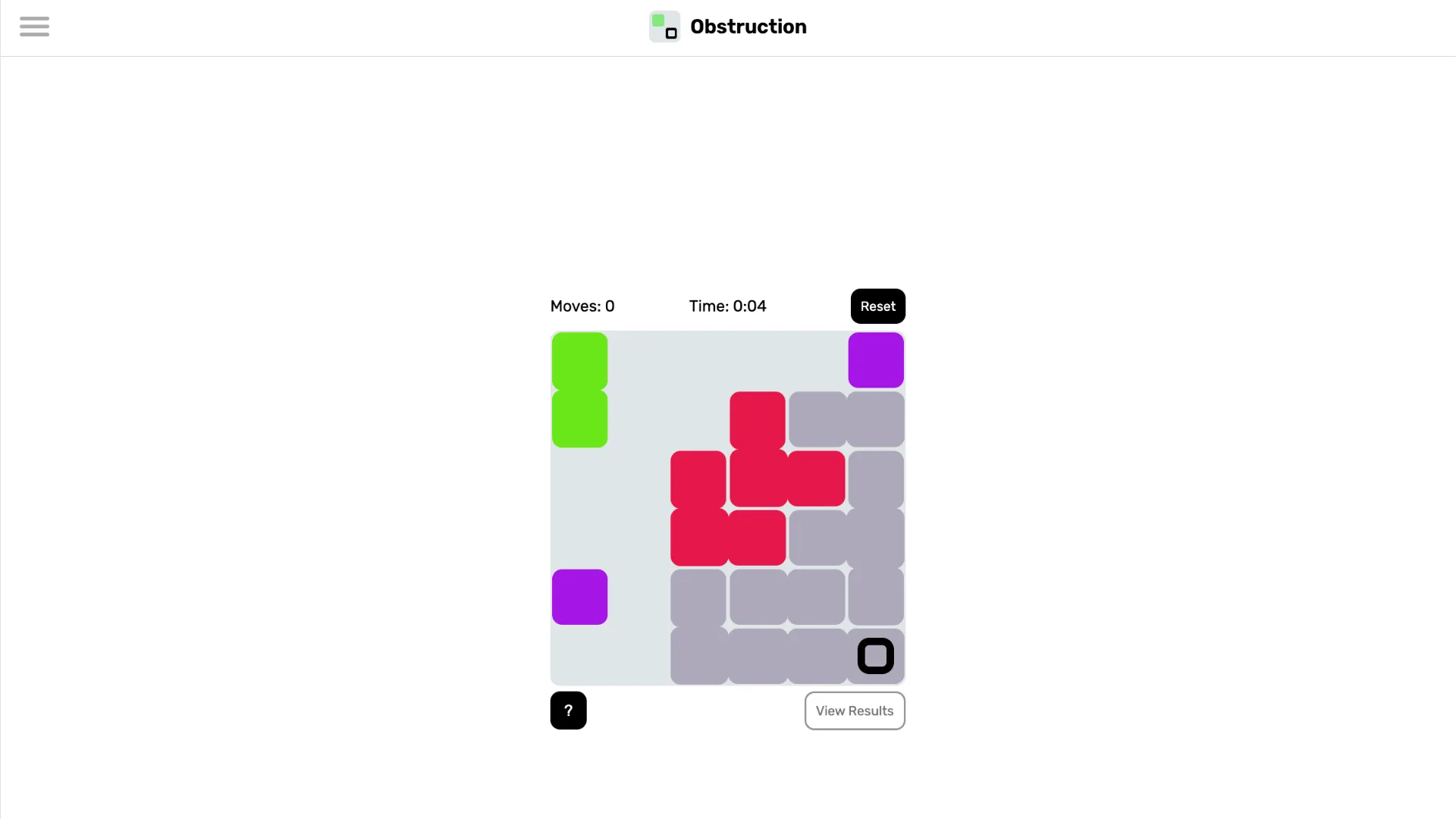
What Is Obstruction?
Obstruction is a free daily browser-based logic puzzle in which players slide colored blocks around a grid to help a green block reach its designated target square. The challenge comes from the different movement restrictions assigned to each color, turning an apparently simple sliding puzzle into a test of spatial reasoning and planning.
Unlike traditional sliding-block games where every piece follows similar rules, Obstruction introduces several types of obstacles. Some blocks can move freely, others are limited to horizontal or vertical movement, and certain blocks must move together or cannot move at all.
The objective is straightforward: clear a route and move the green block onto the target square. However, moving one obstruction can accidentally trap another, forcing you to reconsider your entire solution.
Obstruction uses a compact 6×6 grid and offers a fresh puzzle every day. Players can compete with friends to see who completes the same challenge in the shortest time or with the fewest moves.
The game is free to play directly in a desktop or mobile browser, without downloading an app or creating an account.
Obstruction Rules: What Do the Block Colors Mean?
Understanding the colored blocks is the key to solving Obstruction. Each color represents a different movement rule, and these restrictions determine which routes are possible.
| Block Color | Movement Rule |
|---|---|
| Green | The main block you must guide to the target square |
| Grey | Can move in any permitted direction around the grid |
| Dark Grey | Fixed obstacle that cannot be moved |
| Blue | Can slide only up and down |
| Yellow | Can slide only left and right |
| Purple | Purple blocks move together as a group |
| Red | Cannot come into contact with the green block |
Green Block: Your Main Objective
The green block is the piece you are trying to deliver to the target. Every other movable block is either an obstacle that needs repositioning or a piece whose movement creates an opportunity to advance the green block.
You do not need to remove all the other blocks from the board. Winning requires getting the green block onto the target square.
Grey Blocks: Flexible Obstacles
Ordinary grey blocks are relatively flexible because they can be repositioned in different directions.
They are useful when you need to temporarily create space. However, moving a grey block into the wrong location can still close an important route.
Dark Grey Blocks: Permanent Barriers
Dark grey blocks are stationary. They cannot be shifted to make room for another piece.
Treat them as permanent parts of the board's layout. When planning a solution, build your route around them rather than expecting to move them later.
Blue Blocks: Vertical Movement Only
Blue blocks can slide up and down but cannot move sideways.
For example, if a blue block occupies the square directly above a corridor you need to use, moving it vertically might clear the passage. However, if the required space is immediately to its left or right, you cannot simply drag it sideways.
Yellow Blocks: Horizontal Movement Only
Yellow blocks follow the opposite restriction: they move left and right but not vertically.
A yellow block may be easy to slide away when you have enough room along its row. If other pieces occupy the necessary squares, you might need to reposition those pieces first.
Purple Blocks: Linked Movement
Purple blocks introduce a more complicated interaction because they move together.
You need to think about how repositioning the purple group affects multiple areas of the board. A movement that opens one route can simultaneously obstruct another.
Red Blocks: Keep Away From Green
Red blocks have a special restriction: they cannot touch the green block.
This adds another consideration beyond ordinary collision avoidance. Even when there appears to be enough empty space to move a piece, the red-green contact restriction can make a proposed move invalid.
When planning a path for the green block, check whether nearby red blocks must be repositioned first.
How to Play Obstruction
Obstruction uses simple drag-and-slide controls, making it accessible even if you have never played a sliding-block puzzle before.
- Open the official game. Visit Obstruction in your browser and select Play. You can also open the Guide to familiarize yourself with the different block types before starting.
- Study the board. Find the green block and its target square. Examine the colored obstacles between them, paying particular attention to fixed dark grey blocks and pieces that can move in only one direction.
- Slide blocks to create space. Click and hold a movable block, then drag it using your mouse or finger. Follow the movement restrictions associated with its color. The goal is to reposition obstructions and open a usable route.
- Guide the green block toward the target. Once enough space is available, move the green block through the cleared passage. You may need to alternate between moving the green block and repositioning other pieces.
- Reach the target and compare your result. The puzzle ends when the green block reaches its destination. The victory screen displays your completion time and total number of moves, and you can share your result with friends.
If you become trapped or make an unhelpful sequence of moves, the game provides a reset option. However, restarting does not eliminate the time already spent, so planning before moving is valuable.
Example: Solving a Blocked Path
Consider a hypothetical Obstruction puzzle where the green block needs to move to a target on the opposite side of the board.
A yellow block occupies part of the required route, a blue block prevents the yellow block from sliding away, and a dark grey obstacle limits the available space.
Trying to move the yellow block vertically will not work because yellow blocks can move only left and right.
Instead, the solution might involve the following sequence:
- Move the blue block upward to free a square along the yellow block's row.
- Slide the yellow block horizontally into the newly available space.
- Reposition a grey block to open the remaining section of the corridor.
- Move the green block through the gap and onto its target square.
This is an illustrative example rather than a solution to a particular daily puzzle, but it demonstrates the central mechanic: the best first move is often not a move involving the green block.
Successful solutions depend on recognizing which obstacles prevent other obstacles from moving and clearing them in a useful order.
Obstruction Strategy Tips
1. Work Backward From the Target
Before moving anything, identify the square the green block must reach and examine the possible approaches.
Ask which obstacles prevent the green block from entering that area. Then determine which additional pieces must move to create enough space for those obstacles.
Working backward helps you avoid moving unrelated blocks that do not contribute to solving the puzzle.
2. Identify Fixed Obstacles First
Dark grey blocks cannot move, so their positions should guide your initial planning.
Look for narrow corridors and limited entrances created by these permanent barriers. If the green block must pass through a particular opening, focus on keeping that route accessible.
3. Respect Horizontal and Vertical Restrictions
One of the easiest mistakes is imagining a move that the selected block cannot actually make.
Remember:
- Blue blocks move vertically.
- Yellow blocks move horizontally.
- Ordinary grey blocks have more freedom.
- Dark grey blocks do not move.
If a required move seems impossible, consider which other piece could be repositioned to make a different route available.
4. Plan Purple Movements as a Group
Do not treat purple blocks as independent obstacles. Moving the purple group can affect more than one part of the board at the same time.
Before moving them, consider whether the resulting positions will block the green piece or interfere with another important move.
5. Keep Red Blocks Away From the Green Piece
The special restriction on red blocks can prevent moves that otherwise look possible.
As you plan the green block's route, identify where red blocks might create contact problems. Moving them earlier may be necessary to open a valid passage.
6. Create Temporary Storage Space
In many sliding puzzles, an obstacle does not need to move directly to its final position.
You may first move a flexible grey block into an unused area, reposition a more restricted block, and then move the grey block again.
Think of empty squares as temporary storage that allows pieces to pass one another.
7. Avoid Blocking Your Own Escape Route
A move can clear the immediate path while closing off an area you still need.
Before dragging a block, ask two questions: What space will this movement open, and what space will it occupy afterward?
This is especially important near fixed obstacles and along narrow corridors.
8. Optimize Moves After Learning the Solution
The game records both completion time and number of moves. These measurements create two different challenges.
A quick solution might involve several extra movements, while a move-efficient solution may take longer to plan.
When trying to improve your performance, look for unnecessary back-and-forth movement or opportunities to reposition a blocking piece more efficiently.
How Does Obstruction Scoring Work?
Obstruction measures your performance using two main statistics:
- Time: How long you take to complete the puzzle.
- Moves: How many block movements you make before the green block reaches its destination.
After completing the daily puzzle, a victory screen displays your results.
You can share those results with friends and challenge them to solve the same puzzle faster or with fewer moves.
These two measures reward slightly different approaches. Players focused on speed may react quickly and take a less direct route, while players focused on move efficiency may spend more time studying the board before taking action.
The reset feature is useful when you become trapped, but the game's timer continues to make time management relevant. Repeatedly restarting is therefore not an ideal strategy when trying to achieve a fast result.
Is Obstruction a Daily Puzzle Game?
Yes. Obstruction provides a new sliding-block challenge every day.
The daily format means players can return regularly to encounter a fresh arrangement of colored obstacles and a new route-planning problem.
The game is particularly suitable for short sessions because the objective is immediately understandable: clear the way and guide the green piece to its target.
Everyone playing the daily challenge receives the same puzzle, allowing players to compare their completion times and move counts.
The game's sharing feature makes it easy to turn a personal result into a friendly competition.
Is Obstruction Free to Play?
Yes. Obstruction is free to play through its official website at obstruction.co.uk.
The developer has confirmed that the game supports both desktop and mobile browsers and does not require registration.
Controls are based on clicking or touching a block, holding it, and sliding it to a valid position.
Because Obstruction runs directly in the browser, no separate application download is necessary.
On some devices, the website may request that you rotate your screen if the available display height is too small for the game interface. Switching to landscape orientation can help make the board easier to use.
Obstruction vs. Rush Hour and Other Sliding Puzzles
Obstruction belongs to the sliding-block puzzle family, but its color-coded movement rules distinguish it from more traditional examples.
| Game | Core Objective | Main Difference |
|---|---|---|
| Obstruction | Move a green block onto a target square | Different colored blocks follow different movement and interaction rules |
| Rush Hour | Move obstructing vehicles to free the target car | Vehicles typically move only along their fixed horizontal or vertical orientation |
| Unblock Me | Slide blocks to create an exit path for a designated piece | Primarily uses horizontal and vertical sliding restrictions |
| Klotski | Rearrange differently sized blocks to move a target piece to an exit | Focuses on spatial arrangement rather than color-specific movement rules |
The most important difference is that Obstruction combines several obstacle behaviors in the same puzzle.
A blue block and a yellow block may require completely different approaches, while linked purple blocks and restricted red blocks introduce additional constraints.
This turns the game into a more varied spatial reasoning challenge than simply shifting ordinary obstacles away from an exit.
Who Should Play Obstruction?
Obstruction is a good choice for players who enjoy visual puzzles, strategic planning, and solving problems with a small set of clear rules.
It is especially suitable for:
- Logic puzzle fans who enjoy thinking through several moves before acting.
- Sliding-block enthusiasts looking for an alternative to Rush Hour or Unblock Me.
- Daily puzzle players who want a fresh challenge that can fit into a short break.
- Spatial reasoning enthusiasts who enjoy understanding how objects can move through restricted spaces.
- Competitive friends who want to compare completion times and move counts.
- Casual players looking for an accessible browser game without registration or installation.
The color-coded movement system makes the rules easy to recognize visually, while the interactions between different blocks provide much of the challenge.
Who Created Obstruction?
Obstruction was created by an independent developer who introduced the game publicly in July 2026 through Reddit communities including r/playmygame, r/WebGames, and r/SideProject.
The developer described Obstruction as a solo project developed over several months while learning JavaScript, web development, and the process of releasing an independent game.
The original announcement emphasized short daily puzzles, unique movement restrictions for different colored blocks, and the ability to compare results with friends.
The developer also actively requested feedback on puzzle difficulty and the user interface during the game's early release period.
Frequently Asked Questions
What is the goal of Obstruction?
Move the green block across the grid and onto its target square by sliding other blocks out of the way.
What do the colors mean in Obstruction?
Each color indicates a movement rule. Grey blocks have flexible movement, dark grey blocks are fixed, blue blocks move vertically, yellow blocks move horizontally, purple blocks move together, and red blocks cannot touch the green block.
How do you move blocks?
Click or touch a movable block, hold it, and drag it in a direction permitted by its color.
Can every block move?
No. Dark grey blocks are stationary, while other colors may be restricted to specific directions or interactions.
Do you have to clear every block from the board?
No. The objective is to move the green block onto its target square, not remove all the obstacles.
What happens if you get stuck?
You can reset the puzzle and start again. However, the time spent attempting a solution still matters for your timed performance.
Is Obstruction a multiplayer game?
Obstruction is a single-player puzzle. Its sharing feature allows friends to compare their results on the same daily challenge.
Does Obstruction have a new puzzle every day?
Yes. The game releases a fresh sliding-block puzzle daily.
Is Obstruction free?
Yes. The developer offers Obstruction as a free browser game without required registration.
Can I play Obstruction on mobile?
Yes. The game supports mobile browsers and touchscreen dragging. You may need to rotate your device if the screen is too short to display the interface comfortably.
Final Thoughts
Obstruction takes a familiar sliding-block concept and adds an engaging twist through its color-coded movement restrictions. The green block's destination is always clear, but discovering the sequence of moves needed to reach it can be surprisingly difficult.
The combination of fixed obstacles, directional blocks, linked movements, and special contact restrictions rewards careful thinking rather than random sliding.
With a fresh daily puzzle, free browser access, and shareable time and move statistics, Obstruction offers an enjoyable challenge for anyone who likes compact logic games.
Ready to clear the way? Visit Obstruction, start today's puzzle, and see how efficiently you can guide the green block to its target.