
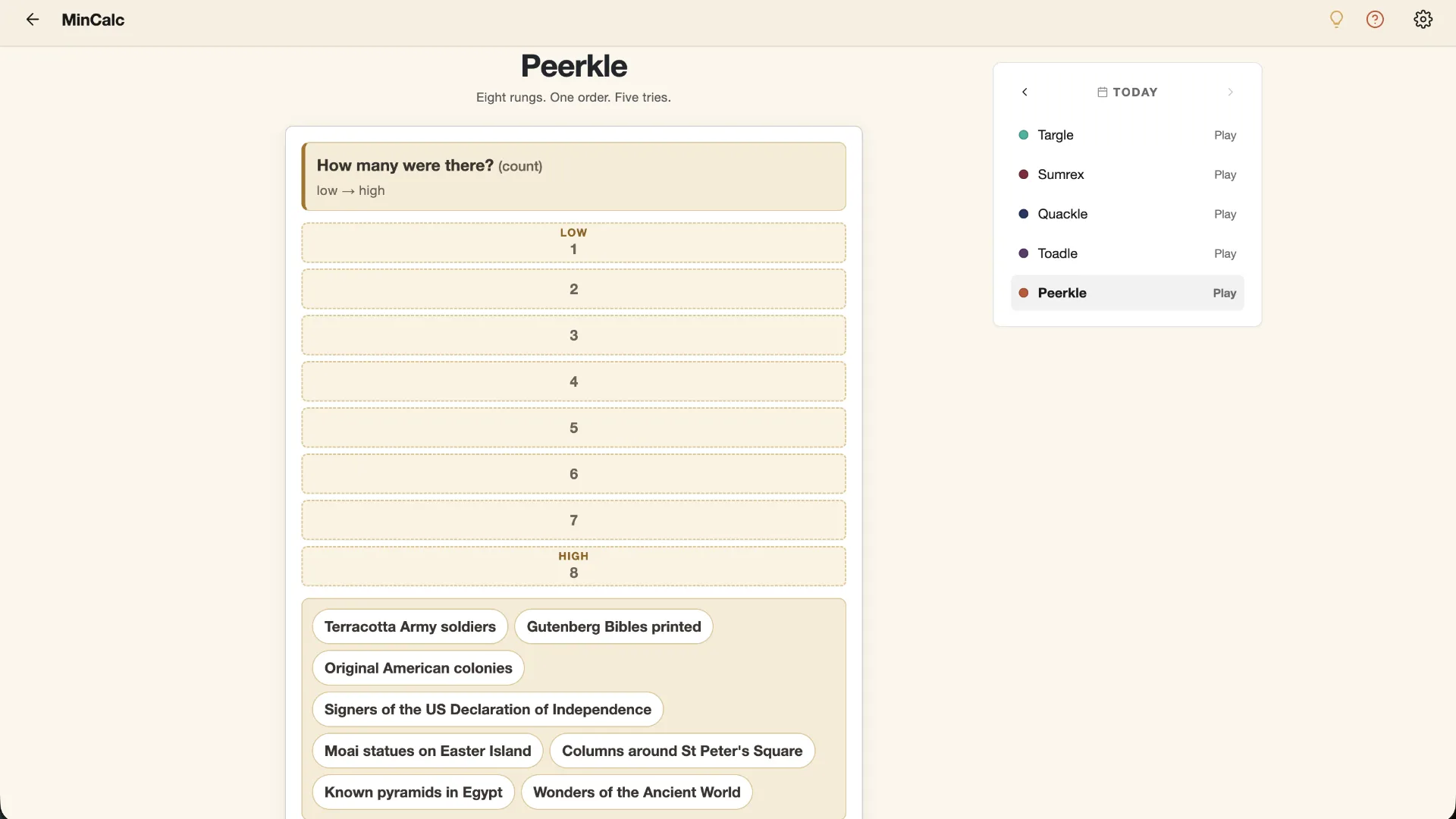
What Is Peerkle?
Peerkle is a daily ranking and deduction game from MinCalc. Each puzzle gives you eight items plus a named measurement or axis, and your goal is to arrange all eight from lowest to highest within five attempts.
The subject changes from puzzle to puzzle. You might be asked to rank mammals by average sleep time, countries by population, things by release year, or another measurable property. The challenge is not simply knowing every exact value: after each attempt, Peerkle tells you how close each item is to its correct position, giving you information you can use to logically improve the next order.
A new Peerkle appears every day at 00:00 UTC, and previous puzzles are available through the archive.
The Core Twist: Positional Feedback
Peerkle uses an eight-rung ladder running from low to high. After submitting an order, every item receives one of three feedback symbols based on its distance from the correct position:
●means the item is in exactly the correct position.◐means the item is one position away from where it belongs.○means the item is two or more positions away.
For example, imagine a simplified four-item puzzle using alphabetical order:
1. Cat ○
2. Bee ●
3. Dog ◐
4. Ant ○
Bee is already correct and can stay where it is. Dog is only one rung away, while Cat and Ant need larger moves. The real game uses eight items, but the same deduction process applies.
Correctly placed items become locked, so future attempts focus only on the remaining unsolved positions. Peerkle does not reveal the underlying numerical values while you are solving; the clues describe positional distance rather than how far apart the actual measurements are.
How to Play Peerkle
- Read the day's ranking axis. Check what property you are ranking, such as population, average sleep hours, release year, or another measurable quantity.
- Build your first ranking. Select each of the eight items and place it onto the ladder from lowest at position 1 to highest at position 8. Use your existing knowledge to make the strongest first guess possible.
- Submit and study the feedback. Each position receives
●,◐, or○. Keep exact matches in place, look closely at items that are only one rung away, and make larger changes to items marked as further away. - Swap items to refine the order. From later attempts, select two unlocked positions to swap their contents. You can also clear the unfinished portion of the ladder and rebuild it while correctly locked items remain in place.
- Solve within five attempts. Continue using the positional clues until all eight items are correctly ordered or your five attempts are used.
Why Peerkle Feels Different
Most higher-or-lower games compare two things at a time. Peerkle instead asks you to solve the complete ordering of eight items simultaneously. That makes each clue interact with the rest of the ladder: moving one item usually means reconsidering where another one belongs.
The changing daily axis also means there is no single subject to memorize. One day may reward geography knowledge, while another may involve entertainment, science, history, demographics, or everyday facts. This makes Peerkle feel like a mix of trivia and logic deduction rather than a conventional quiz.
Peerkle Strategy Tips
- Start with the extremes. The smallest and largest items are often easier to identify than the middle of the ranking, giving you useful anchors.
- Leave
●items alone. Once a position is correct, it locks, reducing the number of possibilities you need to consider. - Treat
◐as strong information. An item marked one rung away has only a very small number of possible destinations, so test nearby swaps before rearranging the entire ladder. - Move
○items more aggressively. These items are at least two positions from their correct location, so tiny adjustments are unlikely to solve them. - Use all the feedback together. If two neighboring items are both close to their correct positions, swapping them may solve both. Likewise, several distant items can indicate that a larger section of the order needs to be rearranged.
- Make the first attempt meaningful. Five attempts provide room for deduction, but a completely random opening order gives you less useful information than a ranking based on reasonable estimates.