What Is Puttsies?
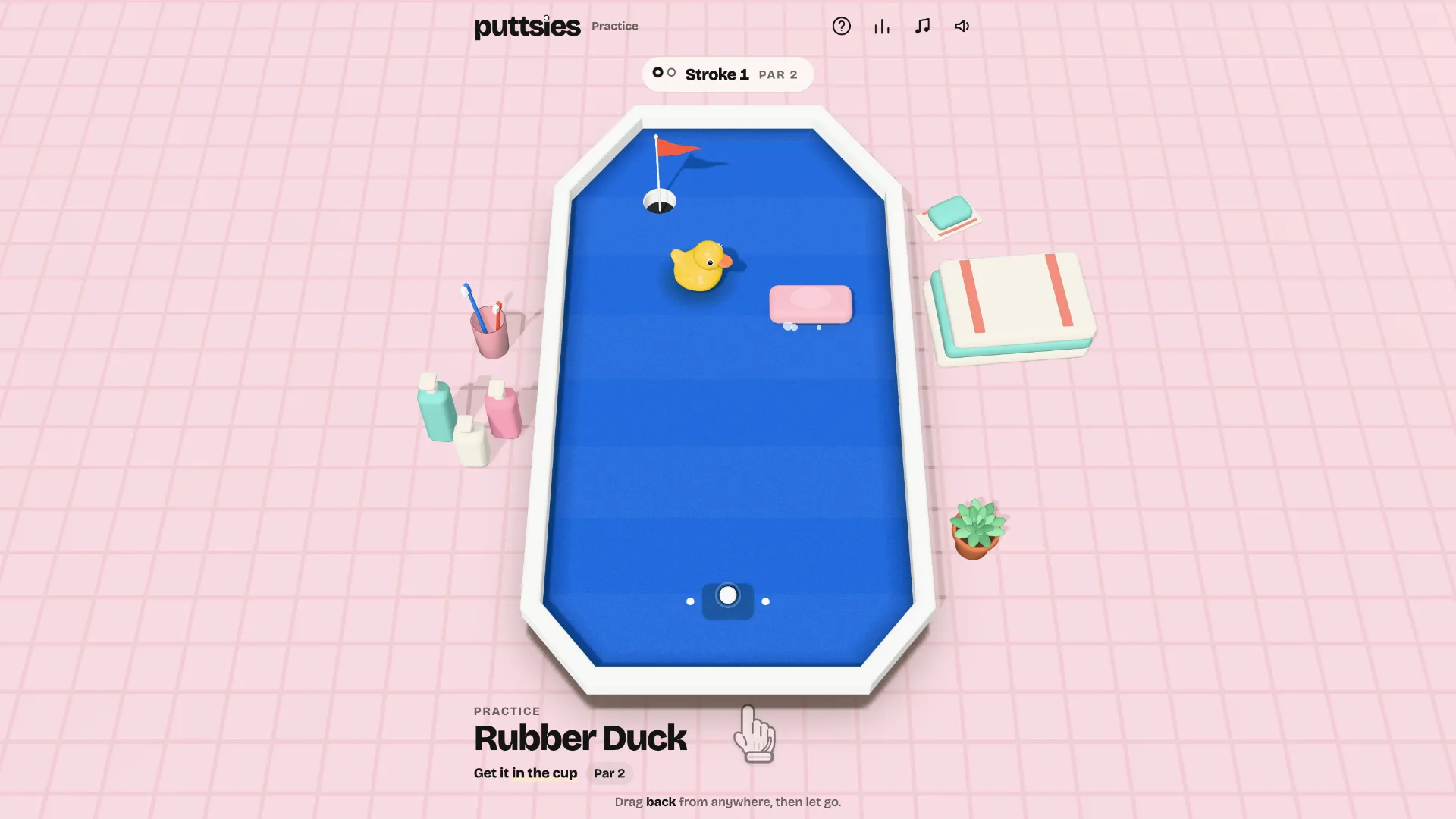
Puttsies is a free daily browser-based mini-golf game created by independent developer Isaac Audet. Each day, players tackle nine miniature putting challenges featuring tabletop obstacles, bouncing rails, and physics-based ball movement.
The objective is simple: get the golf ball into the hole using as few strokes as possible.
Unlike traditional golf games with complex swing meters or multiple clubs, Puttsies uses an intuitive drag-and-release mechanic. Press anywhere on the playing area, pull backward to aim and set your shot strength, and release to send the ball rolling.
The further you pull, the further the ball travels. However, powerful shots are not always better. You must consider the ball's trajectory, obstacles, table boundaries, and potential rebounds before every putt.
The courses are filled with everyday objects such as mugs, rubber ducks, and pencils. Rails can bounce the ball back into play, while open edges present the danger of sending it off the table.
Everyone plays the same nine holes each day, making Puttsies a shared daily challenge where players can compare their scores.
Puttsies is also part of DLE Club, a collection of daily browser games that includes Amountle, Halfsies, Stackdle, and Weighsies.
Puttsies Game Rules
Puttsies combines familiar mini-golf scoring with accessible physics-based controls.
The main rules are:
- Nine daily holes: Complete a sequence of nine miniature golf challenges.
- Shared daily course: Everyone receives the same nine holes each day.
- Drag to aim: Press and drag backward to set the direction of your putt.
- Control shot power: Pull farther back to make the ball travel farther.
- Release to shoot: Let go to launch the ball across the tabletop course.
- Use the rails: The ball can rebound off rails, allowing angled and indirect shots.
- Avoid obstacles: Everyday objects such as mugs, ducks, and pencils can interfere with the ball's movement.
- Watch the edges: Sending the ball beyond an open table edge takes it out of the playing area.
- Every putt counts: Each shot adds one stroke to your score.
- Finish the hole: Continue putting from wherever the ball stops until it reaches the cup.
- Beat par: A hole completed in one stroke fewer than par earns a birdie.
The overall challenge is to complete all nine holes efficiently rather than simply sinking the ball by any means possible.
How to Play Puttsies
- Open today's challenge: Visit Puttsies in your browser and start the daily nine-hole course. Look at the position of the ball, the hole, surrounding rails, and any obstacles.
- Plan your shot: Identify a possible route to the cup. You can aim directly toward the hole or use the surrounding rails to redirect the ball around obstacles.
- Press, drag, and release: Press anywhere on the playing area and drag backward, like pulling a putter away from the ball. A longer pull produces a stronger shot. Release to send the ball rolling.
- Adjust your next putt: Watch where the ball travels and stops. If it does not reach the cup, use its new position to plan your next shot. Remember that each additional putt increases your stroke count.
- Complete all nine holes: Continue until you have finished the daily course. Review your performance and compare your result with other players through the associated DLE Club competition.
The basic interaction is easy to learn, but consistently finishing difficult holes under par requires careful control of both direction and power.
Example: How Puttsies Works
Imagine a hypothetical tabletop putting challenge with a ball near the bottom-left corner, a cup near the upper-right corner, and a mug blocking the most direct route.
A simplified overhead layout might look like this:
+-----------------------+
|                  HOLE |
|                   O   |
|                       |
|        [ MUG ]        |
|                       |
|   o                   |
|  BALL                 |
+-----------------------+
A straight shot toward the cup might hit the mug and send the ball in an unpredictable direction.
You have several possible approaches:
Option 1: Go around the obstacle. Aim toward an open section of the table and use a controlled first putt to position the ball for a clear second shot.
Option 2: Bank off a rail. Aim toward a nearby wall and allow the ball to rebound toward the hole from another angle.
Option 3: Attempt a stronger direct shot. Use more power if the available route permits it, but remember that a stronger shot can overshoot the cup or send the ball toward an open edge.
A successful bank shot may save a stroke, but a poorly judged bounce could leave the ball in a worse position.
This example illustrates the game's putting decisions rather than reproducing an actual daily hole.
Puttsies Controls Explained
Aim by Dragging Backward
Puttsies uses a pull-back shooting gesture.
Press on the playing area and drag backward relative to the direction you want the ball to travel. This resembles drawing a putter back before striking the ball.
For example, to launch the ball toward the right side of the course, pull in the opposite direction before releasing.
Control Shot Strength
The distance of your drag determines how powerful the shot will be.
A short drag produces a gentle putt, while a longer drag sends the ball farther.
Power control is especially important when the hole is close to a boundary or when you need the ball to stop in a particular position.
Release to Putt
Once you are satisfied with the direction and strength, release your mouse button or finger.
The ball travels according to the game's physics, interacting with rails and obstacles along its route.
Continue From the Ball's New Position
If your shot does not reach the cup, the next putt begins from wherever the ball stops.
This means every shot influences the difficulty of the following one. A safe first putt that leaves an easy second shot may be better than an ambitious attempt that puts the ball behind an obstacle.
Obstacles and Course Features
Puttsies uses a playful tabletop setting rather than a conventional outdoor golf course.
Rails and Bank Shots
Rails form boundaries that can reflect the ball back into the playing area.
Learning how the ball rebounds is an important skill. Instead of attempting to hit directly toward the cup, you can sometimes use a rail to approach it from another direction.
Bank shots are especially useful when a direct path is blocked.
Mugs
Mugs act as physical obstacles that interfere with the ball's route.
A mug positioned between the starting point and the cup may force you to choose a wider path or attempt a carefully calculated rebound.
Rubber Ducks
Rubber ducks are among the playful objects that can appear on the tabletop course.
Their presence creates another reason to consider the ball's path before applying maximum power.
Pencils
Pencils can obstruct an otherwise straightforward putt.
A long, narrow object may change which approach angles are available, encouraging indirect routes or more precise shots.
Open Table Edges
Not every boundary is protected by a rail.
If the ball travels beyond an open edge, it leaves the table. This makes excessive power especially risky near exposed sides of the course.
Puttsies Scoring Explained
Puttsies follows the basic scoring principle of miniature golf: fewer strokes are better.
Every time you putt the ball, one stroke is added to your result. Each hole also has a par value representing a reference number of strokes.
Understanding Golf Terms
| Result | Meaning |
|---|---|
| Hole-in-one | Sink the ball with your first putt |
| Birdie | Finish one stroke under par |
| Par | Finish in the reference number of strokes |
| Bogey | Finish one stroke over par |
| Double bogey | Finish two strokes over par |
For example, consider a hypothetical par-3 hole.
- Finishing in one stroke gives you a hole-in-one and places you two strokes under par.
- Finishing in two strokes gives you a birdie.
- Finishing in three strokes means you made par.
- Finishing in four strokes gives you a bogey.
The aim is to minimize your total stroke count across the nine daily holes.
This creates a meaningful trade-off between aggressive shots that might save strokes and safer routes that offer greater control.
Puttsies Strategy and Tips
1. Study the Course Before Your First Shot
Look at the complete arrangement of rails, obstacles, exposed edges, and the cup.
Identify whether the direct route is open or whether an indirect approach is necessary.
A few seconds spent planning can prevent unnecessary strokes.
2. Use Less Power Near the Cup
Longer drags create stronger shots, but too much power can cause the ball to roll past the hole.
When the cup is nearby, prioritize accurate direction and controlled movement over maximum distance.
3. Learn How the Rails Affect the Ball
Rails are not merely barriers. They can become useful parts of your strategy.
A carefully aimed rebound may reach the cup from an angle that is impossible with a direct putt.
However, bank shots require practice because the ball's arrival position depends on both direction and speed.
4. Avoid Open Edges
A powerful shot toward an exposed edge creates an unnecessary risk.
When the cup sits close to an unprotected boundary, consider approaching it from a safer direction or using a shorter putt.
5. Plan for Your Next Stroke
Not every hole needs to be completed in one spectacular shot.
Sometimes the best move is a short positioning putt that creates a simple route to the cup.
Think about where the ball will stop, not just how far it will travel.
6. Use Obstacles to Guide Your Decisions
Mugs, ducks, and pencils can change the available routes.
Rather than treating every obstacle as something to hit through, look for clear paths around it or safe rebound opportunities.
7. Balance Risk and Reward
An ambitious bank shot might produce a birdie, but it can also create a much more difficult follow-up.
If you are already in a good position, a straightforward putt may be the more reliable choice.
8. Stay Consistent Across Nine Holes
One excellent hole does not guarantee a great daily result.
Try to avoid costly mistakes across the entire course. Consistent putting can be more valuable than pursuing a hole-in-one on every challenge.
Puttsies and DLE Club
Puttsies is one of the core games in DLE Club, a collection of free daily puzzle and arcade games created by Isaac Audet.
The club combines performance across five main games into a single daily competition.
| Game | Main Challenge |
|---|---|
| Amountle | Estimate how many objects are inside a container |
| Halfsies | Divide an object into two equal-weight pieces |
| Stackdle | Build a stable stack of objects |
| Puttsies | Complete nine miniature golf holes |
| Weighsies | Estimate quantities needed to balance a scale |
Each of the five games contributes up to 100 club points, producing a maximum combined score of 500.
According to the official DLE Club explanation, Puttsies contributes points based on two factors:
- Individual performance: Half of the available club points reflects your own result.
- Relative performance: The other half reflects how many other players you outperform that day.
This means the game's putting score and its contribution to the DLE Club leaderboard are related but not identical.
A strong individual result can earn valuable club points, especially if relatively few players achieve a better score on the same daily course.
DLE Club also provides daily leaderboards and friend-group competition, giving players another reason to return to Puttsies regularly.
What Makes Puttsies Different?
Puttsies stands out from many daily browser games because its main challenge involves physical control rather than guessing a hidden answer.
A Shared Nine-Hole Challenge
Everyone plays the same collection of nine holes each day.
This makes the game suitable for comparing results with friends without worrying about different players receiving completely different challenges.
Simple Controls With Skill-Based Outcomes
The entire putting mechanic is built around a single gesture: press, drag backward, and release.
The controls are approachable, but judging the correct direction and distance takes practice.
Playful Tabletop Environments
Instead of conventional fairways, Puttsies uses rails and recognizable everyday objects.
This gives the courses a toy-like personality and creates unusual miniature golf situations.
A Daily Competition Beyond Golf
As part of DLE Club, Puttsies contributes to a broader daily score that includes estimation and physics-based challenges.
Players can focus exclusively on putting or complete the entire five-game gauntlet.
Puttsies vs Other Daily Mini-Golf Games
| Game | Daily Challenge | Main Gameplay |
|---|---|---|
| Puttsies | Nine tabletop mini-golf holes | Drag backward, release, and use rail rebounds |
| putt.day | One daily 3D mini-golf hole | Aim and control putting power |
| PuttDaily | Three daily mini-golf holes | Navigate obstacles, hazards, and enemies |
| PUTTLE | Five daily 3D mini-golf holes | Complete a shared course on floating islands |
Puttsies is especially distinctive for its nine-hole format, tabletop obstacles, simple pull-back controls, and integration with the DLE Club daily competition.
Players who enjoy a physical skill challenge may prefer it to traditional word or trivia games.
Is Puttsies Free to Play?
Yes. Puttsies is available as a free browser-based game at puttsies.dev.
The game is part of the independent DLE Club collection, which is designed around accessible daily games.
No dedicated application download is required for the browser version.
DLE Club offers optional ways to support its developer, but the core Puttsies daily challenge can be played without purchasing access.
Frequently Asked Questions
What is Puttsies?
Puttsies is a daily mini-golf game where players complete nine tabletop putting challenges using drag-and-release controls. The goal is to sink every putt while keeping the total stroke count low.
How many holes are in Puttsies?
Each daily challenge contains nine holes.
How do you aim in Puttsies?
Press anywhere on the playing area and drag backward in the opposite direction from where you want the ball to travel. Release to take the shot.
How do you control shot power?
The distance of your backward drag determines shot strength. Pulling farther makes the ball travel farther.
Can you bounce the ball off walls?
Yes. Rails bounce the ball back and can be used to create indirect routes toward the cup.
What obstacles appear in Puttsies?
The official instructions mention mugs, rubber ducks, and pencils. These objects can interfere with your intended putting route.
What happens if the ball goes off the table?
Open table edges allow the ball to leave the playing surface. Players should avoid these edges when planning shots, particularly powerful ones.
What is a birdie in Puttsies?
A birdie is a hole completed in one stroke fewer than its par value.
Does everyone play the same holes?
Yes. Puttsies gives everyone the same nine-hole challenge each day.
Is Puttsies a daily game?
Yes. The game is designed around a shared daily mini-golf challenge.
Who created Puttsies?
Puttsies was created by Isaac Audet, the independent developer behind the DLE Club collection of browser games.
Is Puttsies part of DLE Club?
Yes. Puttsies is one of the club's five core daily games and contributes up to 100 points toward a combined daily score of 500.
Is Puttsies free?
Yes. The core game can be played free in a web browser without downloading a separate application.
Who Should Play Puttsies?
Puttsies is particularly appealing to players who enjoy miniature golf, simple physics games, short skill challenges, and daily score competitions.
Its straightforward controls make it approachable for casual players, while its bank shots, obstacles, and exposed table edges provide enough difficulty for players who want to master each course.
Fans of golf games will recognize the familiar goal of completing holes under par, while players who enjoy daily browser challenges will appreciate the shared nine-hole format.
Puttsies is also a natural choice for anyone already playing Amountle, Halfsies, Stackdle, or Weighsies through DLE Club.
Conclusion
Puttsies turns miniature golf into an entertaining daily browser challenge. With nine shared holes, intuitive drag-and-release putting, playful tabletop obstacles, and opportunities for clever rail rebounds, the game rewards both accuracy and planning.
The objective is easy to understand, but earning a strong score across all nine holes requires patience, careful aim, and consistent power control.
As part of DLE Club, Puttsies also offers a way to compare daily performance with other players and contribute to a larger five-game competition.
Ready to test your putting skills? Play Puttsies for free and see how few strokes you need to complete today's nine holes.
For the official rules and DLE Club scoring details, visit the Puttsies How to Play guide.