What Is Puzzleship Hearsay?
Puzzleship Hearsay is a daily browser-based logic game that turns truth and lies into a positioning puzzle. Instead of deciding whether a statement is simply correct or incorrect, players must arrange statements so that each one matches the truth requirement of its position.
The game belongs to the classic knights-and-knaves family of logic puzzles, where some speakers always tell the truth and others always lie. Hearsay gives that idea a clever twist: the statements themselves move between positions, and changing their positions can change whether they are true.
Each day, Puzzleship offers six Hearsay puzzles ranging from very easy to ultra hard. The shorter arrangements introduce the rules, while the harder puzzles demand more careful deduction and an understanding of how statements interact.
Hearsay is a good choice for players who enjoy logical reasoning, self-referential riddles, and puzzles that reward thinking rather than guessing.
How Does Hearsay Work?
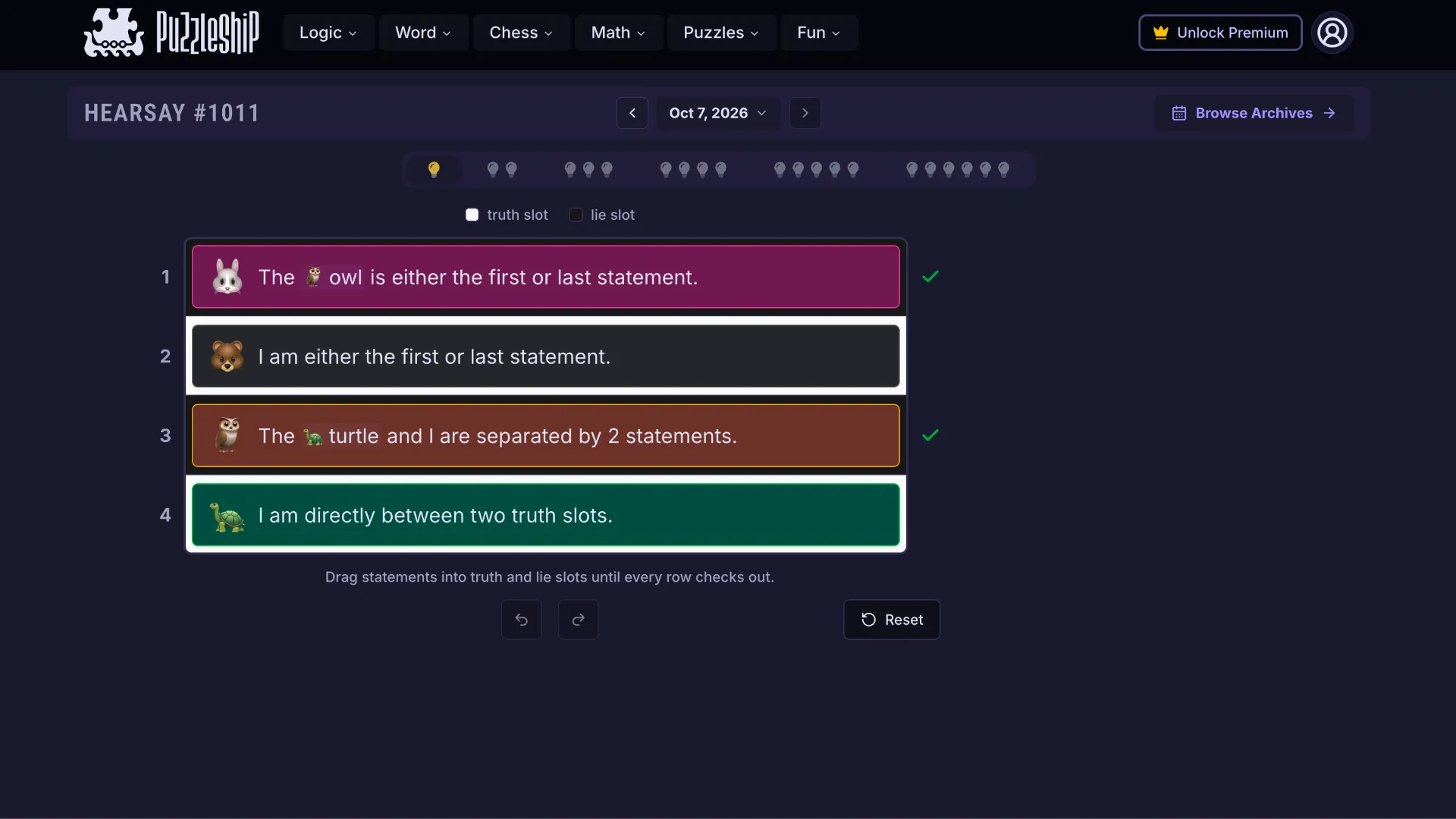
The board contains a series of statements arranged in slots. Every slot has one of two roles:
- White slot (Truth): The statement placed here must be true.
- Black slot (Lie): The statement placed here must be false.
Statements describe their own positions, neighboring statements, or relationships with other statements on the board.
For example, a statement might say:
I am neither the first nor the last statement.
If this statement occupies a white truth slot, it must appear somewhere between the first and last positions. However, if it occupies a black lie slot, it must appear at the beginning or end so that its claim is false.
Other statements might claim:
There are 2 statements between me and the tiger.
That clue refers to another statement identified by its character icon. Whether the claim must hold depends on the slot where it is placed.
This creates the central challenge: every statement must agree with the truth or lie condition of its final position, and all conditions must be satisfied simultaneously.
A placement that makes one statement correct can change the meaning of several others.
How to Play Puzzleship Hearsay
- Open the game. Visit the official Puzzleship Hearsay page and choose one of the available daily puzzles. Starting with a lower difficulty is useful for learning how the rules work.
- Examine the slots. Identify which positions are white truth slots and which are black lie slots. Read every statement before making changes.
- Find the strongest clues. Look for statements referring to fixed positions, such as being first, last, or directly between two other statements.
- Drag statements into position. Rearrange the statements between truth and lie slots. After each move, check whether the affected statements satisfy their required conditions.
- Complete the arrangement. Continue adjusting the order until every statement is true in a white slot or false in a black slot. Use Reset if you want to restart the arrangement.
The key is to consider the entire board rather than solving each statement independently.
Example: Understanding the Truth and Lie Mechanic
Consider this statement:
Statement A: I am directly between two truth slots.
The statement creates different restrictions depending on its destination.
| Placement | What must happen? |
|---|---|
| White truth slot | Both immediately adjacent positions must be truth slots. |
| Black lie slot | The statement must not be directly between two truth slots. |
Now imagine another statement claims to be directly before Statement A. Moving either statement changes their relative positions, potentially affecting both claims.
This is why checking one clue in isolation is not enough. A successful arrangement must satisfy every statement together.
Tips for Solving Hearsay Puzzles
Start With Absolute Position Clues
Statements mentioning the first or last position are often easier to evaluate. There are only a few positions that can make them true, and their negations can sharply restrict where they belong.
Remember That Lies Are Useful Information
A lie slot does not mean its statement can be ignored. It means the statement must be false.
For example, if a statement in a lie slot says it is first, that statement cannot occupy the first position. Treating false statements as constraints is essential to solving harder puzzles.
Count the Available Truth and Lie Slots
Before rearranging anything, count the white and black positions. A statement making a claim about how many truth or lie slots exist may be testable immediately, without depending on the order of the statements.
Work With Relationships
Statements referring to neighboring positions, exact distances, or other named statements should be considered together. One placement may satisfy several clues while ruling out other possible arrangements.
Test Assumptions Logically
When two placements seem possible, temporarily assume one is correct and follow its implications. If another statement becomes impossible to satisfy, reject that arrangement and investigate the alternative.
Recheck Everything After Moving a Statement
A statement that was previously true can become false when another statement changes position. Reevaluate the relationships after each meaningful rearrangement, especially on larger boards.
Is Puzzleship Hearsay a Daily Game?
Yes. Puzzleship publishes six Hearsay arrangements every day, with difficulties ranging from very easy to ultra hard.
New daily puzzles become available at midnight in the player's local time zone, according to Puzzleship. The site also maintains an archive of previous Hearsay puzzles, with historical archive access offered through its premium subscription.
The daily format makes Hearsay suitable for a quick mental challenge or a longer session working through increasingly difficult arrangements.
Who Should Play Hearsay?
Hearsay is particularly appealing to players who enjoy:
- Knights-and-knaves riddles involving truthful and dishonest speakers.
- Deduction games where clues refer to other clues.
- Self-referential logic puzzles with interconnected conditions.
- Daily brain teasers that do not require outside knowledge.
- Games where experimenting with logical assumptions is more useful than random guessing.
Unlike ordinary trivia games, Hearsay does not test how many facts a player knows. Its difficulty comes from recognizing the consequences of each statement and finding an arrangement without contradictions.
More Games Like Puzzleship Hearsay
Players who enjoy Hearsay may also like other logic games on Puzzleship:
- Self-Referential Quiz: Answer questions whose correct answers depend on the answers to other questions.
- Clue Manor: Deduce where guests stood using statements and spatial constraints.
- Whereabouts: Place letters on a grid while satisfying clues about their positions and relationships.
- Ranking Puzzles: Reorder entries using relative-position clues and a rule about initially correct placements.
These games share Hearsay's emphasis on deduction but use different puzzle structures.
Conclusion
Puzzleship Hearsay offers a distinctive challenge built around a simple but powerful idea: a statement's position determines whether it must be true or false.
The combination of self-referential clues, movable statements, and interconnected conditions makes each arrangement a satisfying exercise in deductive reasoning. With six daily difficulty levels, there is room for both newcomers and experienced logic-puzzle players.
Ready to untangle the truth from the lies? Play Puzzleship Hearsay in your browser and see whether you can arrange every statement without a contradiction.