
What Is Real Flag / Fake Flag?
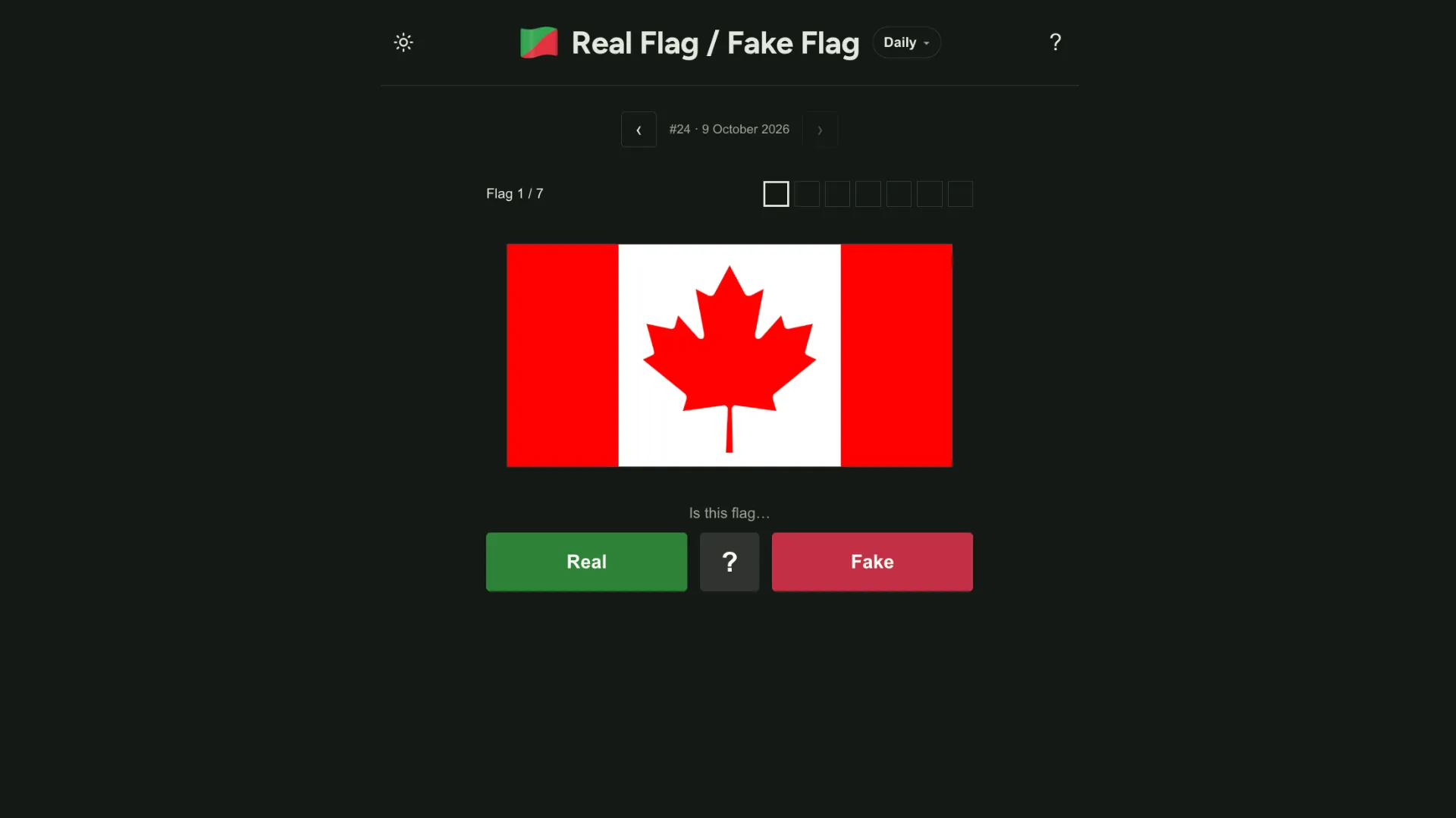
Real Flag / Fake Flag is a free browser-based geography game that challenges players to distinguish genuine flags from invented designs. Each day, the game presents seven flags, and your task is simple: decide whether each one is Real or Fake.
The catch is that a convincing-looking flag is not necessarily real, while an unfamiliar or unusual design might be an authentic flag with a fascinating history.
Unlike traditional flag quizzes that ask you to identify a country, Real Flag / Fake Flag tests your knowledge of flags from around the world, including national flags, regional emblems, historical banners, naval ensigns, city flags, and flags associated with organizations or movements.
Created by independent developer Zimo (zimonitrome), the game combines geography, history, and vexillology—the study of flags—into a quick daily challenge.
A new set of seven flags becomes available every day at midnight UTC. The puzzles generally become more difficult as you progress, making the final flags especially challenging for players who know only familiar national designs.
How Does Real Flag / Fake Flag Work?
The game uses a straightforward true-or-false guessing mechanic. A flag appears on the screen with two possible answers:
- Real: The flag is or was genuinely used and has documented historical or contemporary usage.
- Fake: The flag is an invented design, fictional creation, redesign, or altered version of an existing flag.
After selecting an answer, the game immediately reveals whether you were correct and provides information about the flag. You can read its explanation and follow source or credit links to learn more before moving to the next question.
Each standard daily challenge contains seven flags, selected from a mixture of real and fake designs. The proportion can vary from day to day, so there is no guaranteed number of genuine flags.
What Counts as a Real Flag?
The game's definition of a real flag extends well beyond today's national flags. Documented flags from several categories can appear:
- National flags: Current and historical flags used by countries.
- Regional and state flags: Flags representing states, provinces, and other subdivisions.
- City flags: Municipal designs, such as Amsterdam's distinctive three-cross flag.
- Historical flags: Older designs that were previously used but have since been replaced.
- Naval and military flags: Ensigns, banners, and flags used by military organizations.
- Indigenous flags: Flags representing Indigenous peoples and communities.
- Organizational flags: Flags associated with established institutions, political movements, and other groups.
For example, Germany's familiar black-red-gold national flag is real. However, an unfamiliar historical flag can also be real if it has documented usage.
What Counts as a Fake Flag?
Fake flags can be original designs or modifications of genuine ones. They include:
- Mashups combining elements from two or more existing flags.
- Fan-made redesigns of national or regional flags.
- Fictional flags created for games, films, or imaginary countries.
- Computer-generated or completely invented flags.
- Existing flag designs with altered symbols, colors, or arrangements.
For example, a hypothetical flag combining Japan's red circle with the blue-and-yellow cross of Sweden could look plausible, but a newly invented combination would be classified as fake unless the specific design had documented real-world use.
Important: A fake flag does not have to look badly designed. Some fictional flags are professionally created, while authentic historical or municipal flags can appear surprisingly unusual.
The game generally avoids ambiguous cases, including poorly documented designs, heavily disputed flags, and many proposals that were never adopted. Some exceptions may be classified at the creator's discretion.
How to Play Real Flag / Fake Flag
Getting started takes only a few clicks. The game runs in a web browser without requiring registration or installation.
- Open the official website. Visit Real Flag / Fake Flag and choose Daily to play the standard seven-flag challenge. New players can select Daily easy for a more familiar set of national flags and convincing imitations.
- Examine the first flag. Look carefully at its colors, layout, symbols, and overall design. Consider whether you recognize it from a real country, historical period, city, or organization.
- Choose Real or Fake. Select one of the two buttons beneath the flag. You are deciding whether the specific design is documented as a genuine flag, not identifying which country it resembles.
- Read the answer. The game reveals the correct classification and explains the flag's identity or origin. Review the explanation and source information to learn why your guess was right or wrong.
- Complete all seven rounds. Continue through the remaining flags, review your final performance, and return the next day for a fresh challenge. You can also explore additional game modes immediately.
The standard daily round generally starts with more recognizable designs before introducing harder or more obscure flags.
Real Flag / Fake Flag Game Modes
Real Flag / Fake Flag offers several ways to play beyond the standard daily puzzle.
Daily
The main mode features seven flags per day. Players decide whether each flag is genuine or invented, with difficulty generally increasing across the round. New puzzles arrive at midnight UTC.
Daily Easy
Daily easy also contains seven flags, but focuses on current national flags and fake designs made to resemble them. This is an accessible option for beginners who want to build confidence before encountering obscure historical and regional flags.
10, 20, 50, and 100 Flag Challenges
These modes generate longer challenges using flags from the game's existing collection. Choose your preferred length and test how consistently you can distinguish genuine flags from convincing inventions.
Generated challenges have shareable links, allowing friends to play the same selection of flags and compare their results.
Endless
Endless mode lets you continue answering flag questions beyond the usual daily limit. It is useful for players who want more practice or enjoy exploring unfamiliar flag designs.
Endless Instadeath
Instadeath introduces a high-pressure survival challenge. Flags appear one after another, but one incorrect answer immediately ends your run.
The goal is to build the longest possible sequence of correct answers. This mode also features a top-20 high-score board, giving experienced players a competitive target.
Daily Archive
The Archive allows you to select and play previous daily editions. Completed days display your score for that edition on the current device, making it easy to revisit earlier puzzles and track your history.
Tips for Getting More Flags Right
Although every answer ultimately requires a Real or Fake decision, several strategies can improve your accuracy.
1. Look Beyond Modern National Flags
One of the most common mistakes is assuming an unfamiliar flag must be fake. The game includes genuine historical, municipal, regional, Indigenous, military, and organizational flags.
If a design looks unusual but resembles an older heraldic banner or a municipal emblem, consider whether it might represent a real community or institution.
2. Watch for Flag Mashups
Some fake designs combine recognizable elements from two genuine flags. A familiar color arrangement paired with an unexpected emblem or symbol may indicate a fictional combination.
However, shared symbols and similar color schemes are common among authentic flags. Treat this as a clue rather than proof.
3. Check the Details
Pay attention to the placement of stars, crosses, crescents, coats of arms, and geometric shapes. An invented flag may borrow most of its design from a genuine flag while changing one important element.
Ask yourself whether you recognize the complete arrangement, rather than simply recognizing its colors.
4. Do Not Judge by Design Quality
A polished, balanced flag could be fictional, while an awkward-looking design might have centuries of documented history.
Flag design quality is not a reliable way to distinguish real flags from invented ones.
5. Learn From Every Explanation
After each answer, take a moment to read the flag's description. The explanations and source links can introduce historical flags, regional symbols, and creative redesigns that you may encounter in future games.
The game is more rewarding when each incorrect guess becomes an opportunity to discover something new.
6. Start With Daily Easy
If the standard game feels too difficult, try Daily easy before moving to longer challenges. Recognizing national flags and common design features provides a useful foundation for more obscure questions.
Is Real Flag / Fake Flag Free?
Yes. Real Flag / Fake Flag is free to play directly in a browser. The website offers daily puzzles, longer challenges, endless play, and an archive of previous editions.
No account is required. Your completed games and streak information are stored in your browser.
If you clear the website's stored data, you can lose your saved progress. The game provides a transfer-code feature for moving your streak to another device without creating an account. Transfer codes are temporary, so they should be used promptly.
After completing a daily challenge, players can also opt into a reminder for the next day's puzzle.
Who Should Play Real Flag / Fake Flag?
Real Flag / Fake Flag is particularly appealing to players who enjoy geography games but want something more unpredictable than memorizing national flags.
It is a good choice for:
- Geography enthusiasts who enjoy discovering flags from different countries, regions, and historical periods.
- Daily puzzle fans looking for a short browser game with fresh challenges.
- Vexillology enthusiasts interested in authentic flags, fictional designs, and unusual flag history.
- Trivia players who enjoy quick two-choice questions and immediate feedback.
- Competitive players who want to test their knowledge in long challenges or Instadeath mode.
- Casual players seeking a free, accessible game that does not require registration.
The simple Real-or-Fake format makes the game easy to understand, while its broad selection of flags ensures that even knowledgeable players can encounter surprises.
Who Created Real Flag / Fake Flag?
Real Flag / Fake Flag was developed by Zimo, also known online as zimonitrome.
According to the game's official About page, its design was inspired in part by Real Bird / Fake Bird and Flagdoku.
Flag images are sourced primarily from Wikipedia, Reddit, and other online flag communities, with individual credits and source links provided after guesses. Players can also submit genuine or invented flags for possible inclusion in future editions.
The game launched its first daily edition on September 16, 2026, and has since introduced additional modes, shareable challenges, a daily archive, and gameplay improvements.
Frequently Asked Questions
How many flags are in the daily game?
The standard daily challenge features seven flags. Each must be classified as Real or Fake.
When does the daily puzzle reset?
A new collection of seven flags is released at midnight UTC every day.
Are all the real flags national flags?
No. Genuine flags can include historical national flags, city flags, regional flags, military ensigns, Indigenous flags, and organizational symbols.
Can fictional flags be classified as fake?
Yes. Fictional flags, fan redesigns, invented designs, and certain altered versions of genuine flags can be classified as fake.
Can I play more than seven flags per day?
Yes. The website offers longer challenges, Endless, Endless Instadeath, and an archive of previous daily puzzles.
Does the game require an account?
No. You can play without registering. Your streak and progress are saved locally in your browser, and a transfer-code feature is available for moving your streak to another device.
Can I submit my own flag?
Yes. The website includes a submission feature where players can suggest genuine or invented flags for future challenges.
Final Thoughts
Real Flag / Fake Flag puts an entertaining twist on traditional geography quizzes by asking a different question: is the flag on your screen actually real?
Its seven-question daily format is quick to play, but the inclusion of historical banners, regional symbols, creative redesigns, and convincing fictional flags makes the challenge more difficult than it first appears.
With multiple difficulty options, shareable challenges, an archive, and an Instadeath survival mode, the game offers plenty of reasons to return even after completing the daily puzzle.
Think you can spot an invented flag? Visit Real Flag / Fake Flag, try today's seven flags, and see how many you can identify correctly.