
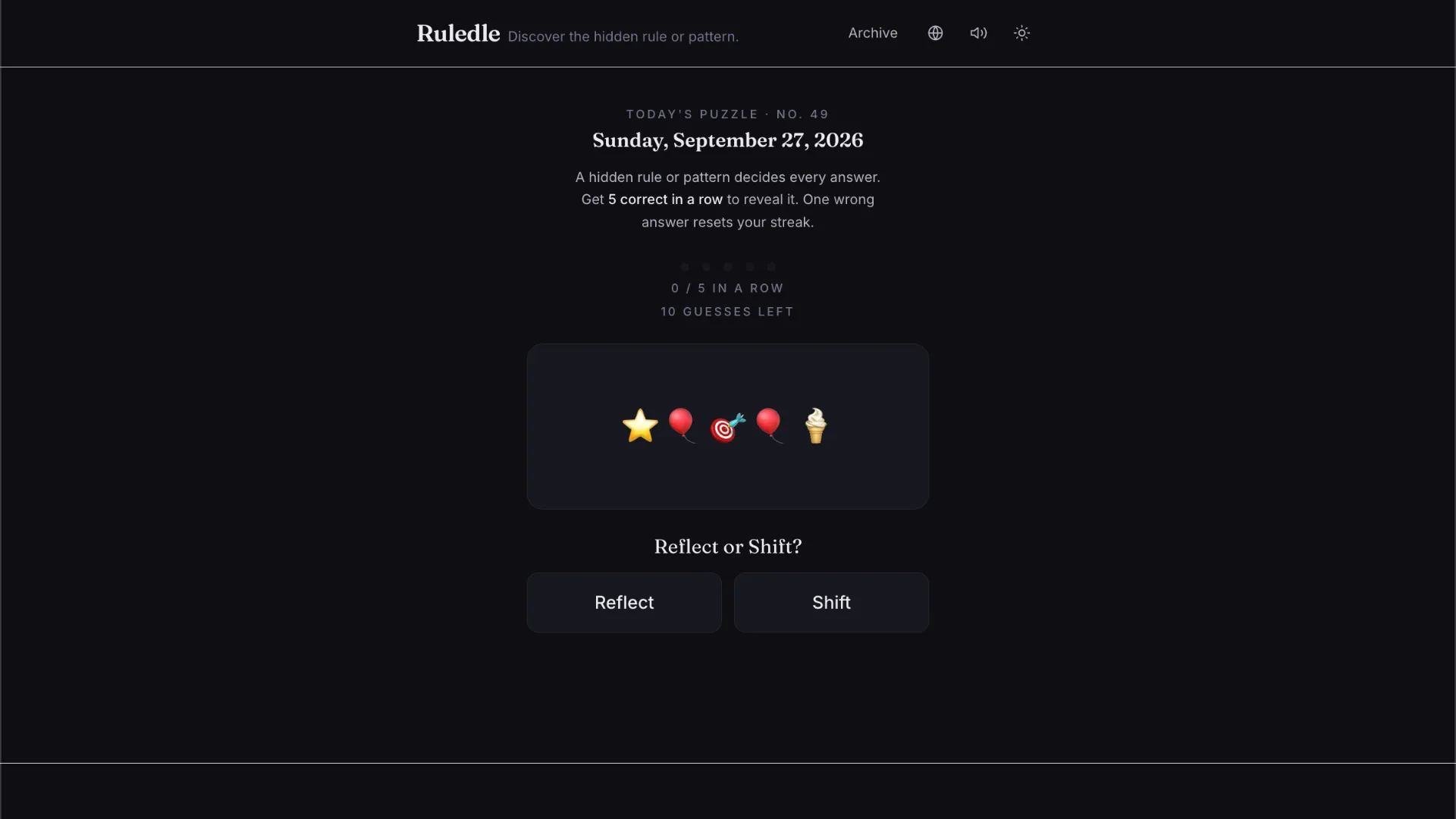
What Is Ruledle?
Ruledle is a daily browser puzzle built around pattern recognition and inductive reasoning. Instead of guessing a word or answering trivia, you are trying to discover one secret rule by watching how the game classifies a series of examples.
Each day presents the same puzzle to everyone. The examples can involve symbols, numbers, words, short phrases, positions, counts, visual properties, or relationships, so the type of reasoning required can change considerably from one day to the next.
Ruledle is free to play, requires no account, and works directly in a desktop or mobile browser. Previous puzzles are also available through an archive.
The Core Twist
The game does not tell you the rule at the start. Instead, it shows an example and asks you to choose between two possible answers. The labels themselves can vary by puzzle, so you have to learn what separates one answer from the other.
After each choice, Ruledle tells you whether you were correct. That feedback becomes evidence for your next hypothesis.
The goal is to get five answers correct in a row. A wrong answer resets the current streak to zero, forcing you to reconsider the rule before trying again. Once you reach five consecutive correct answers, the hidden rule is revealed.
Your previous guesses remain visible in a review list, which is useful because solving the puzzle usually depends on comparing several examples rather than studying only the current one.
A rule might involve something straightforward such as whether a symbol count is even, whether a number ends above a certain value, whether a word begins with a vowel, or whether a word contains repeated letters. Other puzzles can require more lateral thinking.
How to Play Ruledle
- Study the first example. You might see a sequence of symbols, a number, a word, or a short phrase followed by two answer buttons.
- Make an initial prediction. Choose the answer that seems most plausible. Early guesses are partly about gathering information, so being wrong can still teach you something.
- Compare the feedback. Look at the new example alongside your earlier guesses. For instance, if a hypothetical puzzle classified
BOOKdifferently fromCAT, you might test ideas involving word length, repeated letters, vowels, or letter position rather than assuming the first obvious pattern is correct. - Refine your rule and keep predicting. Use each new example to eliminate explanations that no longer fit. You need five correct choices consecutively, and one mistake sends the streak back to zero.
- Reach five in a row. Once your predictions remain correct across five examples, Ruledle reveals the hidden rule so you can compare it with the theory you developed while playing.
Strategy Tips
Use wrong answers as evidence. A failed prediction is often more informative than a lucky correct one because it can eliminate an entire hypothesis.
Compare opposite results. Look for two examples that received different correct answers and identify what changed between them. Count items, inspect the first and last characters, compare lengths, and look for repeated or mirrored elements.
Do not overfit the first few examples. Several different rules can explain one or two observations. Wait for additional evidence before committing strongly to a theory.
Test simple explanations first. Ruledle is designed around everyday observation rather than specialist trivia or advanced mathematics. If your theory requires obscure knowledge or a complicated formula, there may be a simpler relationship you have missed.
Review your guess history. The on-page history is effectively your notebook. Looking at several confirmed examples together makes recurring properties much easier to notice.
Who Should Try Ruledle?
Ruledle is a good fit for players who enjoy discovering systems rather than memorizing facts. Fans of lateral-thinking puzzles, logic games, pattern tests, and daily browser challenges should feel at home, while the short daily format makes it easy to play without committing to a long session.
Because there is no vocabulary-specific answer to guess and no specialist knowledge requirement, the satisfaction comes from the moment when several seemingly unrelated examples suddenly make sense under one rule.