What Is Sweeple?
Sweeple is a free browser-based logic puzzle that combines the hidden-bomb deduction of Minesweeper with the repeated-guess format of Wordle. Instead of clearing a minefield one safe square at a time, you try to identify the exact locations of every hidden bomb within a limited number of guesses.
The central challenge is simple: select all the bomb locations together in a single turn to win.
Each board contains a known number of hidden bombs. On every guess, you select exactly that many squares. The information revealed through your attempts helps you narrow down the possible bomb locations until you can identify the complete arrangement.
Sweeple has one particularly distinctive mechanic: numbered squares show the Manhattan distance, also called taxicab distance, to the nearest bomb. This is fundamentally different from traditional Minesweeper, where numbers count bombs in neighboring squares.
The game also includes a Hard Mode, a shared daily challenge, and randomly generated boards for additional practice.
Created by independent developer Chris L. Hall, known as ChrisLHall, Sweeple is playable directly on itch.io and was built using GameMaker. Its browser version was released in February 2022.
How Does Sweeple Work?
Sweeple uses a grid containing several hidden bombs. Your task is to discover their positions by combining the information from previous guesses.
The essential rules are:
- Find every bomb: You must identify all hidden bomb locations to solve the board.
- Select the correct number of squares: Each guess requires as many selected squares as there are bombs.
- Submit a complete guess: Check your chosen locations together rather than revealing one square at a time as in traditional Minesweeper.
- Read distance clues: A numbered square tells you the horizontal-plus-vertical distance to its nearest bomb.
- Mark safe locations: Select a square twice to mark it with an X when you know it cannot contain a bomb.
- Use previous information: Combine clues across attempts to narrow down the possible locations.
- Win in one turn: Your final submitted selection must contain every bomb location simultaneously.
The official screenshots show puzzles with different grid dimensions and bomb counts, including a 4-by-6 board containing two bombs and a larger board containing four bombs.
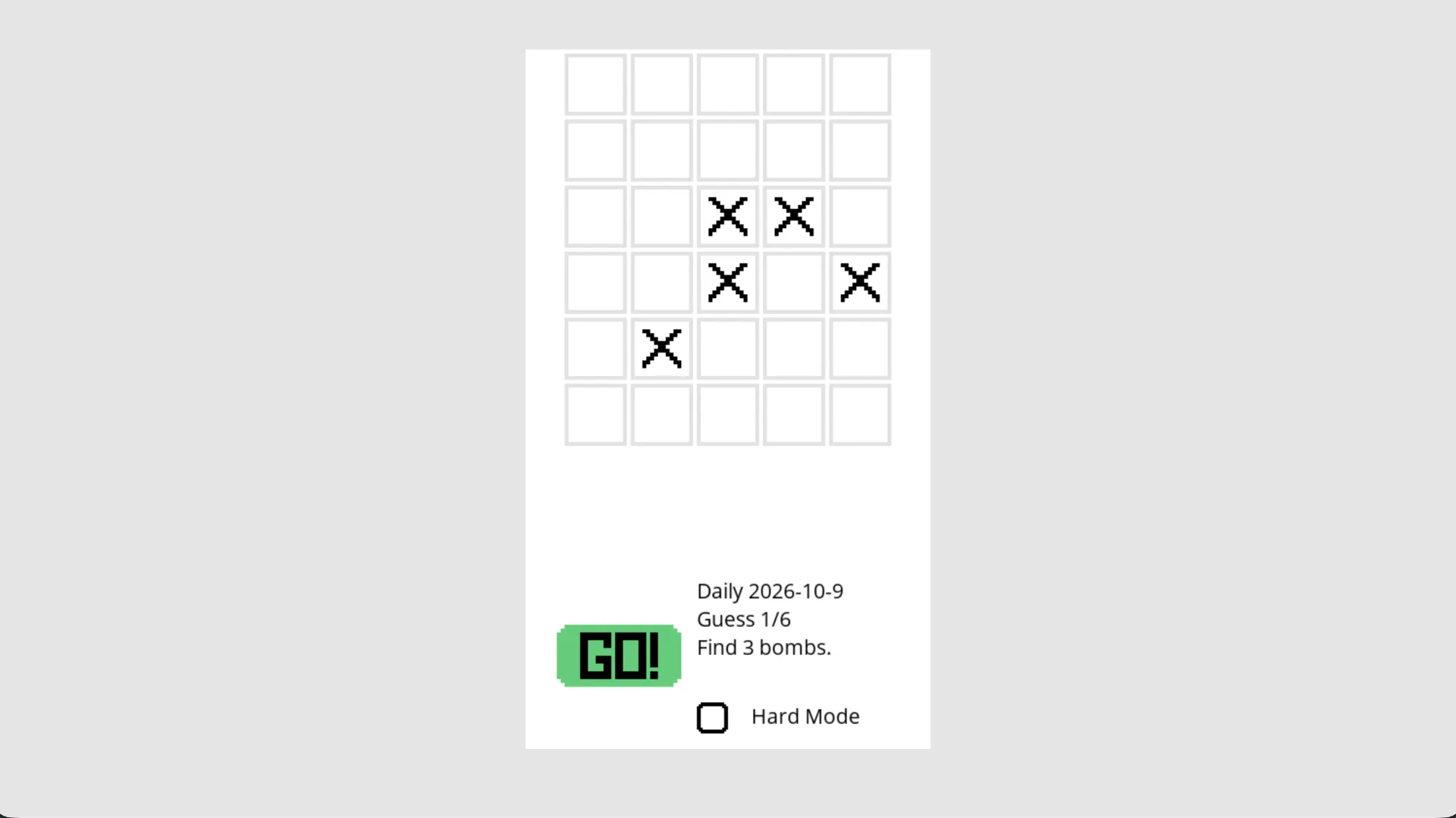
The screenshots also show a six-guess counter, emphasizing the importance of making informative selections rather than guessing randomly.
Understanding Sweeple's Distance Clues
The distance clues are the most important difference between Sweeple and ordinary Minesweeper.
In traditional Minesweeper, a square displaying 2 means exactly two mines are located among its eight immediately neighboring squares.
In Sweeple, a square displaying 2 means its nearest bomb is exactly two grid steps away when measuring horizontal and vertical movement.
What Is Manhattan Distance?
Manhattan distance measures how many horizontal and vertical grid steps separate two locations.
The formula is:
Distance = |row difference| + |column difference|
Diagonal movement is not counted as one step. Moving one square diagonally changes both the row and column, so it contributes two steps to Manhattan distance.
For example, consider two cells:
- Cell A: Row 2, Column 2.
- Cell B: Row 4, Column 5.
The row difference is 2 and the column difference is 3.
The Manhattan distance is therefore 2 + 3 = 5.
If Cell B were the nearest bomb to Cell A, Cell A would display the number 5.
Example: What Does a 1 Mean?
A clue showing 1 means the nearest bomb is exactly one horizontal or vertical step away.
The bomb could be immediately above, below, left, or right of that square.
A diagonally adjacent bomb is two Manhattan steps away, not one.
This makes a 1 especially useful because it restricts the nearest bomb to a small number of potential locations.
Example: What Does a 3 Mean?
A clue showing 3 means the nearest bomb is three Manhattan steps away.
Possible offsets include:
- Three rows away in the same column.
- Three columns away in the same row.
- Two rows and one column away.
- One row and two columns away.
The clue does not tell you which direction contains the bomb. You must combine it with other information to identify the correct location.
The Nearest Bomb Matters
If a board contains several bombs, a numbered square reports the distance to the closest one.
For example, if one bomb is two Manhattan steps away and another is five steps away, the clue displays 2.
This means that every bomb must be at least two steps away, and at least one bomb must be exactly two steps away.
That distinction becomes valuable when several clues overlap.
How to Play Sweeple
Sweeple runs directly in your browser through its official itch.io page.
- Open the game. Visit Sweeple and select Run Game. The board displays a grid, the number of bombs to find, and the current guess information.
- Select possible bomb locations. Choose as many squares as there are hidden bombs. For example, if the board contains two bombs, select two candidate locations before checking your guess.
- Submit your selection. Press the GO button to check the selected squares. Examine the resulting clues, paying attention to numbered cells and confirmed information about possible bomb positions.
- Use the clues to improve your next guess. Interpret the Manhattan-distance numbers, mark squares known to be safe with an X, and choose a more informed set of bomb locations. If Hard Mode is enabled, include bombs you have already discovered in subsequent guesses.
- Find every bomb together. Continue until one submitted guess contains all the bomb locations. After completing the daily challenge, use the reset control to play additional random boards.
The challenge rewards careful reasoning rather than fast clicking. You need to use each attempt to gather useful information about the hidden bomb arrangement.
Sweeple Example: Solving a Two-Bomb Puzzle
Imagine a hypothetical grid containing six rows and four columns, with two hidden bombs.
Suppose the bombs are secretly located at:
- Row 2, Column 2.
- Row 5, Column 4.
You do not initially know these locations.
After checking some candidate squares, imagine receiving a clue of 2 at Row 2, Column 4.
That tells you that the nearest bomb is exactly two Manhattan steps away.
The first hidden bomb, at Row 2, Column 2, satisfies the clue because it is two columns away.
The second bomb, at Row 5, Column 4, is three rows away and therefore does not determine that clue.
Now imagine another numbered square at Row 6, Column 4 displaying 1.
That would indicate a bomb one step away. The second hidden bomb, at Row 5, Column 4, satisfies this clue.
Together, these clues provide useful evidence about the possible bomb locations.
Your final selection would need to include both bomb squares in the same submitted guess.
This is an illustrative example, not an actual daily puzzle. The key lesson is that distance clues describe geometric relationships to the nearest bomb, and several clues can be combined to reduce uncertainty.
What Does the X Mean in Sweeple?
Sweeple allows you to mark a square with an X by selecting it twice.
The X indicates that you believe the square cannot contain a bomb.
This is useful for keeping track of deductions without having to remember every eliminated position mentally.
For example, suppose two distance clues establish that a particular square cannot contain the nearest bomb and another known clue eliminates any additional bomb there.
You can mark that square with an X and focus on the remaining candidates.
X marks are particularly helpful on larger boards because each clue may eliminate several possible bomb locations.
Unlike Minesweeper flags, which usually indicate suspected mines, Sweeple's X marks identify locations considered safe.
What Is Hard Mode in Sweeple?
Sweeple includes an optional Hard Mode inspired by Wordle.
In Wordle's Hard Mode, players must reuse information that has already been confirmed by previous guesses.
Sweeple applies a similar principle to bomb locations.
When Hard Mode is enabled, bombs you have already found must be included in later guesses.
For example, suppose a board contains three bombs and you have already identified one confirmed location.
Your next guess must include that known bomb, leaving two selections available for other candidate locations.
This prevents players from ignoring confirmed information while experimenting with entirely different sets of squares.
Hard Mode can make the game feel more structured because every new guess must respect discoveries made earlier.
Players who are learning the distance-clue system may prefer to start with the regular mode before trying this additional restriction.
Sweeple Strategy Tips
1. Pay Attention to the Bomb Count
Before selecting squares, check how many bombs are hidden on the board.
You need to submit exactly that number of candidate locations and eventually identify all of them together.
A two-bomb board requires a different approach from one containing four bombs because there are more possible combinations to investigate.
2. Understand Manhattan Distance
Do not interpret the numbers as traditional Minesweeper clues.
A 2 does not mean two bombs are touching that square. It means the nearest bomb is two horizontal-plus-vertical steps away.
Understanding this distinction is essential for accurate deduction.
3. Use Small Distance Clues First
Clues showing 1 or 2 often restrict the nearest bomb to relatively few positions.
Start by identifying the possible squares that satisfy those clues.
You can then use larger distance values to eliminate candidates that are inconsistent with other information.
4. Combine Overlapping Clues
A single clue may leave several possible bomb positions.
Two clues can be much more informative because a valid location must satisfy both constraints whenever they refer to the same bomb.
Think of each distance clue as identifying a diamond-shaped boundary of possible nearest-bomb positions around its square.
Look for intersections between these boundaries, while remembering that different clues may refer to different bombs.
5. Mark Confirmed Safe Squares
Use the X marker whenever you have strong evidence that a square cannot contain a bomb.
This reduces visual clutter and makes it easier to focus on unresolved locations.
Avoid marking a square as safe merely because it seems unlikely. Base your decision on the available clues.
6. Remember That Diagonals Count as Two Steps
A diagonally adjacent square has Manhattan distance 2, not 1.
This can be surprising for players familiar with standard Minesweeper, where diagonal cells are considered immediate neighbors.
When checking a possible bomb location, count the row difference and column difference separately, then add them.
7. Use Confirmed Bombs as Anchors
When a bomb location is confirmed, keep track of it.
You can use the known position to explain nearby distance clues and identify which clues must instead refer to another bomb.
In Hard Mode, remember to include previously discovered bombs in each new guess.
8. Make Informative Guesses
Early attempts should help distinguish between competing possibilities.
If several candidate locations remain, consider which selection might reveal the most useful information about the hidden arrangement.
Avoid repeatedly choosing nearly identical sets without learning anything from the previous results.
9. Think in Complete Bomb Sets
The win condition requires all bombs to be selected in the same turn.
Finding one correct location does not automatically solve part of the board in the way that clearing a safe region does in Minesweeper.
Maintain a complete list of candidate bomb locations and consider how the clues constrain the entire arrangement.
10. Practice With Random Boards
After completing the daily challenge, use the reset button to play random boards.
These additional puzzles provide opportunities to practice Manhattan-distance reasoning without waiting for the next daily challenge.
Experiment with different approaches and see how quickly you can narrow down the possible bomb positions.
Is Sweeple a Daily Game?
Yes. Sweeple includes a shared daily challenge similar to Wordle and other daily guessing games.
The developer states that the daily puzzle is the same for everyone, allowing players to attempt the same hidden-bomb arrangement.
After completing that challenge, players can press the reset button to play randomly generated boards.
This gives Sweeple two complementary ways to play:
- Daily Challenge: Solve the shared puzzle and compare your experience with other players.
- Random Boards: Continue playing additional puzzles for practice or entertainment.
The official description does not specify the daily reset time zone or advertise a separate historical puzzle archive.
How Is Sweeple Different From Minesweeper?
Sweeple uses hidden bombs and numerical clues, but its rules differ substantially from classic Minesweeper.
| Feature | Sweeple | Classic Minesweeper |
|---|---|---|
| Main goal | Select every bomb in one submitted guess | Reveal every safe square |
| Number meaning | Distance to the nearest bomb | Number of bombs in eight neighboring squares |
| Distance system | Manhattan distance | Immediate adjacency |
| Guessing | Select a complete set of bomb locations | Reveal individual squares |
| Safe markers | X marks | Typically flags for bombs |
| Daily mode | Shared daily puzzle | Depends on the version |
| Wordle influence | Limited guesses and Hard Mode | Not inherent to the original game |
The biggest distinction is the meaning of the numerical feedback.
In traditional Minesweeper, numbers describe local bomb counts. In Sweeple, numbers describe the distance to the closest bomb, making the game a different kind of deduction problem.
Sweeple also encourages repeated complete guesses rather than gradually revealing every safe cell on the board.
Sweeple vs. Wordle and Mastermind
Sweeple also shares ideas with several code-breaking games.
Sweeple vs. Wordle
Both games involve repeated guesses and using feedback to identify a hidden solution.
However, Wordle asks players to identify a secret word through letter-position clues. Sweeple asks players to find hidden bomb locations using numerical distance information.
Sweeple's Hard Mode follows Wordle's general principle of requiring previously discovered information to be incorporated into subsequent guesses.
Sweeple vs. Mastermind
Mastermind challenges players to discover a hidden code using feedback about their previous attempts.
Sweeple also uses repeated attempts and deduction, but the answer is a set of spatial locations rather than a sequence of colored symbols.
The Manhattan-distance clues introduce a geometric reasoning component not present in standard Mastermind.
Sweeple vs. Traditional Logic Grids
Traditional logic-grid puzzles often rely on written clues and relationships between categories.
Sweeple communicates its constraints through positions and distances on a board, making it more visual and mathematical.
Is Sweeple Free to Play?
Yes. Sweeple is listed as a free browser game on itch.io.
It runs in HTML5 and was developed using GameMaker. Players can launch the game directly from the official page without downloading an executable.
The developer also makes the GameMaker project source code publicly available on GitHub.
Mobile players should be aware of an interaction issue mentioned by the creator: on some mobile devices, it may be necessary to press and hold a finger to register a selection.
For the smoothest experience, desktop players can use a mouse to select and mark squares.
The game's official itch.io page lists it as an in-development project, so its interface and behavior may change with future updates.
Who Should Play Sweeple?
Sweeple is a good choice for players who enjoy deduction, spatial reasoning, and short daily puzzles.
It is especially suitable for:
- Minesweeper fans who want a new interpretation of hidden-bomb puzzles.
- Wordle players who enjoy limited guesses and progressive deduction.
- Logic puzzle enthusiasts who like eliminating impossible arrangements.
- Math puzzle fans interested in Manhattan distance and grid geometry.
- Daily game players looking for a short shared challenge.
- Casual players who want a free browser puzzle with additional random boards.
The controls are straightforward, but understanding the distance clues requires a different mindset from ordinary Minesweeper.
Players who enjoy carefully reasoning through a problem rather than depending on quick reactions are likely to appreciate Sweeple's unusual mechanics.
Who Created Sweeple?
Sweeple was developed by Chris L. Hall, who publishes games under the username ChrisLHall.
The browser version was released on February 20, 2022, according to MobyGames.
The developer describes Sweeple as an attempt to combine the mechanics of Minesweeper and Wordle into a single puzzle game.
It was made using GameMaker, and the developer has published the game's source project on GitHub.
Other games associated with ChrisLHall include Pistol Shrimp, Can0e Simulator, Relic & Pursuit, and several smaller puzzle and platform games.
Players can explore the game at Sweeple on itch.io or inspect the open-source GameMaker project.
Frequently Asked Questions
What is the goal of Sweeple?
Identify every hidden bomb and select all bomb locations together in one submitted guess.
Is Sweeple the same as Minesweeper?
No. Sweeple borrows the hidden-bomb theme but changes the objective and clue system. Its numbers show Manhattan distance to the nearest bomb rather than counts of adjacent bombs.
What does a number mean in Sweeple?
A number represents the horizontal-plus-vertical grid distance to the closest hidden bomb.
Do diagonal squares count as one step?
No. Manhattan distance adds the horizontal and vertical differences, so a diagonally adjacent square is two steps away.
How many squares should I select?
Select exactly as many squares as there are hidden bombs on the board.
What does the X mean?
An X marks a square that you know cannot contain a bomb. The developer explains that selecting a square twice places this marker.
What is Hard Mode?
Hard Mode requires you to include bombs you have already discovered in your subsequent guesses.
Does Sweeple have a daily challenge?
Yes. The developer states that every player receives the same daily challenge.
Can I play more than once per day?
Yes. After completing the daily challenge, press the reset button to play randomly generated boards.
Is Sweeple free?
Yes. The original browser version is free to play on itch.io.
Can I play Sweeple on mobile?
The HTML5 game can be accessed through a mobile browser, but the developer warns that some touch interactions require pressing and holding a finger.
Is Sweeple related to the mobile Minesweeper app of the same name?
The game described here is ChrisLHall's browser-based Minesweeper-and-Wordle hybrid on itch.io. It should not be confused with separate mobile applications also called Sweeple that use conventional Minesweeper rules.
Who created Sweeple?
Sweeple was created by independent developer Chris L. Hall and built with GameMaker.
Conclusion
Sweeple offers a clever twist on two familiar puzzle formats. It combines Minesweeper's hidden-bomb deduction with Wordle-style attempts, then introduces Manhattan-distance clues that require players to think about the grid in an entirely different way.
The most important distinction is that you are not trying to reveal every safe square. You must identify the complete set of bomb locations and select all of them together.
With a shared daily challenge, random practice boards, optional Hard Mode, and free browser access, Sweeple is an appealing choice for fans of logic puzzles and code-breaking games.
Think you can find every bomb? Visit Sweeple, study the distance clues, and see whether you can identify the complete bomb arrangement before running out of guesses.