
What Is Tile Knight?
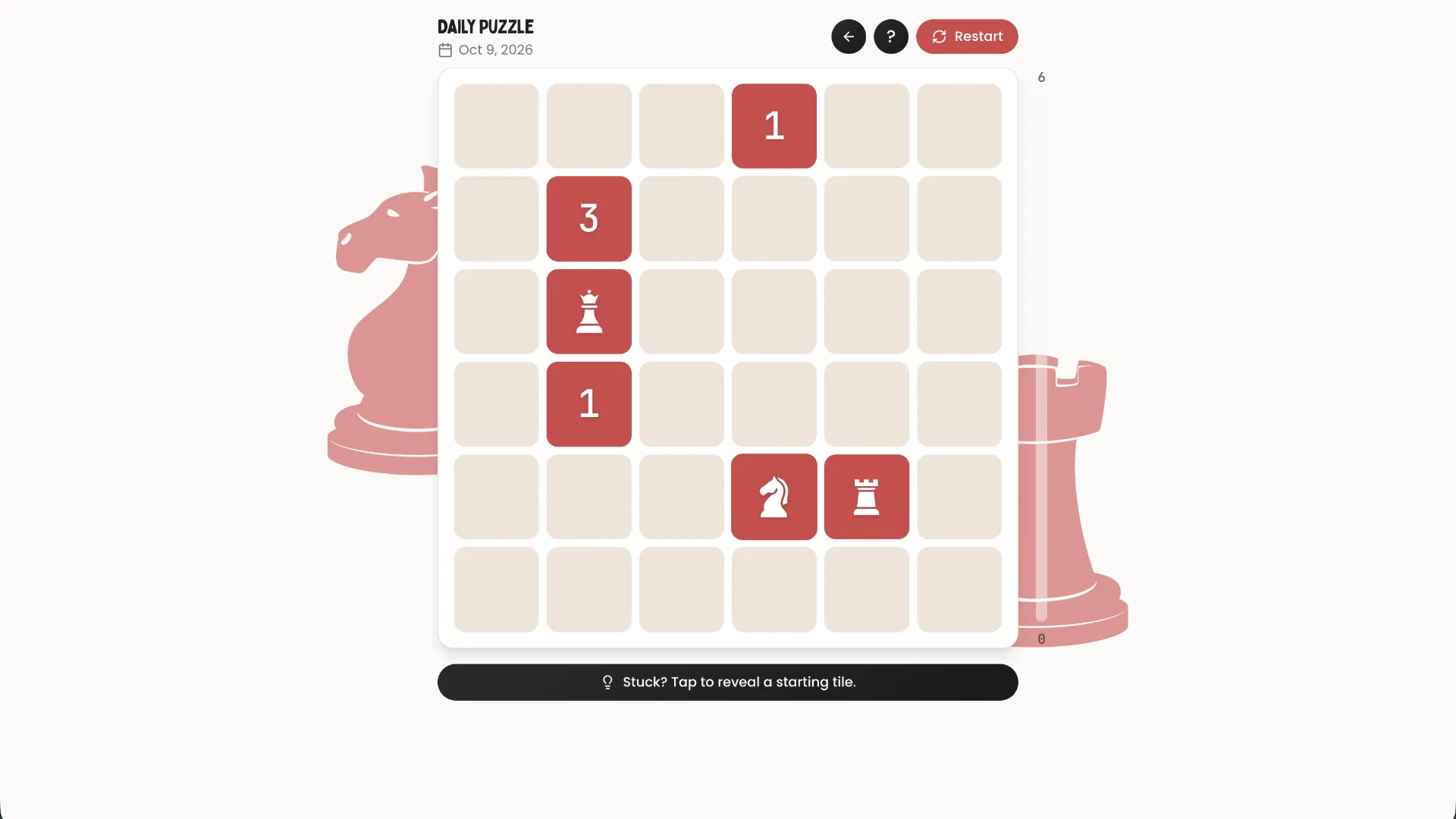
Tile Knight is a free daily logic puzzle that combines chess-inspired movement rules with number-based challenges and pathfinding. Your objective is to remove every occupied tile from a grid by moving between them in a carefully planned sequence, without getting stranded before the board is cleared.
The central mechanic is simple but clever: every tile you select determines how you are allowed to move next. A numbered tile tells you how many spaces to travel, while a chess-piece tile follows the movement rules of the corresponding piece.
For example, selecting a tile marked 2 allows your next move to travel exactly two squares in a straight horizontal, vertical, or diagonal direction. Landing on a knight changes your next move to the familiar L-shaped jump from chess. Landing on a rook changes your next move again.
Each successful move removes the tile you selected from the board. Since removed tiles cannot be visited again, every decision changes the remaining possibilities.
Tile Knight draws inspiration from chess, Sudoku, Nonograms, and other logic puzzles, but it does not require you to know advanced chess strategy. The rules are straightforward, and most puzzles are designed to take anywhere from about 30 seconds to a few minutes.
The game offers three daily difficulty levels—Easy, Medium, and Hard—along with a short interactive tutorial and additional challenges.
Tile Knight Rules: How the Movement System Works
The objective is to clear every occupied tile from the board without landing on a tile that has already been removed or running out of legal moves too early.
The game uses a grid-based board, typically displayed as a 6×6 arrangement of squares. Only certain squares contain active tiles, which may display numbers or chess-piece symbols.
Rule 1: Every Selected Tile Disappears
When you select an occupied tile, it is removed from the board. That tile determines the movement rule for your next selection.
Once removed, a tile cannot be used again. You must build a path that visits every remaining occupied tile exactly once.
Rule 2: Numbered Tiles Control Jump Distance
A tile containing a number allows you to move exactly that many squares in one of eight straight directions: horizontally, vertically, or diagonally.
For example:
- 1: Move one square in any of the eight directions.
- 2: Move exactly two squares horizontally, vertically, or diagonally.
- 3: Move exactly three squares along one of those directions.
The destination must contain a tile that has not already been removed.
Imagine selecting a 2 in the middle of the board. You might be able to reach another occupied tile two squares above, two squares to the right, or two squares diagonally down-left. You cannot select a tile only one square away, even if it appears convenient.
Rule 3: Chess Tiles Use Chess Movement
Some tiles display familiar chess symbols. Their movement patterns determine where you can go next.
| Tile | Movement Rule |
|---|---|
| Knight | Jump in an L shape: two squares along one axis and one perpendicular |
| Rook | Move horizontally or vertically to the first available occupied tile in that direction |
| Bishop | Move diagonally to the first available occupied tile in that direction |
| Queen | Move horizontally, vertically, or diagonally to the first available occupied tile in that direction |
These movement rules are inspired by chess, but the objective is not to capture opponents or deliver checkmate. Every piece symbol is simply a movement instruction for the next step in your route.
Rule 4: Avoid Dead Ends
If your current tile cannot legally reach any remaining occupied tile, your path ends.
If other tiles remain on the board, you have failed to complete the puzzle and need to try a different sequence.
For instance, a tile marked 1 in an isolated corner may have no neighboring occupied squares. Selecting it too early could leave you stuck immediately. However, that same tile might make an excellent final destination because you do not need another move once the board is cleared.
Rule 5: Clear Every Tile to Win
A puzzle is solved only when every occupied tile has been removed through a valid sequence of moves.
Finding a legal move is not enough. Your route must account for the entire board, including pieces that become difficult to reach after neighboring tiles disappear.
How to Play Tile Knight
Tile Knight is played directly in a web browser using simple tile selections.
- Open the game and learn the basics. Visit Tile Knight and try the interactive tutorial, which takes approximately two to three minutes. It introduces numbered tiles, chess movements, and the goal of clearing the board.
- Choose a daily difficulty. Select Easy, Medium, or Hard. Beginners should start with Easy to become familiar with movement rules before attempting more complicated paths.
- Study the board and select a starting tile. Look at the numbered and chess-piece tiles. Choose an occupied tile to remove. Its symbol determines your next legal destinations.
- Follow the changing movement rules. Select a reachable tile, remove it, and apply its movement rule to the next step. Continue planning carefully so that you do not leave isolated tiles behind. If you become stuck, use Restart and try a different route.
- Clear the board and review your result. Complete the puzzle by removing every tile. Your result can include completion time and number of attempts, allowing you to compare your performance with other players.
The daily puzzles are shared across players, so everyone receives the same challenges for a given day. According to the developer, new daily puzzles refresh at midnight Pacific Time.
Example: Planning a Tile Knight Route
Consider a hypothetical board containing seven occupied tiles:
- A Knight tile near the center.
- A 2 positioned one knight's move away.
- A Rook two squares above the 2.
- A 1 along the rook's row.
- A Bishop adjacent to the 1.
- Another 2 along the bishop's diagonal.
- A final 1 that the second 2 can reach.
A successful route might look like this:
Knight → 2 → Rook → 1 → Bishop → 2 → 1
Here is why that route works:
- Start on the Knight, then make an L-shaped jump to the first 2.
- The 2 allows a jump of exactly two squares to the Rook.
- The Rook moves along its row or column to the 1.
- The 1 moves one square to the Bishop.
- The Bishop follows a diagonal to the second 2, which then jumps to the final 1.
This sequence illustrates the game's defining challenge: every destination has its own movement rule, and your route must use those rules in the correct order.
Selecting the wrong tile earlier in the puzzle can make the remaining route impossible, even if that selection was initially legal.
Tile Knight Daily Puzzle Difficulties
Tile Knight offers three daily puzzles of increasing difficulty.
Easy
Easy puzzles are intended to introduce the mechanics and provide manageable challenges. They are particularly useful for learning how numbered jumps interact with chess-piece movement.
Players can practice recognizing legal destinations and avoiding obvious dead ends without needing to analyze lengthy routes.
Medium
Medium puzzles introduce more demanding movement sequences. Players may need to consider several possible routes before choosing their first tile.
Planning becomes more important because a seemingly reasonable move can leave an awkwardly positioned piece unreachable later.
Hard
Hard puzzles provide a greater challenge for players who enjoy deeper pathfinding and logical deduction.
These boards can require more careful planning, including identifying possible endpoints, reasoning backward through movement rules, and rejecting routes that isolate remaining tiles.
Completing a Hard puzzle on the first attempt can be especially satisfying because it rewards working out the route before committing to the initial move.
Tile Knight Strategy Tips
1. Find the Most Isolated Tile First
Before making your first move, look for tiles with very few possible connections.
A tile that can reach almost nothing might need to be the final destination. Another tile may have only one possible predecessor, making its position in the route easier to determine.
Recognizing these constraints early can prevent unnecessary restarts.
2. Work Backward From a Possible Ending
Instead of only asking where you can move next, ask which tile should be removed last.
If a particular 1 has no possible outgoing moves, it may be a strong candidate for the final tile. Next, identify which remaining tiles could legally reach it.
Continue tracing possible predecessors backward. This can reveal a promising route before you make your first selection.
3. Treat Every Tile as a Movement Instruction
A tile's position is only half the puzzle. Its symbol determines what becomes possible immediately afterward.
A knight may offer access to distant tiles, while a 1 could restrict your options to a very small neighborhood. Consider both the destination and its outgoing moves before selecting it.
4. Watch for Rook and Bishop Dependencies
Rooks, bishops, and queens can be useful for connecting distant areas of the board. However, sliding moves are constrained by the first available occupied tile along the chosen line.
As tiles disappear, the first available destination in a direction can change. A route that seems possible on the original board may no longer work after earlier pieces have been removed.
Always evaluate sliding moves against the current board rather than the starting arrangement.
5. Do Not Confuse Numbered Jumps With Knight Moves
A 2 tile does not move like a knight. It moves exactly two squares along a straight horizontal, vertical, or diagonal line.
A knight uses a two-plus-one L-shaped jump.
Remembering this distinction prevents a common source of invalid paths.
6. Plan Before Tapping
Tile Knight rewards logical preparation more than rapid clicking. On harder puzzles, spend time mentally tracing several moves before making your first selection.
A quick start can lead to repeated failed attempts, while identifying a viable chain in advance may allow you to finish in a single attempt.
7. Use the Starting-Tile Hint When Necessary
The game includes a hint prompt for players who are stuck, offering to reveal a possible starting tile.
This can help narrow down the search without requiring you to understand an entire solution immediately. After using a hint, try working out the remaining route independently.
8. Restart and Learn From Dead Ends
If your route becomes impossible, restarting is part of the learning process.
Remember the move that stranded you and try a different branch on your next attempt. You may discover that the correct solution requires clearing a different part of the board first.
Tile Knight Tutorial and Additional Challenges
New players can begin with the interactive tutorial on the homepage. The tutorial explains the essential movement rules through guided examples and is designed to take only a few minutes.
Beyond the three daily puzzles, Tile Knight also includes additional curated challenges intended to help players develop their skills.
The developer has described these challenges as hand-curated, while the daily puzzles are generated through a puzzle-generation algorithm. This distinction gives the challenge puzzles an opportunity to introduce particular movement patterns or teach useful solving techniques.
Players who find Medium or Hard puzzles difficult may benefit from completing easier challenges before returning to the daily boards.
Does Tile Knight Have a Timer and Score?
Tile Knight tracks player performance through information such as completion time and attempts.
Completed results can be shared in a text format that identifies the puzzle date and difficulty, along with the time taken and number of attempts. Shared results have also included percentile comparisons, allowing players to see how their performance compares with other participants.
For example, finishing a puzzle in 40 seconds on the first attempt represents a different performance from solving the same puzzle after several restarts.
However, a slower solution is still a valid success. There is no need to rush through the board if your main goal is to enjoy the reasoning process.
Is Tile Knight Free to Play?
Yes. Tile Knight was launched as a free browser-based puzzle game without advertisements or required purchases.
Players can open the official website and access the tutorial and daily puzzles without installing a separate application.
The game has also been played successfully in mobile browsers, making it convenient for short puzzle sessions on phones as well as desktop computers.
Its quick format is designed for players who enjoy logic challenges but do not necessarily want to spend 20 minutes or more on a full chess game or a difficult Sudoku.
Tile Knight vs. Chess, Sudoku, and Nonograms
Tile Knight takes inspiration from several familiar puzzle genres, but its actual gameplay is quite different.
| Game | Main Objective | Key Difference |
|---|---|---|
| Tile Knight | Remove every tile using movement rules determined by each selected tile | Combines chess movements, numbered jumps, and path planning |
| Chess | Defeat an opponent by checkmate | Two-player strategy with opposing armies and captures |
| Sudoku | Fill a number grid while satisfying row, column, and region constraints | Number-placement deduction rather than movement |
| Nonograms | Reveal a grid pattern from numerical clues | Cell-filling logic rather than route planning |
| Knight's Tour | Move a chess knight through every square exactly once | Uses only knight movement instead of changing rules on each tile |
The closest conceptual comparison is a variation of the Knight's Tour puzzle, where a chess knight must visit every square exactly once.
Tile Knight expands that concept by changing the movement rule after each selection. You are not controlling one knight throughout the entire puzzle; instead, you continually switch between numerical jumps and different chess-piece movements.
This makes it accessible to players who enjoy chess-themed challenges without requiring experience in competitive chess.
Who Should Play Tile Knight?
Tile Knight is particularly well suited to players who enjoy compact logic puzzles with clear rules and satisfying solutions.
It is a good choice for:
- Logic puzzle enthusiasts who enjoy pathfinding, deduction, and finding solutions through careful planning.
- Chess fans who want to apply familiar movement rules in a different kind of puzzle.
- Sudoku and Nonogram players looking for a short alternative to longer grid-based challenges.
- Daily puzzle fans who enjoy returning for new puzzles and sharing results with friends.
- Beginners who want a game with a short tutorial and approachable difficulty levels.
- Competitive puzzle solvers who enjoy improving completion times and reducing failed attempts.
The straightforward controls and short playing time make it easy to fit into a daily routine, while harder boards provide additional depth for experienced players.
Frequently Asked Questions
What is the goal of Tile Knight?
The goal is to remove every occupied tile from the board by following the movement rule of each tile you select. You must finish without becoming trapped while tiles remain.
Is Tile Knight a chess game?
Not exactly. Tile Knight uses chess-piece movement rules, but it is a single-player logic and pathfinding puzzle rather than a traditional chess match.
How many daily puzzles are available?
The game offers three daily puzzles: Easy, Medium, and Hard.
Can numbered tiles move diagonally?
Yes. Numbered tiles allow movement in horizontal, vertical, and diagonal directions. The number specifies the exact distance you must travel.
Can you revisit a tile?
No. Selecting a tile removes it from the board, so it cannot be visited again.
What happens if you run out of moves?
If occupied tiles remain but your current tile cannot reach any of them, your route has failed. You can restart and attempt a different sequence.
Does Tile Knight have hints?
Yes. The game includes an option to reveal a possible starting tile if you are stuck.
Are the daily puzzles the same for everyone?
Yes. The developer has confirmed that players receive the same daily puzzles, allowing them to compare results.
When do new Tile Knight puzzles appear?
According to the developer's launch explanation, the daily puzzles refresh at midnight Pacific Time.
Is Tile Knight suitable for beginners?
Yes. Its interactive tutorial introduces the core rules in approximately two to three minutes, and Easy puzzles provide a manageable starting point.
How long does a Tile Knight puzzle take?
The developer designed puzzles around short sessions, often lasting about 30 seconds to two or three minutes. More difficult boards may take longer, especially when experimenting with multiple routes.
Final Thoughts
Tile Knight turns familiar chess movements into an inventive daily logic puzzle. Its defining twist is that every selected tile changes the rules of your next move, forcing you to think beyond the immediate destination and plan a route through the entire board.
The combination of numbered jumps, chess-piece movement, disappearing tiles, and increasingly challenging puzzles makes it an engaging choice for fans of grid-based reasoning games.
With three daily difficulty levels, a short interactive tutorial, and free browser-based gameplay, Tile Knight offers an approachable way to practice spatial reasoning and problem-solving.
Ready to plan the perfect route? Visit Tile Knight, start with an Easy puzzle, and see whether you can clear the entire board without getting stuck.