What Is Time Machine (MLB)?
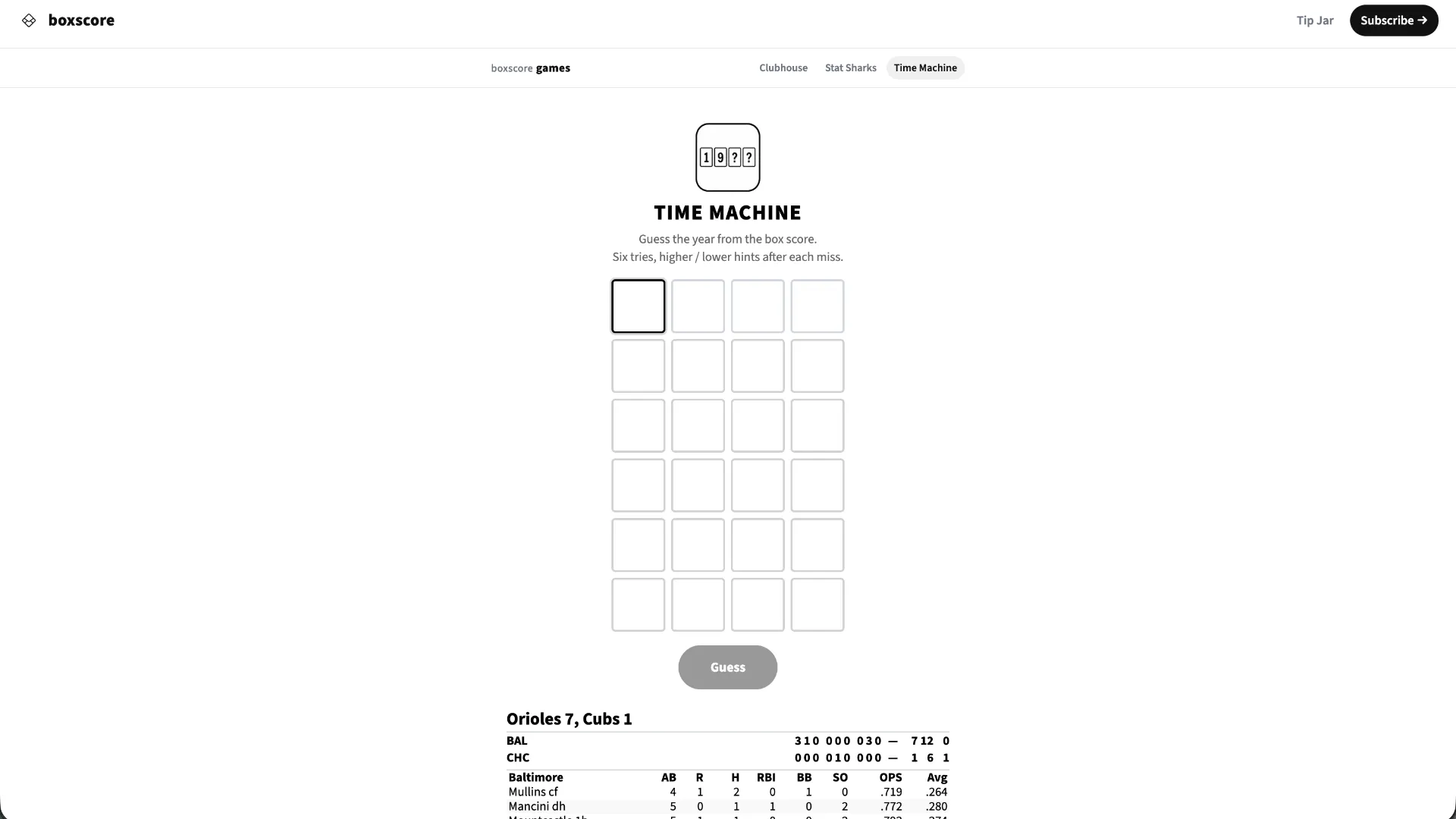
Time Machine is a free daily baseball history guessing game available on boxscore.email. Each puzzle presents an authentic Major League Baseball box score from a past game and challenges you to identify the year in which that game took place.
Instead of answering conventional sports trivia questions or guessing a mystery player, you must examine historical baseball information and determine when the featured matchup occurred.
The box score includes the participating teams, final score, inning-by-inning scoring, player names, batting statistics, pitching performances, and game details. These records contain clues about the period in which the game was played.
You have six attempts to identify the correct year. After each incorrect guess, the game tells you whether the actual year is higher or lower than your prediction.
Time Machine is part of the boxscore games collection, which also includes Clubhouse and Stat Sharks. The collection draws from more than 75 years of Major League Baseball box scores.
The result is a compact daily challenge that combines baseball knowledge, historical deduction, and numerical guessing.
Time Machine MLB Rules
The objective is simple: identify the year of the baseball game shown in the box score.
The main rules are:
- One historical MLB game: Each puzzle features a real Major League Baseball box score.
- Guess the year: Enter a four-digit year representing when you believe the game took place.
- Six attempts: You have a maximum of six guesses to identify the correct year.
- Higher-or-lower feedback: After an incorrect guess, the game indicates whether the actual year is higher or lower.
- Historical clues: Team names, players, batting lines, pitching records, and other game details can help identify the era.
- Exact-year objective: Unlike games that accept approximate answers, the goal is to find the specific year.
- Daily format: Time Machine provides a new baseball history challenge each day.
There is no need to identify the exact calendar date or final score because those details are not the requested answer. You are trying to determine the year in which the featured game occurred.
How to Play Time Machine (MLB)
- Open the daily puzzle: Visit Time Machine on boxscore.email. The page displays a historical MLB box score and a year-guessing interface.
- Study the box score: Examine the two teams, their lineups, notable players, batting statistics, pitching performances, and inning-by-inning scoring. Look for clues that suggest a particular decade or season.
- Enter your first year: Type a four-digit year into the guessing field and submit it using the Guess button.
- Follow the higher-or-lower feedback: If your answer is incorrect, use the directional hint to determine whether the actual season came before or after your guess. Combine this information with the baseball clues to narrow the possibilities.
- Find the exact year: Continue making informed guesses until you identify the correct season or use all six attempts. Return for another daily baseball history challenge.
Example: How the Year Guessing Works
Imagine a hypothetical Time Machine puzzle whose correct answer is 1986.
You examine the box score and believe the game occurred sometime during the 1980s, but you are not certain of the exact year.
Your guesses might progress as follows:
| Attempt | Year Guessed | Feedback | What You Learn |
|---|---|---|---|
| 1 | 1978 | Higher ↑ | The game occurred after 1978. |
| 2 | 1992 | Lower ↓ | The game occurred before 1992. |
| 3 | 1984 | Higher ↑ | The answer is between 1985 and 1991. |
| 4 | 1986 | Correct | You identified the exact year. |
This is an illustrative example, not a real daily puzzle or an actual Time Machine result.
The important mechanic is that every incorrect guess restricts the possible years. If you know the baseball era reasonably well, a combination of statistical clues and higher-or-lower feedback can lead you to the answer before all six attempts are used.
How to Read the Baseball Box Score
Time Machine uses traditional baseball box-score information as the basis of its puzzles. Understanding the information on the page is the most important skill for making an accurate opening guess.
Team Names and Historical Franchises
Start with the teams participating in the game.
Major League Baseball franchises have relocated, changed names, and entered the league at different times. These historical changes can provide useful chronological boundaries.
For example:
- The Brooklyn Dodgers became the Los Angeles Dodgers beginning with the 1958 season.
- The New York Giants became the San Francisco Giants in 1958.
- The Milwaukee Braves moved to Atlanta for the 1966 season.
- The Montreal Expos became the Washington Nationals in 2005.
- The Tampa Bay Devil Rays changed their name to the Tampa Bay Rays in 2008.
If a box score uses an older team name, it can help establish which seasons are plausible.
However, be careful with repeated franchise names. For example, different Washington Senators franchises existed in different periods of MLB history.
Player Names and Career Overlaps
Recognizing players is often more valuable than recognizing the teams.
A famous player's career can help establish a broad era. If several recognizable players appear in the same game, their overlapping seasons may narrow the possible answer considerably.
For example, if two players were teammates for only three seasons, a box score showing both on the same roster gives you a much smaller historical window.
Pay attention to the entire lineup rather than focusing exclusively on the biggest star.
Batting Statistics
The game's batting table provides information such as:
- AB: At-bats.
- R: Runs scored.
- H: Hits.
- RBI: Runs batted in.
- BB: Walks.
- SO: Strikeouts.
- Avg: Batting average.
- OPS: On-base plus slugging percentage.
These statistics help identify the players and their performances. Familiar season-specific batting averages or distinctive player appearances may provide additional clues.
Do not assume that every displayed statistic was widely used when the historical game occurred. Modern box-score presentations can include retrospectively calculated metrics such as OPS.
Pitching Statistics
The pitching section contains another set of potentially useful clues:
- IP: Innings pitched.
- H: Hits allowed.
- R: Runs allowed.
- ER: Earned runs.
- BB: Walks allowed.
- K: Strikeouts recorded.
- HR: Home runs allowed.
- ERA: Earned run average.
Recognizing a starting pitcher, closer, or distinctive pitching combination can help determine when the featured game occurred.
Inning-by-Inning Scoring
The line score shows how many runs each team scored in each inning.
For example, a hypothetical game might look like this:
Team       1 2 3 4 5 6 7 8 9 | R
Yankees    0 1 0 0 2 0 0 1 0 | 4
Red Sox    0 0 1 1 0 0 0 0 0 | 2
The score alone usually does not reveal the season. However, it helps you understand the game, and unusual situations may remind knowledgeable fans of a recognizable historical matchup.
Time Machine MLB Strategy and Tips
1. Identify the Era Before Guessing the Year
Your first objective should be to estimate the decade.
Look at the team names and identify the most recognizable players. If several lineup members are associated with the 1960s, starting with a modern year would waste a valuable attempt.
A reasonable initial estimate can reduce the number of guesses needed to locate the exact season.
2. Find Overlapping Player Careers
A single player might have competed for 15 or 20 seasons, making that name alone a relatively broad clue.
However, multiple players appearing on the same team can provide a much narrower window.
Consider the years when the relevant players were simultaneously active for their displayed franchises. That overlap can be one of the strongest clues available.
3. Use Franchise History Carefully
Historical team names provide clear boundaries in some cases.
A game involving the Montreal Expos, for example, cannot come from the Washington Nationals era after the franchise changed its name.
But franchise information should be combined with other evidence. Teams can retain the same names for decades, and identifying a franchise rarely reveals the exact year by itself.
4. Narrow the Timeline Mathematically
If your first guess is too early and your second guess is too late, you have established an interval containing the correct answer.
For example:
- 1970 produces Higher.
- 1990 produces Lower.
- The answer must be between 1971 and 1989.
A midpoint guess can split the remaining possibilities into smaller ranges.
This binary-search approach is particularly useful when the box score gives you a broad era but not enough information to identify a particular season.
5. Combine Baseball Knowledge With Directional Feedback
Pure mathematical guessing is not always sufficient to guarantee an exact answer in six attempts across many decades.
The strongest approach combines historical clues with higher-or-lower feedback.
If you recognize a player who joined the featured team in 1982 and another who departed in 1987, you may be able to restrict the answer to only a handful of seasons without spending several guesses.
6. Pay Attention to Historical Rule Changes
Certain rule changes can help establish approximate periods.
For example, the American League introduced the designated hitter in 1973, while the National League adopted the universal designated hitter permanently in 2022.
Seeing a pitcher bat in a historical National League lineup may therefore be consistent with a pre-universal-DH game.
However, exceptions and game contexts matter. Rule-related observations are supporting evidence, not automatic proof of the year.
7. Save Your Final Attempts for a Narrow Range
With only six guesses, early random guesses can leave too many possibilities near the end.
Try to establish a reliable historical window before making your first submission. Then use each new result to eliminate as many remaining seasons as possible.
When only a few years remain, inspect the player combinations and season statistics again before choosing your next answer.
Time Machine vs Other MLB Guessing Games
Time Machine belongs to a growing category of daily baseball puzzles that use authentic historical records.
| Game | Objective | Main Skill |
|---|---|---|
| Time Machine (MLB) | Identify the year of a historical box score | Baseball history and chronological deduction |
| MLB Pickle | Identify a mystery MLB player | Player knowledge and attribute comparison |
| Immaculate Grid | Find players matching intersecting criteria | Team history, awards, and career statistics |
| Baseball Wordle | Identify a player using progressive clues | Player identification and deduction |
Time Machine is distinctive because it asks you to identify an entire game's historical setting rather than one individual player.
It rewards familiarity with baseball eras, franchise movements, roster changes, and the careers of both famous and lesser-known players.
Is Time Machine (MLB) Free to Play?
Yes. Time Machine can be played for free directly in a web browser at boxscore.email/games/time-machine.
The page provides the historical box score and the year-guessing interface without requiring a separate game download.
The game is part of the broader boxscore collection of daily baseball puzzles.
Frequently Asked Questions
What is Time Machine (MLB)?
Time Machine is a daily baseball history puzzle in which players examine a real Major League Baseball box score and try to identify the year when the game occurred.
How many guesses do you get in Time Machine?
You have six attempts to guess the correct year.
What happens after a wrong guess?
The game tells you whether the correct year is higher or lower than your submitted year, allowing you to narrow the historical range.
What information does Time Machine show?
The puzzle displays an authentic baseball box score, including teams, player names, batting statistics, pitching performances, inning-by-inning scoring, and additional game information.
Do you need to guess the exact date?
No. The objective is to identify the year in which the featured MLB game took place.
Does Time Machine use real MLB games?
Yes. Its puzzles are based on actual Major League Baseball box scores rather than fictional matchups.
Is there a new Time Machine puzzle every day?
Yes. Time Machine is presented as a daily baseball history guessing game.
Is Time Machine an official MLB game?
Time Machine is hosted by boxscore.email as part of its independent baseball puzzle collection. It should not be confused with the games published through MLB's official MLB Play platform.
Can beginners play Time Machine?
Yes. Although strong historical baseball knowledge can make the game easier, the higher-or-lower feedback provides a way to narrow the answer even when you do not recognize every player.
Players who are less familiar with older seasons may find the game challenging, but it can also introduce them to historic teams and athletes.
Who Should Play Time Machine (MLB)?
Time Machine is particularly appealing to baseball fans who enjoy historical statistics, classic MLB matchups, roster trivia, and daily deduction challenges.
It is a strong fit for players who already enjoy Immaculate Grid or MLB Pickle but want a different type of baseball puzzle.
Rather than recalling just one player's name, you must examine an entire game's context and identify where it belongs on baseball's historical timeline.
That makes the game especially satisfying when an unfamiliar box score suddenly becomes recognizable after noticing a particular player or franchise combination.
Conclusion
Time Machine (MLB) transforms authentic baseball box scores into engaging daily history puzzles. With six attempts, higher-or-lower feedback, and decades of MLB records to explore, every challenge tests your ability to connect players, teams, and statistics to a specific season.
The best strategy is to establish the likely era using historical clues, then narrow the remaining years through logical guesses.
Think you know your baseball history? Play Time Machine (MLB) for free and see whether you can identify today's mystery season before your six guesses run out.