What Is Tradle?
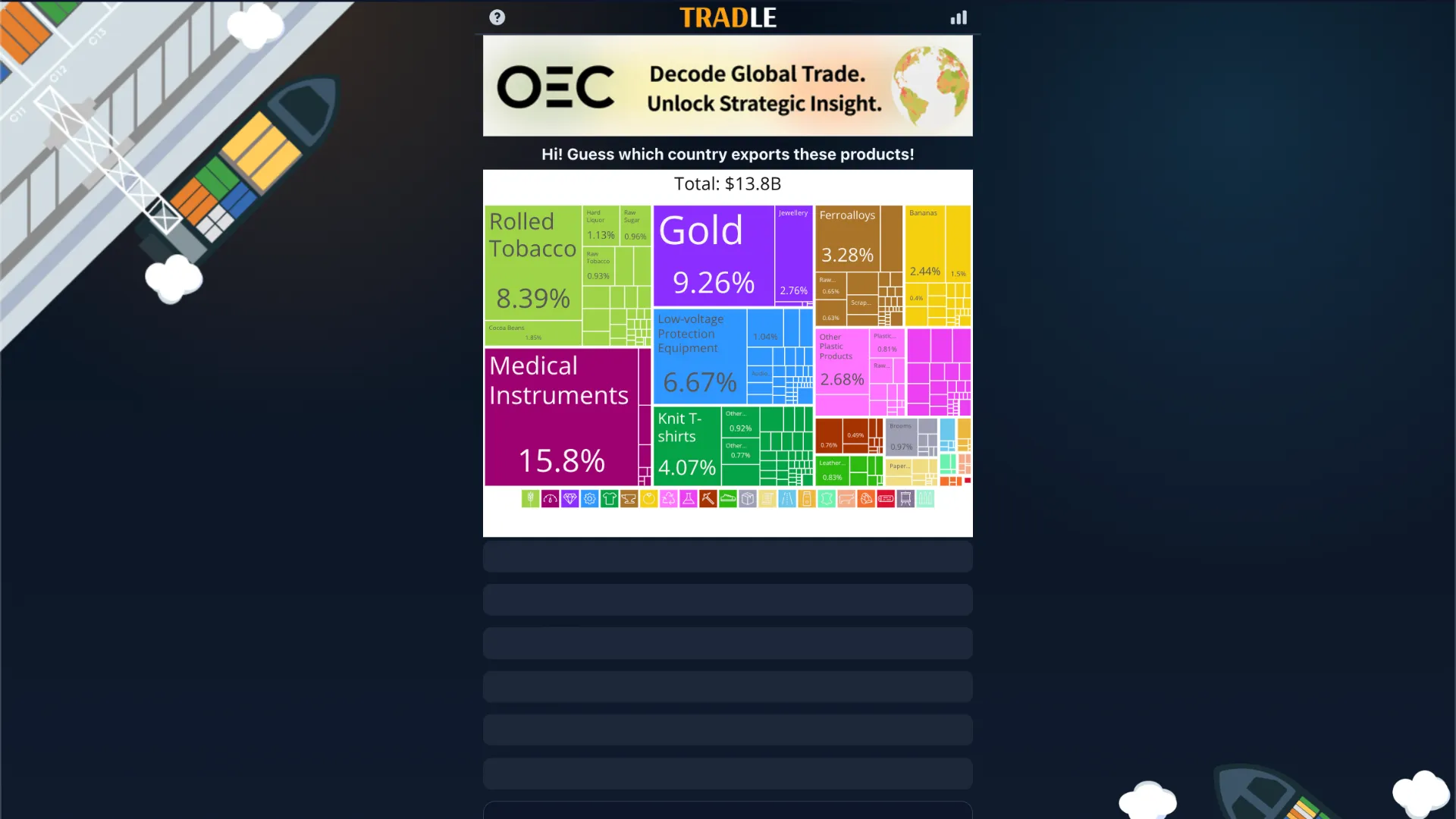
Tradle is a daily country-guessing game created by the Observatory of Economic Complexity (OEC). Instead of showing you a flag, map outline, capital, or landmark, Tradle gives you a colorful treemap of a mystery country's exports and asks you to identify the country in six guesses.
Each rectangle in the treemap represents an exported product. Larger rectangles represent products that account for a larger share of the country's exports, so the chart effectively acts as an economic fingerprint.
A country dominated by crude petroleum will look very different from one whose exports are led by integrated circuits, cars, copper ore, coffee, garments, or pharmaceuticals. Recognizing those patterns is the main challenge.
How Tradle Works
At the start of the puzzle, Tradle displays the mystery country's export treemap without revealing its name. Product labels and their relative sizes provide your initial clues.
You then enter a country or location as your guess. If it is wrong, Tradle gives you geographic feedback that helps narrow the search:
- Distance tells you approximately how far your guessed country is from the answer.
- Direction points toward the target country from your guess.
- Proximity shows how geographically close your guess is to the correct answer.
You have six total guesses to identify the mystery country.
This creates two layers of deduction. The export chart helps you make an informed first guess, while the geographic feedback lets you triangulate the answer if your trade knowledge is not enough.
How to Play Tradle
- Study the export treemap. Start with the largest rectangles and identify the country's most important exports. Look for distinctive products such as crude petroleum, copper, coffee, cars, semiconductors, gold, or textiles.
- Make your first country guess. Choose a country whose economy seems consistent with the export mix shown in the chart.
- Read the geographic feedback. If the guess is incorrect, check the distance, direction arrow, and proximity score. These clues tell you where the mystery country lies relative to your guess.
- Combine trade and geography clues. Narrow the possibilities based on both the export profile and your new location information. If the arrow points southeast and the target is only a few hundred kilometers away, focus on nearby countries in that direction.
- Find the country within six guesses. Continue refining your guesses until you reach the correct location or use all six attempts.
Example of a Tradle Round
Imagine the export chart is dominated by copper ore, followed by refined copper, fruit, fish, and other mineral products.
That combination suggests a country with a major mining industry, so Chile or Peru might immediately come to mind.
Suppose you guess Peru and Tradle reports that the answer is several hundred kilometers to the south. The export profile already suggested a copper-heavy economy, and the geographic clue now makes Chile a much stronger candidate.
Other puzzles can be considerably harder. A chart dominated by petroleum may fit multiple countries, while an export mix containing electronics, machinery, chemicals, and vehicles can require much more careful comparison.
Tradle Strategy Tips
- Start with the largest export. The biggest block often reveals the country's most important economic specialization.
- Look at the combination, not one product. Many countries export petroleum or gold, but the second-, third-, and fourth-largest products can separate them.
- Recognize manufacturing hubs. Large shares of electronics, integrated circuits, machinery, vehicles, and components often point toward highly industrialized export economies.
- Use agricultural clues. Coffee, cocoa, bananas, soybeans, palm oil, tea, wine, and particular seafood products can significantly narrow the region.
- Watch for mineral signatures. Copper, iron ore, diamonds, gold, lithium, nickel, and other resources can reveal countries with distinctive mining sectors.
- Use distance aggressively. Once your first guess is submitted, geography becomes almost as important as economics. Compare the distance and direction with neighboring countries rather than repeatedly guessing countries with similar exports on another continent.
- Save broad guesses for early attempts. A strategically located first guess can provide useful geographic information even when you are uncertain about the export chart.
Reading the Export Treemap
The key to improving at Tradle is learning to read the treemap as a whole. The size of each rectangle reflects how important that product is within the country's exports.
For example, a country where one giant crude-oil block occupies most of the chart is likely heavily dependent on petroleum exports. A chart containing many similarly sized blocks for cars, machinery, pharmaceuticals, chemicals, and electrical equipment suggests a much more diversified industrial economy.
Smaller blocks can also provide surprisingly useful clues. Two countries may both export large quantities of oil, but one might also export petroleum gas while another has significant gold, aluminum, or agricultural exports.
Why Tradle Is Different From Other Geography Games
Most country-guessing games focus on physical geography: outlines, flags, borders, coordinates, or landmarks. Tradle instead tests economic geography.
You learn that countries can have recognizable economic signatures just as they have recognizable shapes and flags. Playing regularly can gradually teach you which economies specialize in energy, mining, agriculture, electronics, vehicles, textiles, chemicals, and other industries.
The distance and direction system also means you do not need to be a trade expert to play. Even a poor first guess provides useful information for the next attempt.
Who Will Enjoy Tradle?
Tradle is a strong choice for players who enjoy Worldle, Globle, geography quizzes, economics, international trade, or data-based deduction games. It is easy to understand but can become surprisingly challenging when the mystery country has an unfamiliar or diversified export economy.
It is also one of the more educational daily geography games because the clues are based on real trade data. A short daily round can expose players to products and industries they may never have associated with a particular country before.