
What Is Verityle?
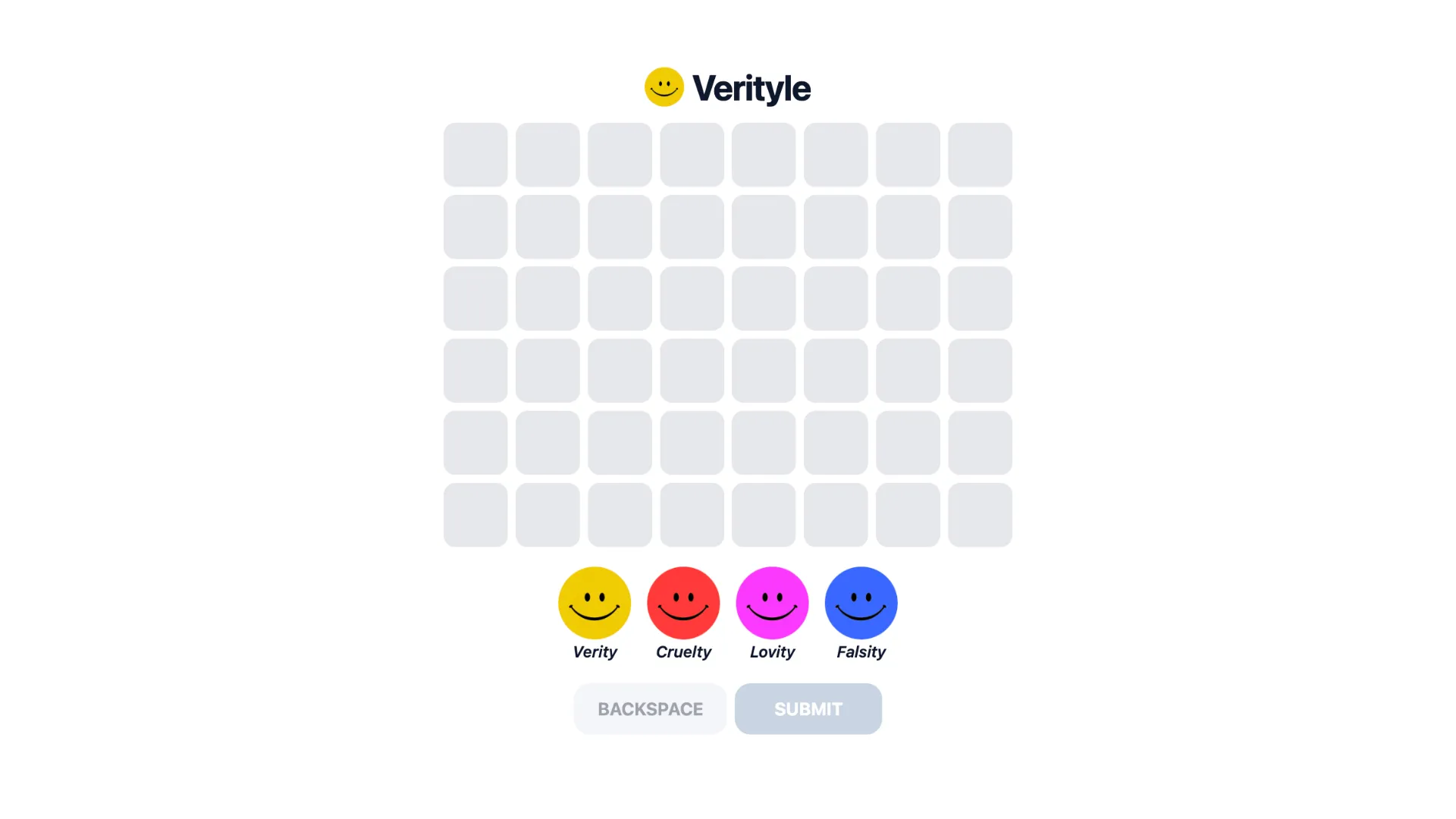
Verityle is a daily browser-based deduction game inspired by Wordle, featuring four characters from the Verity internet fandom: Verity, Cruelty, Lovity, and Falsity.
Instead of guessing a hidden English word, players must discover a secret sequence of eight characters. Every position contains one of the four available Verity variants, and the goal is to identify the exact arrangement within six attempts.
After each guess, the game provides familiar Wordle-style feedback. Green indicates a character in the correct position, yellow means that character belongs somewhere else in the sequence, and gray indicates that the guessed occurrence does not match any remaining occurrence in the answer.
The challenge is surprisingly strategic because characters can appear multiple times. Knowing that a particular variant belongs in the answer is not enough: you also need to determine how many copies are present and where each one belongs.
Verityle is available at verityle.com. Players share daily results using eight-square emoji rows, making it easy to compare solutions without revealing the actual sequence.
Although the game features recognizable internet characters, its primary challenge is logical deduction rather than vocabulary or character trivia.
Verityle Rules and Core Mechanics
Verityle follows a code-breaking format with eight positions, four possible character types, and six guesses.
The basic rules are:
- Eight positions: The hidden answer contains exactly eight character slots.
- Four character types: Choose from Verity, Cruelty, Lovity, and Falsity.
- Repeated characters: The same character type can appear multiple times in the sequence.
- Six attempts: You have up to six guesses to discover the complete arrangement.
- Color-coded feedback: Each submitted guess receives green, yellow, or gray results.
- Exact arrangement required: Every character must occupy the correct position to solve the puzzle.
- Daily challenge: Players can return for another hidden sequence and share their results.
The key difference from regular Wordle is that you are not trying to spell a real word. Any arrangement of the available character types is potentially meaningful, making the game closer to a visual code-breaking puzzle.
Meet the Four Verity Characters
The browser game uses four recognizable variants from the Verity fandom.
| Character | Common Appearance | Role in Verityle |
|---|---|---|
| Verity | Yellow smiling character | One of the four available symbols |
| Cruelty | Red or dark-colored variant | One of the four available symbols |
| Lovity | Pink variant | One of the four available symbols |
| Falsity | Blue variant | One of the four available symbols |
Verity
Verity is the original character associated with the Minecraft horror web series and alternate reality game. The character is known for its yellow smiling appearance and unsettling identity as an apparently helpful AI assistant.
Cruelty
Cruelty is a darker, aggressive variation of Verity, commonly depicted in red or other dark colors. In Verityle, it serves as a distinct character option for constructing the hidden sequence.
Lovity
Lovity is a pink variation of Verity associated with affection and romantic behavior in fan-created content. Its recognizable appearance makes it easy to distinguish from the other variants.
Falsity
Falsity is a blue variation associated with false or misleading information. Like the other characters, it can occupy multiple positions in a Verityle sequence.
These identities provide the game's visual theme. You do not need to understand their fictional personalities to solve the puzzle; you only need to distinguish the four available types.
How to Play Verityle
Verityle is easy to understand if you have played Wordle or another color-feedback guessing game.
- Open the game. Visit Verityle in your browser. Familiarize yourself with the four available character types: Verity, Cruelty, Lovity, and Falsity.
- Create an eight-character guess. Fill the eight positions with your chosen arrangement of characters. You can use a character type more than once because repetitions are possible in the hidden sequence.
- Submit your arrangement. Check your guess against the secret code. The game displays feedback for each of the eight positions using green, yellow, and gray indicators.
- Interpret the clues. Keep track of characters already placed correctly, move misplaced characters to new positions, and reconsider types that received gray feedback. Pay particular attention to repeated characters.
- Solve within six attempts. Continue refining your sequence until all eight positions are correct or your six guesses are exhausted. Afterward, you can share your result using the game's spoiler-free emoji format.
The objective is to turn the feedback from each guess into a progressively more accurate arrangement.
What Do the Colors Mean in Verityle?
Verityle uses the same basic color-feedback concept that made Wordle popular, adapted for a sequence of character icons rather than letters.
Green: Correct Character, Correct Position
A green indicator means that the guessed character matches the hidden character in exactly that position.
For example, if the first position shows green after selecting Verity, then Verity is confirmed as the first character in the answer.
This is the strongest type of clue because it identifies both a character and its exact location.
Yellow: Correct Character, Wrong Position
A yellow indicator means the guessed character belongs in the hidden sequence but not at the position where you placed it.
For example, if Cruelty receives yellow in the third position, at least one matching Cruelty occurrence belongs somewhere else in the answer.
Use this information to test other positions in your next guess.
Gray: No Remaining Matching Occurrence
A gray indicator means that the particular occurrence of the character does not match an available occurrence in the hidden sequence.
This distinction matters when you use the same character multiple times.
For example, suppose the secret answer contains two copies of Falsity, but your guess includes four copies. Once the matching occurrences have been accounted for, extra Falsity selections can receive gray feedback.
Gray therefore does not always mean that the character type is completely absent. It may indicate that you guessed more copies than the answer contains.
Verityle Example: Understanding an Eight-Character Guess
Consider a hypothetical secret arrangement using the following abbreviations:
- V = Verity
- C = Cruelty
- L = Lovity
- F = Falsity
Suppose the secret sequence is:
V – C – L – F – V – C – L – F
You submit the following guess:
V – L – C – F – V – C – L – F
Your feedback would be:
🟩 🟨 🟨 🟩 🟩 🟩 🟩 🟩
Here is how to interpret it:
| Position | Your Guess | Feedback | Meaning |
|---|---|---|---|
| 1 | Verity | Green | Correct character and position |
| 2 | Lovity | Yellow | Lovity belongs elsewhere |
| 3 | Cruelty | Yellow | Cruelty belongs elsewhere |
| 4 | Falsity | Green | Correct character and position |
| 5 | Verity | Green | Correct character and position |
| 6 | Cruelty | Green | Correct character and position |
| 7 | Lovity | Green | Correct character and position |
| 8 | Falsity | Green | Correct character and position |
The solution is nearly complete. Only positions two and three are incorrect, and their yellow clues indicate that swapping them would solve the puzzle.
This is a hypothetical example for explaining the mechanics, not an actual daily answer.
Real puzzles can be considerably more difficult when your early guesses contain fewer green positions or when repeated characters create uncertainty about the correct quantities.
Verityle Strategy Tips
1. Test All Four Character Types Early
Your first guess should ideally provide useful information about the four available characters.
Because there are eight positions and only four types, you can experiment with repeated pairs rather than filling every position with the same character.
A varied opening guess may reveal more about which characters appear in the solution and where they could belong.
2. Preserve Green Positions
Once a character receives green feedback, you know that its position is correct.
Keep that character in the same position for subsequent guesses while focusing on unresolved slots.
Moving a confirmed character unnecessarily wastes information gained from an earlier attempt.
3. Reposition Yellow Characters
Yellow feedback confirms that a character is useful but misplaced.
Do not repeat the same yellow character in the same position unless you have a specific reason to test the sequence differently.
Instead, identify which unresolved positions are compatible with the character and use future guesses to narrow the possibilities.
4. Count Repeated Characters Carefully
With only four available types and eight positions, repetition is unavoidable.
Pay attention to how many times each character receives green, yellow, and gray feedback.
If three copies of Verity appear in a guess but only two receive matching feedback, that can help establish an upper bound on the number of Verity occurrences in the answer.
Tracking quantities is especially useful when multiple arrangements fit the same known positions.
5. Do Not Treat Every Gray as a Complete Exclusion
A gray character can sometimes represent an extra occurrence rather than a character type absent from the answer.
For instance, you could receive both green and gray results for Verity in the same guess if you selected more copies than the hidden sequence contains.
Use the complete row of feedback rather than interpreting each gray square independently.
6. Separate Character Counts From Positions
There are two problems to solve: how many of each character appear, and where those characters belong.
You may discover the correct quantities before finding their exact arrangement.
Once you have strong evidence about the character counts, concentrate on rearranging the remaining uncertain positions instead of introducing unnecessary variations.
7. Compare Multiple Guesses
Every completed row contains information that remains useful later.
Look for patterns across guesses, such as a character turning green after being moved to another position or extra occurrences receiving gray feedback.
Combining several rows is more reliable than interpreting only your most recent guess.
8. Use the Final Attempts for Precise Deduction
When you have only one or two guesses remaining, avoid changing too many uncertain positions without a reason.
Try to eliminate arrangements inconsistent with earlier feedback and choose the sequence supported by the greatest number of clues.
The goal is not to guess randomly but to make the most informative use of your remaining attempts.
Is Verityle a Daily Game?
Yes. Verityle has a daily-puzzle format, with players sharing dated results from the same browser game.
Shared results use the familiar Wordle-style notation showing how many attempts were required out of six.
For example, a result might appear as:
Verityle 3/6
🟨🟩⬛🟨🟩⬛🟨🟩
🟩🟩🟨🟩🟩🟨🟩🟩
🟩🟩🟩🟩🟩🟩🟩🟩
This illustrative result means the player solved the eight-character sequence on their third attempt.
The colored squares communicate how the guesses progressed without revealing which characters occupied the positions.
A new daily sequence provides another opportunity to test your deduction skills and compare results with other players.
The exact reset time zone is not clearly documented in the available public descriptions.
Is Verityle a Word Game?
Despite its similarity to Wordle, Verityle is better described as a visual code-breaking or logic game.
The hidden answer is not an English word, and you do not need to know vocabulary definitions or spelling patterns.
Instead, the game uses four character types as symbols in an eight-position secret code.
Its mechanics resemble Mastermind, the classic deduction game in which players discover a hidden arrangement by interpreting feedback from earlier attempts.
| Game | Hidden Answer | Main Challenge |
|---|---|---|
| Verityle | Eight positions containing four Verity character types | Determine the correct character sequence in six guesses |
| Wordle | Five-letter English word | Identify letters and positions using color feedback |
| Mastermind | Hidden sequence of colored pegs | Deduce the correct symbols and their arrangement |
| Nerdle | Mathematical equation | Identify digits and operators in the correct positions |
Verityle combines Mastermind-style deduction with Wordle's positional feedback and shareable daily results.
The character theme makes it particularly recognizable to players familiar with the Verity fandom, but the game can be understood without knowing the characters' backstories.
Where Do the Verity Characters Come From?
The original Verity character emerged from a Minecraft horror alternate reality game and web series created by YouTuber ThatMob in 2026.
Verity appears as a smiling yellow AI assistant that presents itself as helpful before the story develops a more unsettling tone.
As the character gained popularity, fans created additional color-coded variants with different personalities.
Among the best-known are Falsity, Cruelty, and Lovity, the same three variants that appear alongside the original Verity in this game.
The characters subsequently became popular subjects for fan animations, short videos, Minecraft-related content, Roblox experiences, and online memes.
Verityle uses this recognizable four-character lineup as the basis for a guessing puzzle. The browser game should not be confused with separate Roblox experiences built around the same characters or similar code-breaking mechanics.
For background on the characters, see Verity Variants on Know Your Meme.
Is Verityle Free to Play?
Verityle is accessible through its official browser website at verityle.com.
Players can open the game without installing a dedicated application. Its core format is a short daily guessing challenge featuring eight positions and six attempts.
The browser version is separate from Roblox games with similar names and character themes.
Public information about additional modes, account features, and optional purchases is limited, so players should consult the current game interface for those details.
Who Should Play Verityle?
Verityle is particularly appealing to players who enjoy short deduction puzzles with a recognizable internet-culture theme.
It is a good choice for:
- Wordle fans who enjoy colored feedback and limited-attempt challenges.
- Mastermind enthusiasts who like breaking secret codes through logical deduction.
- Verity fans who recognize the original character and its popular variants.
- Daily puzzle players looking for another quick challenge to add to their routine.
- Logic game enthusiasts who enjoy tracking repeated symbols and eliminating impossible arrangements.
- Casual players who prefer visual pattern puzzles over conventional vocabulary questions.
The straightforward rules make the game accessible, but working out eight positions from only four character types can become surprisingly challenging when repetitions are involved.
Frequently Asked Questions
What is the goal of Verityle?
Discover the exact eight-character secret sequence using Verity, Cruelty, Lovity, and Falsity within six guesses.
How many guesses do you get?
You have six attempts to identify the complete sequence.
How many positions are in a Verityle puzzle?
Each hidden sequence contains eight positions.
Which characters can appear?
The four available character types are Verity, Cruelty, Lovity, and Falsity.
Can the same character appear multiple times?
Yes. The hidden sequence can contain repeated characters, making it important to consider both the number of occurrences and their positions.
What does green mean?
Green means you selected the correct character in the correct position.
What does yellow mean?
Yellow means that the character appears in the hidden sequence but belongs in a different position.
What does gray mean?
Gray indicates that the guessed occurrence does not correspond to any remaining matching occurrence in the answer. This may mean the character is absent or that you selected too many copies of it.
Is Verityle the same as Wordle?
No. Verityle borrows Wordle-style feedback but replaces English words with eight-position sequences of Verity character icons.
Is Verityle a vocabulary game?
No. It is primarily a logic and pattern-deduction puzzle. Players do not need to spell English words to solve it.
Is there a new Verityle puzzle every day?
Yes. Verityle follows a daily challenge format, and players share their results with a date and attempt count.
Can you share your results?
Yes. Players share spoiler-free emoji grids showing the green, yellow, and gray feedback from each attempt.
Do you need to know the Verity storyline?
No. Familiarity with the characters adds to the theme, but gameplay only requires distinguishing the four character types and interpreting feedback.
Is Verityle a Roblox game?
The game described here is the browser-based version hosted at verityle.com. Separate Roblox experiences also use the Verity characters and similar deduction mechanics.
Conclusion
Verityle puts a playful internet-culture twist on the familiar Wordle formula. Instead of solving an English word, players must arrange eight appearances of Verity, Cruelty, Lovity, and Falsity into the correct secret sequence.
The limited set of four character types makes the game easy to understand, but repeated characters introduce an interesting layer of logic. Every green, yellow, and gray result becomes a clue about both position and quantity.
With six attempts per daily challenge and easily shareable results, Verityle offers a compact code-breaking experience for fans of Wordle, Mastermind, and the Verity characters.
Ready to crack the secret sequence? Visit Verityle, arrange the four character types, and see whether you can solve today's eight-position puzzle in six guesses or fewer.