Densha Game Guide: How to Navigate the Surreal Train Adventure
Learn how Densha works, solve its surreal train puzzles, avoid common roadblocks, and decide whether this short free adventure is worth playing.
Quick Answer
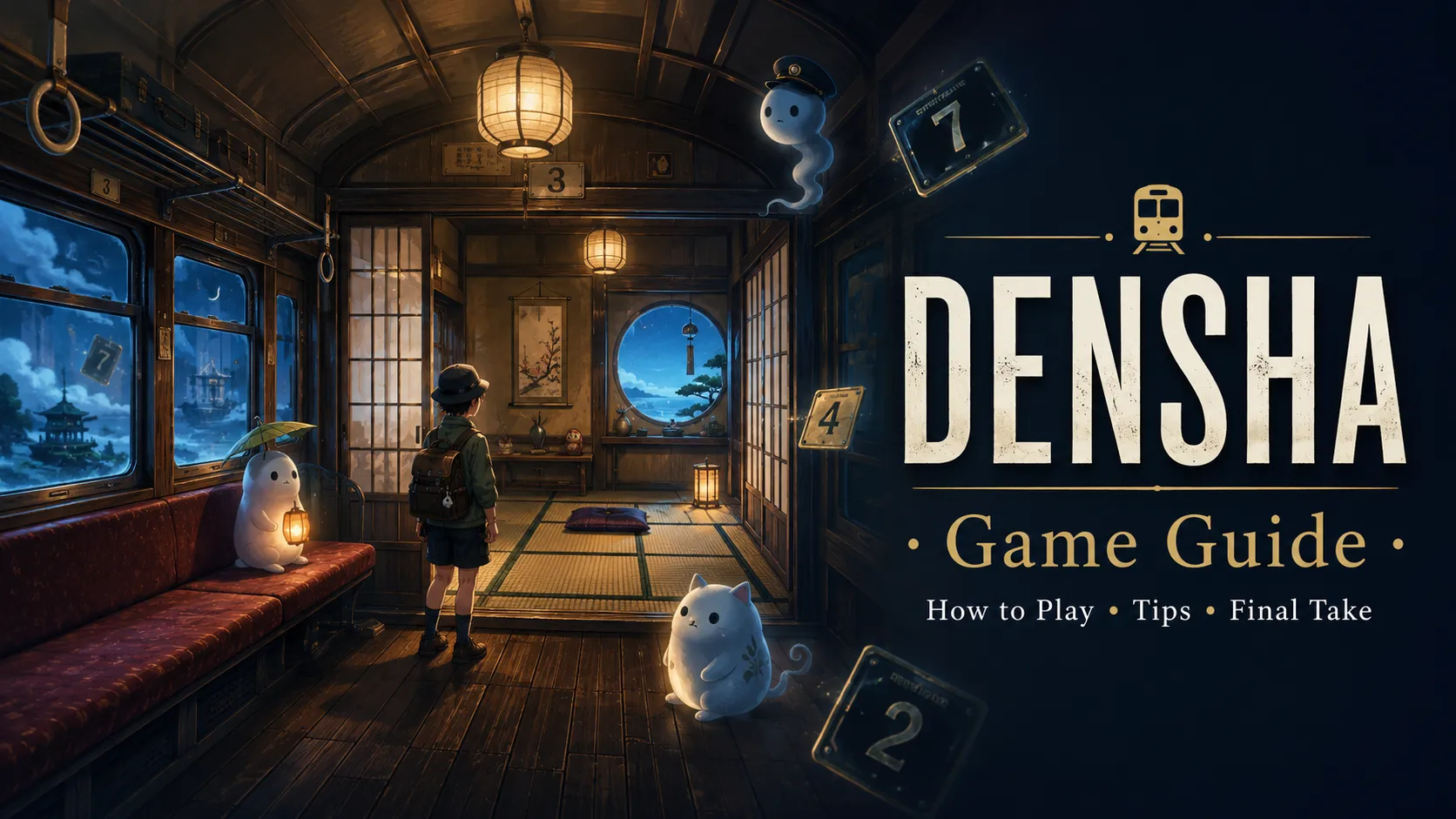
Densha is a short, free exploration adventure set aboard a mysterious train. It is not a train-driving simulator like Densha de Go! Instead, you explore unusual passenger cars, speak with strange spirits, collect objects and manipulate numbered signs to reach new areas.
The complete game takes roughly one hour, has one ending, contains no game-over state and is considered relatively easy. Its challenge comes from recognizing how rooms, items and train-car numbers connect rather than from combat or quick reflexes. ([小麦畑][1])
What Is It?
Densha, meaning “train,” is a freeware Japanese adventure created by Field of the Wheat using WOLF RPG Editor.
The story follows a boy traveling into the countryside with his father. After waking up, he finds himself inside a strange tatami room that somehow appears to be part of the train. Guided by mononoke-like inhabitants, he begins exploring spaces that feel both unfamiliar and nostalgic. ([小麦畑][1])
The basic gameplay loop is:
- Explore each train car and inspect unusual objects.
- Talk to every character, sometimes from different positions.
- Collect tools and seemingly unrelated items.
- Use objects in other cars to reveal new clues or equipment.
- Rotate, flip or replace numbered plates to change where a doorway leads.
- Backtrack through earlier rooms once you understand a new connection.
There is no combat, leveling system or score. Progress is entirely based on observation and environmental puzzle-solving.
How To Play
Explore Every Part of Each Car
Walk through every accessible area and interact with furniture, signs, plants, doors and characters. Important objects are not always visually dramatic, so checking ordinary scenery matters.
Some cars have separate upper and lower paths. A character may only respond when approached from a specific side, making positioning part of the puzzle.
Understand the Numbered Plates
Number plates are Densha’s central mechanic. Changing a plate can alter the identity of a train car or send you into a different space.
A plate may be:
- Turned to display another number.
- Flipped to create a different arrangement.
- Removed and carried elsewhere.
- Replaced with another plate found during exploration.
Do not assume the cars form a normal numerical sequence. The train follows dreamlike rules, and the same doorway may lead somewhere completely different after its plate changes.
Match Items With Environmental Clues
Most objects have one intended purpose, but their uses are rarely explained directly. A tool collected in one car may solve a problem several rooms away.
Typical interactions include:
- Placing an object near an environmental hazard.
- Using a container to collect a material.
- Repairing a broken mechanism.
- Cutting plants to uncover something hidden.
- Completing a decorative object with a missing piece.
- Placing flowers or valuables in the correct location.
When an item appears useless, keep it in mind and continue exploring. Densha often introduces an object before showing the problem it solves.
Revisit Earlier Cars
Progress is deliberately interconnected. Completing one task may change another room, unlock a character interaction or provide an item for a previously unsolved obstacle.
After obtaining a new tool, mentally review earlier locations and ask:
- Was something too high to reach?
- Was a container missing a piece?
- Did an object appear blocked or damaged?
- Was there vegetation that could be removed?
- Did a character request something specific?
Tips
- Write down car numbers. Keeping a small list of each plate and its possible orientations prevents unnecessary wandering.
- Track unfinished interactions. Note locked doors, incomplete decorations, blocked objects and characters waiting for an item.
- Try approaching characters from both routes. Position can determine whether a conversation or exchange becomes available.
- Do not discard strange items mentally. Even objects such as flowers, kitchen equipment or decorative pieces contribute to the progression chain.
- Pay attention to background changes. A successful action may affect another object rather than immediately opening a path.
- Carry useful movable objects forward. Certain puzzles require transporting equipment between train cars.
- Save before experimenting with complicated plate arrangements. There is no game-over state, but restoring a save can reduce repetitive backtracking.
- Extract the game before launching it. Running it directly from the downloaded ZIP can prevent saves from being retained properly. ([vgperson][2])
Final Puzzle Hint
The last puzzle uses Japanese language and visual wordplay. The English distribution includes supporting image files intended to clarify the required arrangement.
Before searching for a full walkthrough:
- Collect every removable plate available near the end of the game.
- Examine how the symbols can be rotated or flipped.
- Check the included sayonara.png reference image.
- Arrange the symbols so they form the intended farewell phrase.
This puzzle is less about difficult deduction and more about understanding a language-specific visual transformation. Consulting the included reference is part of the intended experience for players who do not read Japanese. ([vgperson][2])
Difficulty and Length
Densha’s official description lists the difficulty as low, with an estimated playtime of approximately one hour. It has one ending and no traditional failure condition. ([小麦畑][1])
Most players are likely to finish in 45 to 90 minutes, depending on how quickly they understand the numbered-car mechanic. The most common difficulties are:
- Remembering which cars contain unfinished puzzles.
- Discovering that a character must be approached from another path.
- Working out where to carry a movable object.
- Recognizing how flipped numbers create new destinations.
- Interpreting the Japanese-focused final puzzle.
The game is approachable without a walkthrough, although taking notes significantly improves the experience.
What Makes Densha Stand Out?
Densha uses the structure of an item-based adventure game, but its train is not a realistic physical location. Each carriage functions like a fragment of memory, shifting between domestic rooms, natural spaces and abstract transitional areas.
The unusual number-plate system gives the small map more depth than its size suggests. Instead of unlocking a long sequence of new rooms, players repeatedly reinterpret familiar spaces and discover that their connections are not fixed.
Its atmosphere is also notably gentle. The mysterious characters and empty train can initially resemble an RPG Maker horror game, but the official description specifically identifies it as an exploration adventure without horror elements. ([小麦畑][1])
Who Is It For?
Densha is worth trying if you enjoy:
- Short, story-focused indie adventures.
- Surreal Japanese settings.
- Environmental puzzles and item chains.
- Games that reward note-taking and observation.
- Dreamlike experiences such as Ib, Yume Nikki or other compact RPG Maker-style adventures.
It may not be a good fit if you want:
- Train driving or railway simulation.
- Combat, action or character progression.
- Multiple endings and major replay value.
- A long narrative with extensive dialogue.
- Puzzles that are completely independent of Japanese cultural context.
Final Take
Densha is a compact and memorable puzzle adventure that turns a train into a shifting network of rooms, symbols and half-remembered places. Its mechanics are simple, but the way numbered plates reshape the route gives the exploration a distinctive identity.
The adventure is brief and offers little reason for an immediate second playthrough, yet its focused design prevents it from overstaying its welcome. Players who enjoy atmospheric freeware games, surreal locations and interconnected item puzzles should find its one-hour journey worthwhile.