
What Is All/Some?
All/Some is a free daily browser-based logic puzzle game that challenges players to understand how different categories relate to one another. Instead of guessing hidden words or solving number grids, you examine groups of familiar terms and select the diagram that accurately represents their relationships.
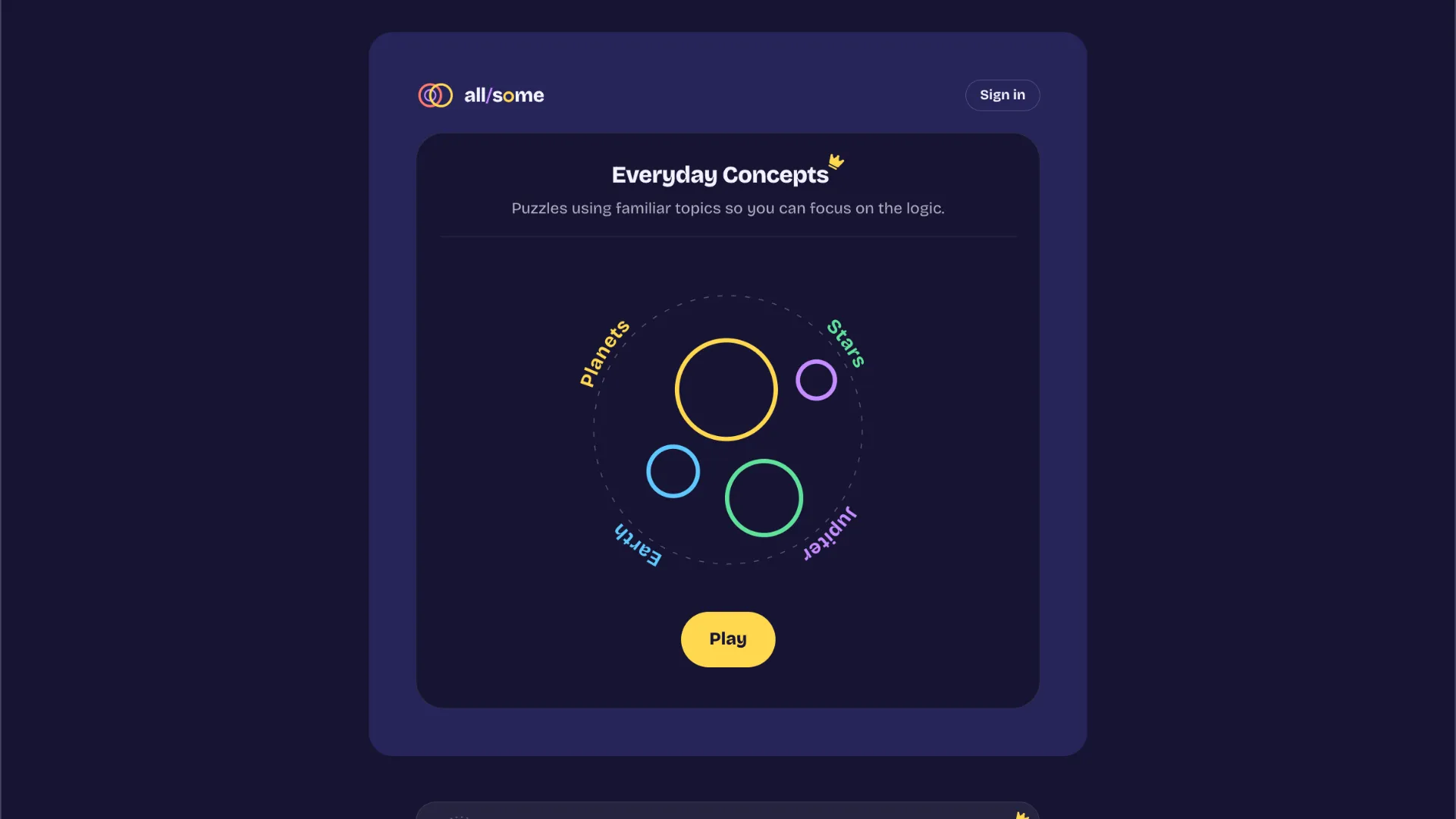
The game is built around Euler diagrams, a visual way of representing sets. Circles can sit inside other circles, overlap partially, or remain completely separate. Your task is to determine which arrangement accurately describes the categories presented.
All/Some offers three new puzzles each day. The first two focus on relatively familiar concepts, allowing players to concentrate on logical reasoning. The third introduces more specialized knowledge, potentially involving science, history, literature, or other subjects.
The daily challenge is free, requires no download, and can be played without registering an account. Optional membership unlocks additional puzzles and themed collections.
How Does All/Some Work?
Every puzzle begins with a small collection of terms representing different categories. You must work out how those categories relate and choose the correct diagram from four possible answers.
As you progress, another category is added, making the diagram more complicated. Each new choice must accurately represent the relationships among all the categories shown.
There are three fundamental relationships to understand:
- All: One category is completely contained within another. For example, all cats are mammals, so the circle representing Cats belongs entirely inside the Mammals circle.
- Some: Two categories share members, but neither is entirely contained within the other. For example, some pets are dogs, but not every pet is a dog, and not every dog is a pet.
- None: Two categories share no members. For example, no cats are dogs, so their circles remain separate.
The challenge comes from combining these relationships into a single accurate diagram.
Unlike a traditional Venn diagram, which displays every theoretically possible intersection, an Euler diagram shows the relationships that actually apply. This distinction is central to the game's design.
A Simple All/Some Example
Imagine a puzzle featuring these three categories:
Animals · Mammals · Cats
Their logical relationships are:
- Every cat is a mammal.
- Every mammal is an animal.
- Not every animal is a mammal.
- Not every mammal is a cat.
The correct diagram would contain three nested circles, with Cats inside Mammals and Mammals inside Animals.
Now imagine adding a fourth category: Dogs.
Dogs also belong inside Mammals and Animals, but the Dogs and Cats circles must remain separate because no individual animal is simultaneously classified as both a cat and a dog.
The correct diagram now requires two separate smaller circles inside the larger Mammals circle, which itself sits inside Animals.
This is an illustrative example of the game's reasoning mechanic, not a solution to a specific daily puzzle.
How to Play All/Some
All/Some is easy to begin playing, even if you have never encountered Euler diagrams before.
- Open the daily challenge. Visit All/Some in your browser and select Play to begin. The free daily challenge contains three puzzles.
- Read the categories carefully. Study the first terms and determine whether one category contains the other, whether they overlap, or whether they are completely separate.
- Choose the matching diagram. Examine the four diagram options and select the one that accurately represents the relationships.
- Add the next category. As the puzzle advances, another term appears. Consider how it relates to every existing category, then select the correct updated diagram. If you choose incorrectly, the game provides an explanation or counterexample and lets you try again.
- Complete the daily set. Continue until you finish the puzzle, then attempt the remaining daily challenges. Return the following day for a fresh set.
The game focuses on reasoning rather than complicated controls. Most of the challenge comes from understanding the categories and checking whether a proposed relationship is universally correct.
Three Daily Puzzles With Different Challenges
All/Some provides three puzzles in its free daily challenge, creating a short but varied experience.
The first two puzzles generally use everyday concepts. They introduce relationships that players can evaluate using common knowledge, making them accessible even without a background in formal logic.
The third puzzle raises the knowledge requirement by exploring more specialized subjects. One day might involve scientific classifications, while another might involve historical figures or literary concepts.
This structure helps the game balance accessibility with variety. Players can practice diagram reasoning on familiar concepts before confronting categories that demand more careful consideration.
The daily format also makes All/Some suitable for quick sessions rather than lengthy puzzle marathons.
Tips for Solving All/Some Puzzles
1. Start With the Most Certain Relationships
Look for categories where the relationship is obvious. If every member of one group belongs to another, establish that containment before considering the remaining categories.
For example, Squares must fit inside Rectangles because every square is a rectangle, while not every rectangle is a square.
2. Do Not Confuse Similarity With Overlap
Two categories can share characteristics without sharing members.
Cats and dogs are both mammals, but that does not mean their circles should overlap. Their shared membership in the broader Mammals category is different from sharing individual members with each other.
Always ask whether something can genuinely belong to both categories simultaneously.
3. Look for Counterexamples
When deciding whether one category belongs entirely inside another, try to identify an exception.
For example, the claim that all birds can fly is false because penguins and ostriches are birds that cannot fly.
Finding even one valid counterexample is enough to reject a proposed universal relationship.
4. Consider Every Category When a New One Appears
A diagram can represent several correct relationships while still being wrong overall.
When another term is introduced, check its relationship with every category already on the screen. Do not select an option merely because one pair of circles looks correct.
5. Learn From Incorrect Answers
All/Some explains incorrect selections with counterexamples, turning mistakes into opportunities to improve your reasoning.
Pay particular attention to whether an error involved full containment, partial overlap, or complete separation. Recognizing these distinctions will make future puzzles easier to analyze.
What Makes All/Some Different?
All/Some takes a different approach from most daily browser puzzles. Rather than testing spelling, arithmetic speed, or the ability to remember obscure facts, it asks players to visualize logical relationships.
Its distinguishing features include:
- Diagram-based gameplay: Answers are visual arrangements of categories rather than typed words or numerical guesses.
- Progressive complexity: Each step introduces another category, requiring players to reconsider the relationships within a growing diagram.
- Meaningful feedback: Incorrect answers receive explanations that help clarify the underlying logic.
- Three daily challenges: Players receive multiple puzzles rather than a single short question.
- Changing subjects: Familiar everyday categories are mixed with more specialized topics.
- Accessible free play: The daily challenge is available directly in a browser without requiring a paid membership.
The result is a game that combines the approachable format of a daily puzzle with the reasoning involved in classification and set theory.
Is All/Some Free?
Yes. All/Some offers a free daily challenge containing three puzzles, with no mandatory signup.
An optional paid membership provides access to additional content, including themed collections and archived puzzles. Collections cover subjects such as everyday concepts, biology, astronomy, history, and mathematics.
Players who only want a short daily logic challenge can enjoy the free version. Those who prefer longer sessions can explore the additional collections available through membership.
The game also tracks progress and streaks. Anonymous progress is associated with the current browser or device, while signing in allows progress to be retained across devices.
Who Should Play All/Some?
All/Some is especially appealing to players who enjoy deduction puzzles, visual reasoning, classification challenges, and games that reward careful thinking.
It is a strong choice for anyone looking for something different from Wordle-style guessing games. The rules are approachable, but correctly organizing several overlapping categories can require considerable thought.
Players who enjoy puzzles involving logic, sets, and identifying exceptions will find the format particularly interesting.
Those who prefer fast action or unlimited free levels may find the daily format less suitable. However, the short challenge makes it easy to incorporate into a regular puzzle routine.
Conclusion
All/Some turns an everyday question—how do these things relate?—into a surprisingly engaging visual logic challenge.
By selecting Euler diagrams, checking category relationships, and learning from counterexamples, players practice careful reasoning across three daily puzzles.
With free browser access, fresh challenges, and progressively more complex diagrams, All/Some offers a distinctive alternative to traditional word and trivia games.
Ready to test your logic? Play All/Some and see whether you can solve today's three diagram puzzles.