
What Is ASSEMBDLE?
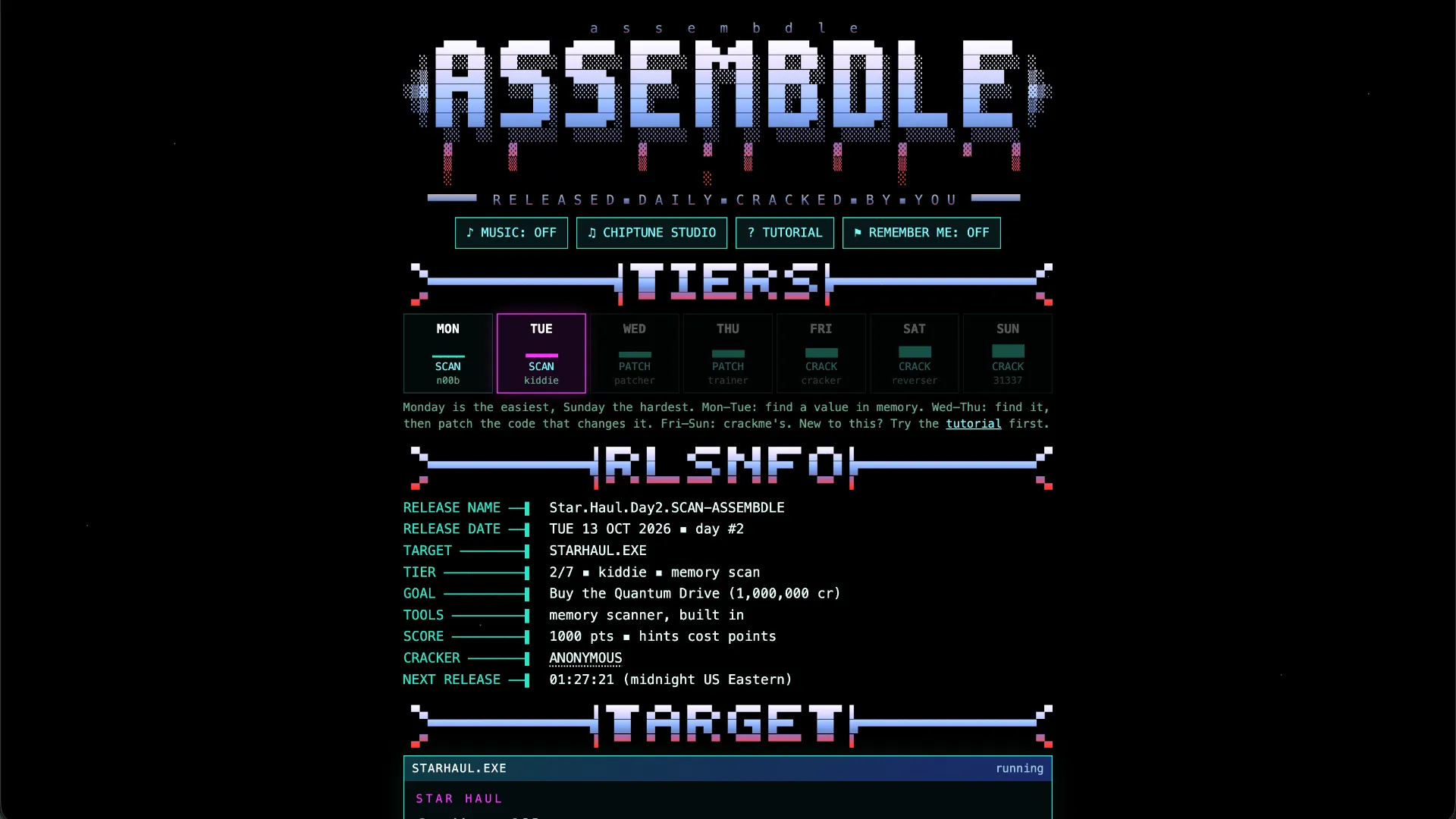
ASSEMBDLE is a daily game-hacking puzzle. Each day you get a tiny program to hack: scan memory to find and change a value, patch a line of assembly, or crack a serial check. The puzzles get harder from Monday to Sunday. Your answer is run on a small simulated CPU, so any solution that works counts. There are hints, a step-by-step beginner mode for people who've never seen assembly, streaks, and a spoiler-free share line. Free, no account, no ads.
Unlike traditional daily guessing games, ASSEMBDLE challenges players to understand and manipulate how a small computer program works. Instead of guessing a hidden word or arranging puzzle tiles, you investigate a fictional game's memory, modify its behavior, or change the instructions controlling its decisions.
The experience draws inspiration from classic game trainers, reverse engineering, assembly programming, and old-school software cracking culture. Its interface features retro ASCII art, fictional executable files, hacker-style release names, and optional chiptune music.
Despite its technical theme, ASSEMBDLE is designed to welcome complete beginners. Built-in tools handle the simulated environment, while tutorials explain the concepts behind each challenge.
Play the game directly at assembdle.com. Everything needed for the puzzles is provided within the experience, so there is no need to download a debugger, install an assembler, or modify any real software.
How Does ASSEMBDLE Work?
Every day, ASSEMBDLE presents a small simulated program with a specific objective. The player must change its behavior by investigating memory, editing instructions, or defeating a programmed check.
The central mechanic is understanding how a program reaches a particular outcome and finding a way to change that outcome.
For example, a fictional arcade game might show that you have too few tickets to buy an expensive prize. Instead of spending hours earning tickets, you can use the game's built-in memory scanner to locate the stored ticket value and modify it.
Later puzzles introduce programs that automatically restore modified values, forcing you to investigate and patch the assembly instructions responsible for those changes.
More difficult challenges involve serial-number verification and software checks, where players must understand or alter the logic determining whether an input is accepted.
The game uses a simulated CPU to execute solutions. Rather than checking whether you typed one predetermined answer, it evaluates whether your modifications actually accomplish the objective. Different working solutions can therefore be valid.
ASSEMBDLE Daily Difficulty Schedule
ASSEMBDLE follows a seven-day progression, starting with introductory memory editing and ending with more advanced cracking challenges.
| Day | Challenge | Difficulty | Main Skill |
|---|---|---|---|
| Monday | SCAN | 1/7 | Find and modify a value in memory |
| Tuesday | SCAN | 2/7 | Narrow down a less obvious memory value |
| Wednesday | PATCH | 3/7 | Locate and patch the instructions changing a value |
| Thursday | PATCH | 4/7 | Solve a more involved assembly patching puzzle |
| Friday | CRACK | 5/7 | Modify a program's serial-checking logic |
| Saturday | CRACK | 6/7 | Work through more complex cracking and serial puzzles |
| Sunday | CRACK | 7/7 | Solve the week's hardest reverse-engineering challenge |
Monday and Tuesday emphasize memory scanning. Wednesday and Thursday add debugging and assembly patching. Friday through Sunday focus on crackme-style challenges involving verification logic and serial checks.
This schedule makes the beginning of the week particularly welcoming to new players, while experienced programmers and puzzle solvers can look forward to more demanding challenges toward the weekend.
How to Play ASSEMBDLE
Follow these steps to get started with your first puzzle:
- Open today's challenge. Visit assembdle.com and read the daily release information. Check the target executable, difficulty tier, available tools, and objective before making any changes.
- Investigate the simulated program. Examine the fictional game or application. For a memory-scanning challenge, look for a value such as tickets, money, or another game resource. Use the built-in scanner to search for the value stored in memory.
- Find a way to change the outcome. Depending on the day, edit the discovered memory value, inspect the instructions that write to its address, or investigate a serial verification routine. More advanced puzzles require modifying assembly instructions instead of simply changing numbers.
- Test your solution. Run or interact with the modified program to check whether your approach achieves the stated objective. The game's simulated execution determines whether your solution works. If it fails, inspect the behavior and adjust your approach.
- Complete the challenge and share your result. Once the objective is satisfied, review your result and progress. Use the spoiler-free sharing feature to compare your achievement with friends without revealing the solution.
If you have never encountered assembly language or memory scanning, start with the built-in tutorial rather than trying to solve an advanced daily puzzle immediately.
Example: Hacking a Fictional Arcade Game
One of ASSEMBDLE's introductory scenarios involves a simulated arcade game where the player needs enough tickets to purchase an extremely expensive prize.
The objective in the Monday tutorial is to buy the Giant Plush Robot, which costs 1,000,000 tickets.
Consider this simplified illustration of the puzzle concept:
TARGET: ARCADE.EXE

CURRENT TICKETS: 120
PRIZE COST:     1,000,000

OBJECTIVE:
Buy the Giant Plush Robot

TOOLS:
Memory Scanner
The numbers shown above are illustrative rather than a reproduction of a particular live puzzle state.
A possible approach is to identify the ticket value displayed by the arcade game, search the simulated memory for that value, and inspect the results. Once the correct memory address is identified, the player can attempt to replace the stored value with enough tickets to afford the prize.
For a simple memory-editing puzzle, successfully changing the appropriate value may be enough to complete the objective.
However, finding the right address is not always straightforward. Multiple memory locations may contain the same number, and later challenges introduce values that are not immediately discoverable through the most obvious scan.
This is what makes ASSEMBDLE different from a conventional coding quiz: the player must discover which part of the simulated program matters and demonstrate a working solution.
Understanding Memory Scanning
Memory scanning is the first major skill introduced in ASSEMBDLE.
A running program stores information in memory, including resources such as money, health, tickets, or inventory values. A memory scanner searches for candidate locations containing specified data.
In an introductory puzzle, the target value might be visible directly on the screen. A player can search for that number and inspect the candidate memory addresses.
More challenging situations require narrowing down the possibilities by observing how a value changes when the simulated program runs.
The important distinction is that finding a matching number does not automatically mean finding the correct variable. Players must understand what they are changing and verify that the modification affects the intended game mechanic.
ASSEMBDLE provides the scanner within its own browser-based environment, allowing players to explore this idea without using external software.
Understanding Assembly Patching
Wednesday and Thursday introduce another concept: changing the instructions that control a program.
Some simulated programs actively update or restore memory values. In these situations, directly editing a value may not produce a lasting result.
ASSEMBDLE's patching tutorial demonstrates this through a fictional dungeon game. The player must obtain enough gold to buy the Crown of Kings, but the program monitors its own memory and can undo direct modifications.
The solution involves investigating what writes to the relevant memory address.
After identifying an address with the scanner, players can use the debugger's Find out what writes to this address function to locate the routine responsible for updating it. The game's interface then allows the player to edit an assembly instruction.
As a conceptual example, imagine a routine that repeatedly resets a fictional player's currency:
; Illustrative pseudocode, not exact game syntax

currency = 100

; Desired outcome:
; Prevent the unwanted reset
; or change how currency is updated
The goal is not necessarily to reproduce one exact patch. Players need to create a modification that makes the simulated program satisfy the challenge's success condition.
This mechanic introduces the relationship between stored data and executable instructions, making ASSEMBDLE both a logic puzzle and an approachable introduction to low-level programming concepts.
Understanding Serial Cracking Challenges
Friday through Sunday introduce crackme-style puzzles centered on software verification.
A crackme is a small program intentionally designed to challenge someone to understand or modify its validation behavior.
ASSEMBDLE includes scenarios involving serial-number checks. In its introductory crackme tutorial, the player is challenged to modify a fictional executable so that it accepts an incorrect serial number.
Rather than guessing thousands of possible codes, players investigate the checking routine and look for a way to change the program's decision.
A simplified version of the underlying idea is:
; Conceptual verification logic

IF serial_is_valid:
    ACCEPT
ELSE:
    REJECT
The puzzle is to understand which instructions govern that decision and determine how the simulated program can be made to reach the required outcome.
This is deliberately different from conventional password-guessing games. The player is reasoning about the program itself, not simply trying random inputs until one happens to work.
Beginner Mode, Tutorials, and Hints
ASSEMBDLE includes several features that make its technical puzzles more accessible.
Step-by-Step Beginner Mode
The TOTAL BEGINNER? Walk me through it option provides guided assistance for players unfamiliar with assembly language, debugging, or memory editing.
Instead of assuming previous programming knowledge, the walkthrough helps players work through a challenge one step at a time.
Using the guided walkthrough on a scored daily puzzle makes that run unscored, allowing beginners to concentrate on understanding the mechanics rather than maximizing points.
Four Practice Tutorials
The ASSEMBDLE tutorial includes practice challenges covering four areas:
- SCAN: Learn to search and edit simulated memory values.
- PATCH: Learn to identify and change assembly instructions that modify memory.
- CRACK: Explore how a verification routine can be patched to accept an otherwise invalid serial.
- KEYGEN: Practice reasoning about serial-validation behavior.
These tutorial puzzles are unscored and can be repeated. Their hints and guided walkthroughs are available without sacrificing daily puzzle points.
Hints and Scoring
Daily challenges provide optional hints for players who get stuck.
On scored puzzles, requesting hints reduces the available score. For example, the site's introductory daily scoring display shows a 1,000-point starting score with three hints costing 60, 90, and 150 points respectively.
This creates a useful choice: solve independently for a stronger result, or spend points to learn something new and keep progressing.
The central objective remains completing the simulated program challenge successfully, not memorizing a predetermined answer.
Tips and Strategies for ASSEMBDLE
1. Read the Objective Before Using Tools
Every puzzle tells you what must happen for the challenge to count as solved. Focus on that success condition rather than making unrelated changes to the simulated program.
For example, if the objective is to purchase an expensive item, simply displaying a large currency balance may not be sufficient. The simulated purchase still needs to succeed.
2. Start With the Memory Scanner
On scanning days, identify which displayed value or program behavior relates to the objective. Search for relevant memory values and consider how they might change during execution.
3. Distinguish Data From Instructions
Changing a stored number and modifying the code that writes that number are different approaches. If a value immediately resets after editing, investigate the routine responsible for modifying it.
4. Inspect Verification Logic on Crackme Days
When faced with an invalid serial, consider how the program determines whether the input is accepted. Understanding the decision path may be more productive than guessing candidate serial numbers.
5. Experiment With Alternative Solutions
ASSEMBDLE executes the modified program to evaluate whether the objective has been reached. This means that a working approach can succeed even if it differs from another player's solution.
Experimentation is especially rewarding when multiple changes could plausibly produce the required behavior.
6. Use the Tutorial Before Spending Points
If the concepts are unfamiliar, repeat the relevant practice puzzle first. Tutorials offer free hints and guided assistance, while hints on scored daily challenges can reduce your score.
7. Build Confidence Throughout the Week
Monday's memory-scanning challenge is a good entry point. As the week progresses, apply what you have learned to assembly patching and eventually serial-cracking puzzles.
Daily Streaks and Spoiler-Free Sharing
Like other daily browser puzzles, ASSEMBDLE encourages repeat play through streak tracking and shareable results.
The weekly progression adds variety because the type of challenge changes as the days advance. Completing an introductory memory scan on Monday feels different from solving a difficult serial-check puzzle on Sunday.
After finishing a puzzle, players can share a spoiler-free result line without exposing the specific modifications or solution.
This makes ASSEMBDLE suitable for informal daily competitions among programmers, security enthusiasts, puzzle fans, and friends who enjoy technical challenges.
The website also includes an optional Remember Me setting for retaining identity-related preferences. An account is not required to play.
Is ASSEMBDLE Free to Play?
Yes. ASSEMBDLE is free to play directly in a web browser, with no account required, no advertisements, and no external hacking tools to install.
The site provides its own simulated programs, memory scanner, debugger, and assembly-editing tools. JavaScript must be enabled for the interactive puzzles to run.
The website also states that it does not use advertising trackers and does not set cookies unless the optional Remember Me feature is enabled.
Its retro visual design and optional chiptune soundtrack add to the atmosphere without changing the puzzle mechanics.
Who Should Play ASSEMBDLE?
ASSEMBDLE is especially appealing to several types of players:
- Logic puzzle fans: Enjoy investigating systems, identifying cause and effect, and discovering creative solutions.
- Programming beginners: Learn introductory concepts involving memory, instructions, and program execution through guided puzzles.
- Developers: Apply programming knowledge to short, unusual challenges outside conventional coding exercises.
- Reverse-engineering enthusiasts: Explore simulated debugging, assembly patching, and validation logic in a purpose-built puzzle environment.
- Daily game players: Return for a new technical challenge each day, track streaks, and share spoiler-free results.
- Retro computing fans: Appreciate the ASCII interface, executable-themed puzzles, release-group references, and chiptune aesthetic.
Players do not need to be experienced programmers to begin, although later puzzles become more demanding and reward familiarity with low-level computing concepts.
Unlike traditional Wordle-style guessing games, ASSEMBDLE is not about finding a hidden word. It is about figuring out how a tiny simulated system works and changing its behavior to achieve a goal.
Frequently Asked Questions
What is ASSEMBDLE?
ASSEMBDLE is a free daily game-hacking logic puzzle where players manipulate simulated programs through memory scanning, assembly patching, and serial-check cracking.
Is there a new ASSEMBDLE puzzle every day?
Yes. The game follows a daily schedule with difficulty increasing from Monday to Sunday. Different days emphasize scanning, patching, or cracking.
Do I need to know assembly language?
No. The game includes a step-by-step beginner mode and four practice tutorials designed to teach the core mechanics. Previous programming knowledge becomes more useful on advanced puzzle days.
Is ASSEMBDLE a real hacking tool?
No. It is a game built around fictional programs and a controlled simulated execution environment. The provided scanner and debugger operate as part of the puzzle experience.
What happens if I use hints?
Hints can help you understand a challenge, but they cost points during scored daily runs. Tutorial hints are free, and guided beginner assistance is available without scoring the daily attempt.
Can different solutions work?
Yes. ASSEMBDLE evaluates whether your modified program achieves the objective, rather than requiring one fixed answer. Any modification that satisfies the simulated challenge can count.
Does ASSEMBDLE have practice puzzles?
Yes. Its tutorial section provides four repeatable, unscored practice challenges covering memory scanning, assembly patching, serial checks, and keygen-style reasoning.
Does ASSEMBDLE require registration?
No. The game can be played for free without creating an account.
Can I play ASSEMBDLE without installing software?
Yes. The game runs in the browser with JavaScript enabled, and its memory scanning and debugging interfaces are built in.
What is the hardest day in ASSEMBDLE?
Sunday is the hardest day in the weekly difficulty progression, rated 7 out of 7. It focuses on advanced crackme-style challenges.
Conclusion
ASSEMBDLE brings a creative twist to daily browser puzzles by turning memory editing, assembly programming, and software verification into interactive challenges.
Its biggest strength is the combination of genuine technical problem-solving and approachable puzzle design. Beginners can follow guided tutorials, while experienced players can experiment with different solutions and attempt increasingly demanding challenges throughout the week.
With daily puzzles, a clear difficulty progression, built-in tools, optional hints, streaks, and spoiler-free sharing, ASSEMBDLE offers something distinctive for players who enjoy understanding how systems work.
Play ASSEMBDLE for free and see whether you can crack today's simulated program.