What is Anthropeum?
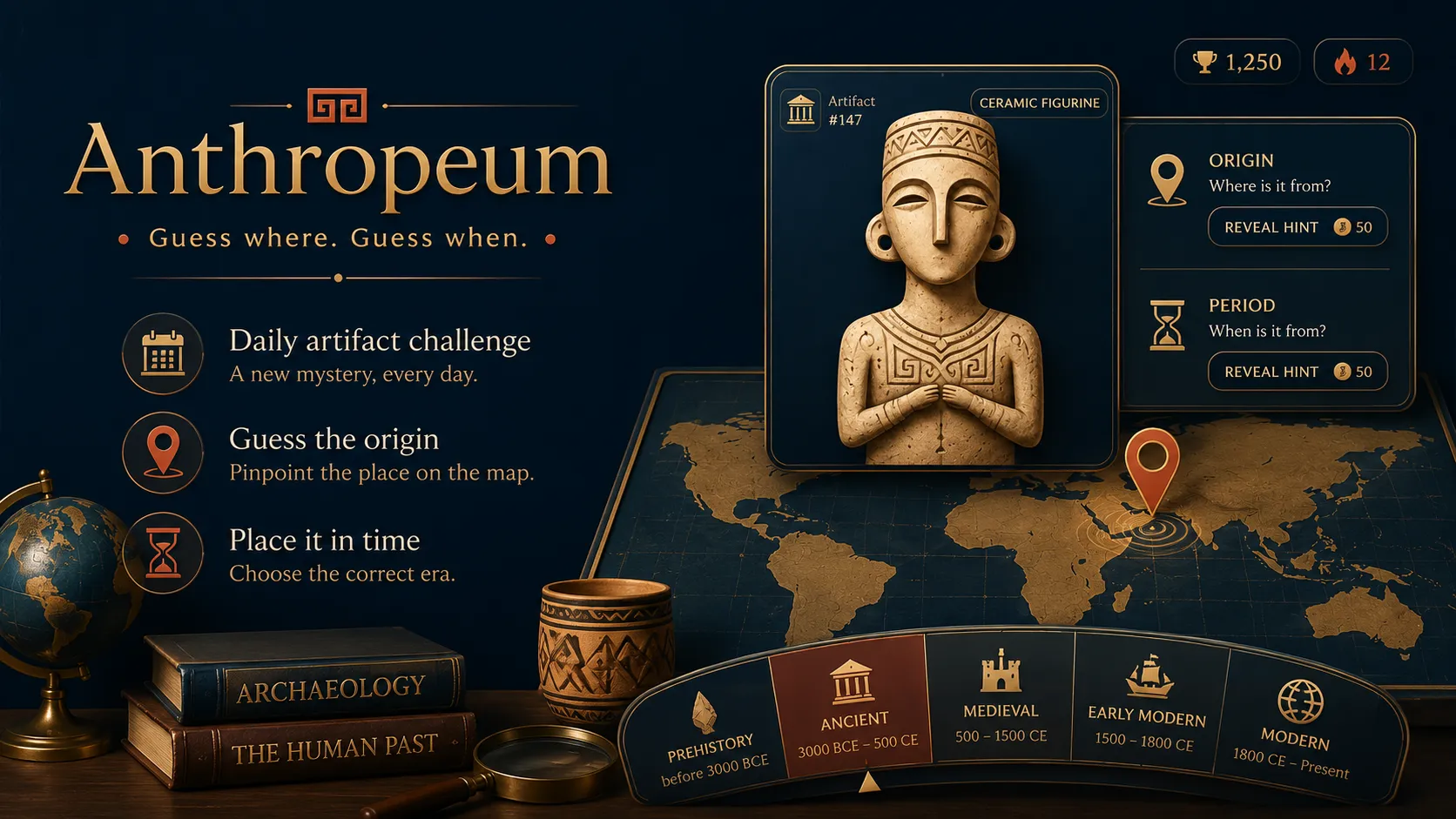
Anthropeum places a mysterious human-made object in front of you and strips away the two facts that matter most: where did it come from, and when was it created? Study its shape, material, decoration, and craftsmanship, then place it somewhere on the world map and somewhere inside thousands of years of history.
Each daily game contains ten museum artifacts. Your geographical and chronological accuracy both contribute to the score, and after the final round you can see how your performance compares with everyone else who played that day.
Anthropeum Game Rules (The Catch / The Trap)
Every round follows the same archaeological investigation:
ARTIFACT → INSPECT DETAILS → PIN LOCATION → CHOOSE ERA → REVEAL
- Ten artifacts per daily game: Complete all ten rounds to receive your final score.
- Study the object: Examine its images, material, form, patterns, and any factual details provided.
- Guess the location: Drop a pin where you believe the artifact was made.
- Guess the time: Select the historical period that best matches its creation date.
- Use optional hints: When an object leaves you completely lost, available clues can narrow its geographical region or historical era.
- Submit both answers: Once submitted, the round is LOCKED IN.
- See the truth: Anthropeum reveals the correct place, date range, and additional information about the object.
- Score by proximity: A nearby map pin and a close time estimate earn more points than a guess from the wrong continent or millennium.
- Compare at the end: Your ten-round score is placed against the distribution of other players' results for the day.
The trap is that familiar-looking styles can appear in completely different cultures. A carved figure may look Egyptian but come from Central America; a geometric vessel may seem ancient while actually belonging to a much later tradition. Anthropeum punishes confident stereotypes and rewards careful observation.
How To Play Anthropeum?
Step 1: Inspect the artifact
Object shown: A ceramic vessel shaped like a feline, decorated with strong geometric forms.
Visible clues:
Material: Ceramic
Form: Animal-shaped vessel
Style: Bold geometric decoration
You suspect an Indigenous culture from the Americas, but the continent is still a large battlefield.
Step 2: Make the geographical guess
Player action: Place a map pin near the central Andes in Peru.
Your pin: Central Peru 📍
The object's shape and painted decoration feel more Andean than Mediterranean or East Asian.
Step 3: Choose the historical period
Player selects: 500–1000 CE
You are not certain of the exact century, but the craftsmanship suggests a developed pre-Columbian culture rather than a modern reproduction.
Step 4: Submit and read the reveal
Result:
Origin: Peru
Period: 600–900 CE
Location guess: Close
Time guess: Overlapping range
What this means: Both halves of the deduction were strong, so the round earns a high score. The revealed information now teaches you what similar artifacts may look like in future games.
Step 5: Survive all ten objects
The next artifact could be a bronze figure, woven textile, carved fragment, ceremonial mask, or painted vessel from another part of the world.
Round 1 ✓ → Round 2 → ... → Round 10 → Final rank
After the tenth reveal, Anthropeum totals your points and shows where you ranked among the day's players.
Anthropeum Strategy & Tips
Start with material and production method. Porcelain, bronze casting, carved ivory, woven fibers, and glazed ceramics developed differently across regions and periods. These clues are often more reliable than the object's general appearance.
Separate geography from chronology. You may recognize an artifact as West African without knowing whether it belongs to 500 CE or 1500 CE. Secure the part you understand, then use the remaining evidence to estimate the other dimension.
Study motifs without treating them as guarantees. Animals, spirals, human figures, and geometric borders appear across many cultures. Combine the decoration with material, function, and manufacturing quality before committing to a map pin.
Use hints when they can prevent a catastrophic miss. Narrowing an unknown object to a broad region or millennium can save far more points than making a blind guess from the opposite side of the world.
Finally, treat every reveal as training. Anthropeum is not only about winning today's puzzle; each corrected origin and date becomes another visual reference for tomorrow's expedition.