
What Is AtlasGenie?
AtlasGenie is a free browser-based geography quiz game that challenges players to recognize countries, identify capital cities, match official languages, and distinguish country outlines. Its main attraction is a daily geography challenge featuring 10 questions shared by every player.
Each question has four possible answers and a 15-second timer. Correct answers earn points, with additional rewards for answering quickly. After every question, a country fact card reveals useful information, making the game both an entertaining daily challenge and an opportunity to learn more about world geography.
Beyond the daily quiz, AtlasGenie offers dedicated games for flags, capitals, languages, country shapes, and mixed geography knowledge. A separate Pin Drop mode challenges players to locate countries and capitals on an interactive 3D globe.
The game covers 195 countries, offers regional challenges across Africa, the Americas, Asia, Europe, and Oceania, and includes two difficulty settings for regular quizzes.
AtlasGenie can be played directly at atlasgenie.world without installing software or creating an account. The daily challenge is free, with additional regular games available under a daily allowance.
How Does AtlasGenie Work?
AtlasGenie combines several types of geography questions into a fast-paced multiple-choice challenge.
The daily game presents 10 questions drawn from four subjects: flags, capital cities, official languages, and country shapes.
The questions are shuffled, so you must switch between different types of geographical knowledge throughout the game.
Flag Recognition
Some questions display a national flag and ask you to identify its country. Others name a country and challenge you to select the correct flag from four possibilities.
For example, you might see a flag featuring three vertical stripes of blue, yellow, and red.
Depending on the exact colors, the answer could be Romania or Chad. These two countries have extremely similar flags, making them a useful example of the visual details players must learn to recognize.
Flags retain their real proportions, so distinctive shapes such as Nepal's nonrectangular flag provide additional clues.
Capital City Questions
Capital questions test whether you can connect countries with their capitals in either direction.
For example:
What is the capital of Australia?
- A. Sydney
- B. Melbourne
- C. Canberra
- D. Perth
Correct answer: C. Canberra.
The challenge comes from avoiding familiar but incorrect answers. Sydney and Melbourne are major Australian cities, but Canberra is the national capital.
Other questions may name a capital and ask you to identify its country.
Official Language Questions
Language questions ask players to match countries with their officially recognized languages.
For example:
Which country has Amharic as an official language?
The correct answer is Ethiopia.
Some countries recognize several official languages, making these questions more challenging than they initially appear.
Switzerland, for example, recognizes German, French, Italian, and Romansh as national languages, with particular distinctions in their official administrative use.
The game focuses on officially recognized languages rather than assuming that the most widely spoken language must be an official one.
Country Shape Recognition
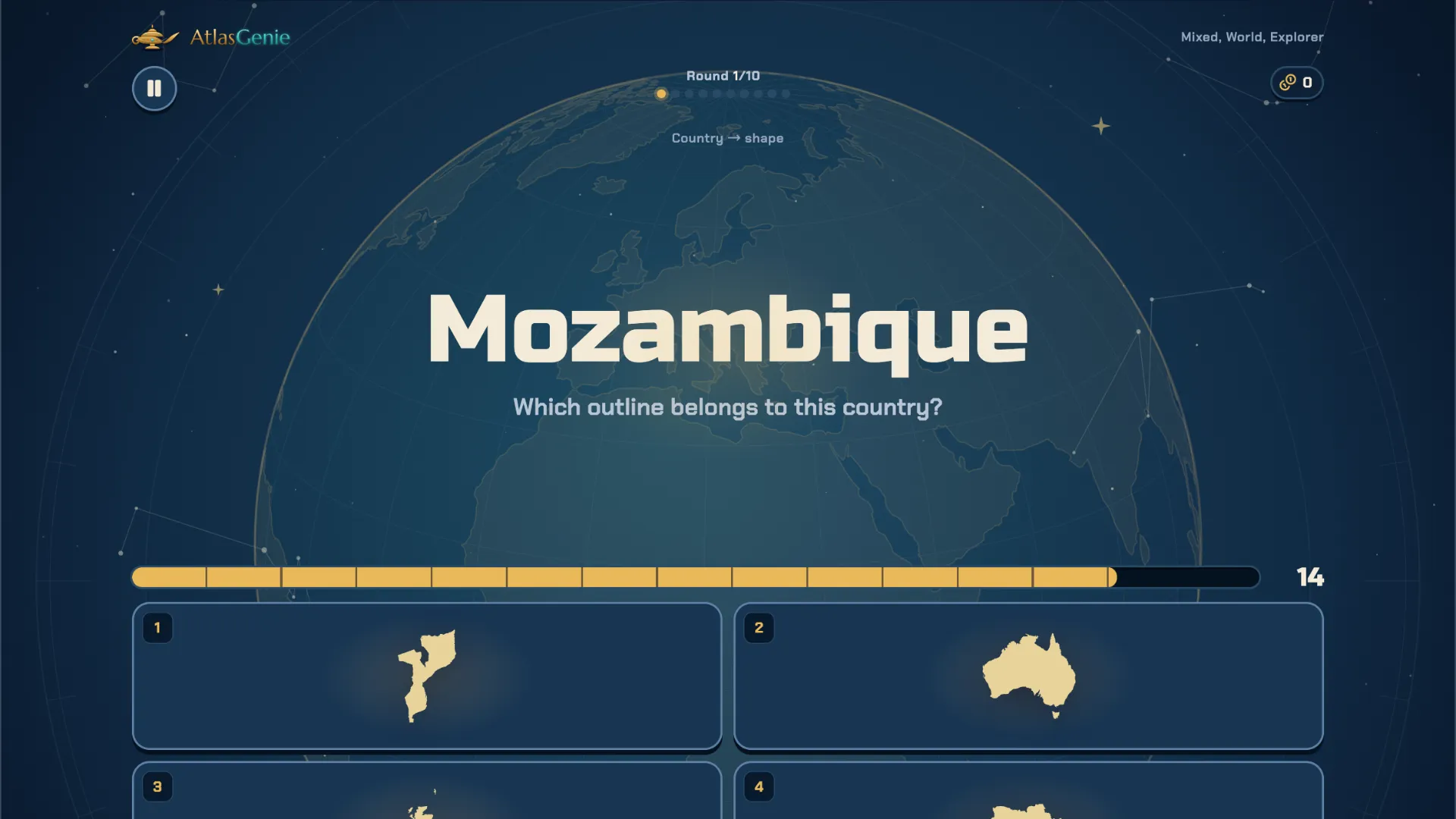
Country shape questions show the outline of a country and ask players to identify it, or name a country and ask which silhouette represents it.
For example, a long, narrow silhouette stretching down the western coast of South America would suggest Chile.
All outlines are scaled to fill the available frame. This means you cannot rely on the apparent size of the image to distinguish large and small countries.
Instead, pay attention to coastlines, border angles, distinctive protrusions, and overall proportions.
How to Play AtlasGenie
Getting started takes only a few seconds, and the game works with either mouse or touchscreen controls.
- Open the daily challenge. Visit AtlasGenie Daily and start today's challenge. The daily game contains the same 10 geography questions for everyone playing that day's challenge.
- Read the question carefully. Each round presents a geography question with four possible answers. You have 15 seconds to identify the correct option before time expires.
- Choose your answer. Click or tap the answer you believe is correct. On a computer, you can also press the number keys 1 through 4. Correct answers earn 500 base points plus a speed bonus of up to 500 additional points.
- Learn from the fact card. After answering, review the country information displayed on the screen. The card includes geographical facts such as the country's flag, outline, capital, official languages, and region. Select Next when you are ready to continue.
- Finish all 10 rounds. Continue answering until the quiz ends. Review your final score out of 10,000 points and share your results with friends. Return the following day for a fresh challenge.
The daily quiz is played on Explorer difficulty, which uses random incorrect options rather than specially selected traps. More difficult Expert quizzes are available separately.
How AtlasGenie Scoring Works
AtlasGenie rewards both geographical knowledge and quick decisions.
Each question is worth a maximum of 1,000 points. Your score depends on whether you answer correctly and how quickly you respond.
| Result | Points |
|---|---|
| Correct within 1 second | 1,000 |
| Correct after 8 seconds | Approximately 750 |
| Correct near 15 seconds | Approximately 500 |
| Incorrect answer | 0 |
| Timer expires | 0 |
A correct answer always earns 500 base points. The remaining 500 points form a speed bonus that decreases as time passes, reaching zero at 15 seconds.
With 10 rounds, the maximum total score is 10,000 points.
For example, answering all 10 questions correctly does not necessarily guarantee a perfect score. If you take several seconds to answer each question, you will lose some speed-bonus points.
To achieve 10,000 points, you must answer every question correctly within the maximum-bonus window.
However, accuracy should come before speed. A correct answer near the end of the timer still earns 500 points, while a wrong answer earns nothing.
The timer pauses while fact cards are displayed, so you can read the information without sacrificing time on the next question.
The Daily AtlasGenie Challenge
The daily challenge is the central feature of AtlasGenie.
Every day, players receive the same set of 10 geography questions covering flags, capitals, languages, and national outlines.
One Shared Challenge
Everyone playing the challenge for the same date receives the same questions.
This creates a fair way to compare performance with friends, even if they live in different countries.
The daily challenge refreshes at midnight in your local timezone.
One Attempt Per Day
You can complete the daily challenge once per day.
Your result is stored on your device, allowing you to review your performance after finishing.
Unlike regular AtlasGenie quizzes, the daily challenge does not consume any of your free regular-game allowance.
Explorer Difficulty
The daily challenge uses Explorer difficulty.
Incorrect answers are selected from countries around the world rather than being deliberately chosen to look similar to the correct answer.
This makes the daily quiz accessible to a broad range of players while still testing multiple areas of geographical knowledge.
Share Your Results
After completing the challenge, you can share your score and compare your performance with friends.
AtlasGenie also uses medals and progress indicators in its broader quiz experience, giving returning players another reason to improve their scores over time.
Explore the Different AtlasGenie Game Modes
Players who enjoy the daily challenge can practice individual subjects through dedicated quiz modes.
Flags Quiz
The Flags Quiz challenges players to recognize national flags or identify the correct flag for a named country.
Each game contains 10 timed questions, split between identifying countries from flags and selecting flags for countries.
This mode is particularly useful for learning similar-looking flags and recognizing national symbols.
Capitals Quiz
The Capitals Quiz tests knowledge of world capital cities.
Some questions ask for the capital of a named country, while others provide a capital and ask which country it belongs to.
It is especially useful for learning the difference between a country's capital and its largest or most famous city.
Languages Quiz
The Languages Quiz focuses on officially recognized languages.
Questions may ask which country recognizes a particular language or which language is officially recognized by a named country.
This mode introduces interesting connections between geography, history, culture, and multilingual societies.
Country Shapes Quiz
The Country Shapes Quiz tests your ability to identify countries using their outlines.
Because the silhouettes are not shown to scale, you must rely on their geographical shapes rather than their apparent sizes.
It is a useful challenge for players who want to improve map recognition.
Mixed Geography Quiz
The Mixed Geography Quiz combines flags, capitals, languages, and country shapes into one 10-round game.
Every game includes at least two questions from each of these four categories, with two additional rounds selected from the available categories.
This mode closely resembles the variety found in the daily challenge, but regular Mixed games let you choose a region and difficulty.
Pin Drop: The 3D Globe Game
The Pin Drop mode offers a different type of geography challenge.
Instead of selecting one of four answers, you must locate a country or capital city on a spinning 3D globe.
Each game contains 10 rounds, with 30 seconds available for each pin placement.
For example, a question might ask where Lima is located.
You must rotate the globe, find Peru, and place your pin as close to Lima as possible.
The scoring system rewards geographical accuracy. A capital pin within 25 kilometres of its target earns 1,000 points, while a pin anywhere inside the requested country's borders also earns full points for a country-location question.
Unlike the other quizzes, Pin Drop does not award a speed bonus.
This mode is separate from the daily challenge, which uses the four-answer quiz formats rather than globe-based pin placement.
Explorer vs. Expert Difficulty
AtlasGenie offers two difficulty settings for regular quizzes.
Explorer Mode
Explorer is designed for players who want an accessible way to build their geography knowledge.
Incorrect answers are generally chosen randomly from the selected geographical region.
For example, a flag question about a European country may present alternatives that are visually quite different from the correct answer.
Explorer is also the difficulty used in the shared daily challenge.
Expert Mode
Expert makes the questions more difficult by introducing carefully selected incorrect options.
In flag questions, players may encounter similar designs such as Romania and Chad, or Indonesia and Poland.
In capital quizzes, incorrect answers may include well-known cities that are not national capitals, such as Sydney for Australia or Istanbul for Türkiye.
Language questions may include languages spoken in neighbouring countries, while country-shape questions can present similar-looking outlines.
In Pin Drop, Expert removes country borders from the globe and begins from a random orientation, making locations harder to identify.
Expert mode is a good choice for experienced geography players who want more difficult challenges after mastering Explorer.
Choose a Region to Practice
AtlasGenie allows players to focus on specific geographical regions in regular quiz modes.
Available selections include:
- World: Questions from countries around the globe.
- Africa: Flags, capitals, languages, and country shapes from African countries.
- Americas: Countries throughout North America, Central America, the Caribbean, and South America.
- Asia: Geography questions focused on Asian countries.
- Europe: European capitals, countries, languages, and flags.
- Oceania: Geography challenges involving Australia, New Zealand, and Pacific nations.
Region-specific practice is particularly helpful when learning unfamiliar parts of the world.
Some combinations are unavailable where there are not enough suitable questions. For example, the dedicated Country Shapes Quiz does not offer Oceania as a standalone region because too few countries meet its outline requirements for a full 10-round game.
Strategy Tips for Better AtlasGenie Scores
1. Prioritize Accuracy Over Speed
Fast answers earn more points, but an incorrect answer scores zero.
If you are uncertain, use the available time to eliminate incorrect choices before committing.
A correct response after 10 seconds still contributes to your total, while an impulsive wrong answer cannot be recovered.
2. Learn Similar-Looking Flags
Several countries use remarkably similar flag designs.
Study pairs such as Romania and Chad, Indonesia and Poland, and Ireland and Côte d'Ivoire.
Pay attention to stripe order, color shades, national emblems, and flag proportions.
These details are especially important in Expert mode.
3. Do Not Confuse Capitals With Major Cities
Many famous cities are not national capitals.
For example, Canberra is Australia's capital rather than Sydney, Ottawa is Canada's capital rather than Toronto, and Brasília is Brazil's capital rather than Rio de Janeiro.
Recognizing these common traps can improve both your capital quiz results and your daily score.
4. Connect Languages With History
Official language questions often become easier when you understand a country's history.
For example, Portuguese is officially recognized in Angola and Mozambique, while French is an official language in several African countries.
Learning historical and regional connections helps you reason through unfamiliar questions rather than relying entirely on memorization.
5. Recognize Distinctive Country Outlines
When identifying country shapes, look for recognizable geographical features.
Italy has its famous boot-like shape, Chile is exceptionally long and narrow, and Vietnam has a distinctive elongated outline.
For less familiar countries, pay attention to coastline patterns, straight borders, and the relationship between neighbouring countries.
6. Read Every Fact Card
After each answer, AtlasGenie displays a country fact card containing information such as its flag, shape, capital, official languages, and region.
This is one of the most useful learning features in the game.
Even if you answered correctly, the card may contain information that helps with a future question in another category.
7. Practice One Region at a Time
Instead of immediately attempting difficult worldwide quizzes, focus on a single region.
For example, spend several games learning African flags or Asian capitals before returning to Mixed mode.
This approach helps establish stronger associations between countries and their geographical characteristics.
8. Practice Pin Drop to Improve Map Knowledge
Knowing a country's name is useful, but understanding its location adds another layer of geographical knowledge.
The Pin Drop mode helps connect country names and capital cities with their positions on Earth.
Practicing with the 3D globe can improve your understanding of continents, neighbouring countries, and geographical distances.
Is AtlasGenie Free to Play?
Yes. AtlasGenie offers free browser-based gameplay without requiring an account.
Guest players can access all regular quiz modes, available regions, and difficulty settings within the free allowance.
The free version includes:
- One daily geography challenge containing 10 shared questions.
- Three additional regular games per local day.
- Access to Explorer and Expert difficulty settings.
- Regional quiz options and the Pin Drop mode.
- Country fact cards after answers.
- Personal best scores stored locally in the browser.
The daily challenge is separate from the three-game allowance, so you can always play it even after using your regular games.
Optional Premium Membership
AtlasGenie also offers an optional Premium subscription.
The previously listed subscription prices are $1.99 per month or $11.99 per year, although prices and plan benefits may change.
Premium is intended to remove the regular-game limit and provide additional account features, including expanded statistics and cross-device progress storage.
A free account can be created using supported sign-in methods. Registered players can earn XP, advance through levels, and maintain a day streak by finishing games on consecutive days.
The core daily challenge does not require Premium.
For current subscription details, visit the official AtlasGenie pricing page.
What Makes AtlasGenie Different?
AtlasGenie offers more variety than a typical single-mechanic daily geography puzzle.
Instead of asking players to guess one hidden country, the daily challenge tests several distinct aspects of world geography across 10 quick rounds.
Its distinguishing features include:
- Shared daily quiz: Everyone receives the same 10 geography questions for the same day.
- Four geography subjects: Flags, capitals, official languages, and country shapes appear in the daily challenge.
- Speed-based scoring: Correct answers earn between 500 and 1,000 points depending on response time.
- 10,000-point maximum: A perfect game requires fast and accurate answers throughout all 10 rounds.
- Educational fact cards: Every answer reveals information that helps players learn about countries.
- Multiple game modes: Specialized quizzes allow focused practice beyond the daily challenge.
- Interactive 3D globe: Pin Drop adds a map-based location challenge with distance-based scoring.
- Adjustable difficulty: Explorer welcomes casual players, while Expert introduces more convincing wrong answers.
- Regional practice: Players can concentrate on specific continents and regions.
- Free daily access: The daily challenge remains available without an account or subscription.
The combination of timed multiple-choice questions, geography facts, and globe-based challenges makes AtlasGenie appealing to both casual trivia fans and dedicated geography enthusiasts.
AtlasGenie vs. Other Geography Games
AtlasGenie differs from games such as Worldle, Globle, and GeoGuessr in the type of knowledge it tests.
Worldle challenges players to identify a hidden country using its silhouette and feedback about distance and direction.
Globle asks players to discover a mystery country using geographic proximity feedback.
GeoGuessr challenges players to determine locations from real-world Street View imagery.
AtlasGenie uses a broader geography quiz format. Its daily game asks 10 questions about flags, capitals, languages, and outlines, while its separate Pin Drop mode tests location knowledge on a 3D globe.
This makes AtlasGenie a good option for players who prefer varied trivia questions over repeatedly guessing a single hidden location.
Who Should Play AtlasGenie?
AtlasGenie is particularly well suited to players who enjoy world geography, flag recognition, capital city quizzes, country trivia, and quick daily knowledge challenges.
The multiple-choice format makes it approachable for beginners, while the Expert difficulty and regional games provide additional challenges for experienced players.
It is also a useful choice for students who want to reinforce geographical knowledge through short interactive sessions.
Players who enjoy competing for better scores can focus on faster answers and perfect rounds, while those who prefer learning can take time to read the fact cards and explore new countries.
The game's combination of daily questions and specialized practice modes provides a reason to return regularly without requiring lengthy playing sessions.
Frequently Asked Questions
How many questions are in the AtlasGenie daily challenge?
There are 10 questions covering flags, capital cities, official languages, and country shapes.
Is the daily challenge the same for everyone?
Yes. Players receive the same questions for the same calendar date, allowing them to compare scores with friends.
When does AtlasGenie reset?
The daily challenge refreshes at midnight in your local timezone.
How long do you have to answer each question?
The standard multiple-choice quiz gives players 15 seconds per question.
What is the highest possible AtlasGenie score?
The maximum is 10,000 points, achieved by earning 1,000 points on each of the 10 questions.
Can you replay the daily challenge?
No. The official daily challenge allows one completed attempt per day. Regular quizzes can be played separately within the free daily allowance.
Is Pin Drop included in the daily challenge?
No. Pin Drop is a separate 3D globe game. The daily challenge uses the four-option geography quiz formats.
Can you play AtlasGenie without registering?
Yes. The daily challenge and free regular games are available to guests without account registration.
How many free games can you play?
Guest players can play three regular games per local day, plus the separate daily challenge.
Can you play AtlasGenie on mobile?
Yes. AtlasGenie works in modern mobile browsers, with touch controls for selecting quiz answers and interacting with the globe.
Conclusion
AtlasGenie turns world geography into an accessible and entertaining daily challenge. By combining flags, capitals, languages, and country outlines into 10 timed questions, it rewards players for both geographical knowledge and quick thinking.
The daily quiz provides a short competitive challenge, while dedicated practice modes and the interactive 3D globe offer different ways to expand your understanding of the world.
With free daily access, informative country fact cards, and a maximum score of 10,000 points, AtlasGenie is a compelling addition to any geography enthusiast's puzzle routine.
Ready to test your world knowledge? Play AtlasGenie and see how close you can get to a perfect 10,000-point score!
For detailed rules and game options, visit the official AtlasGenie FAQ.