
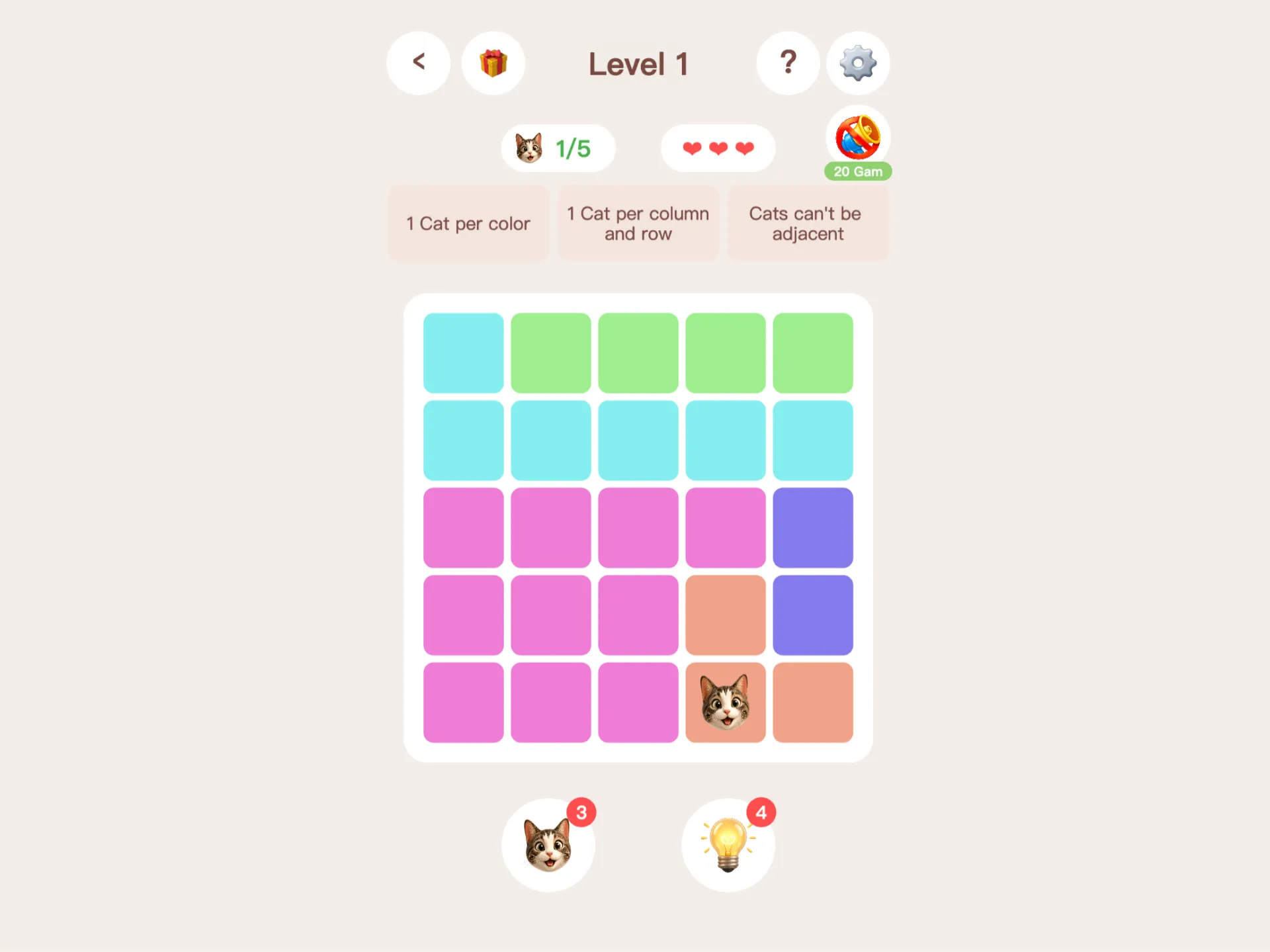
What Is CatDoku?
CatDoku is a free, cat-themed logic puzzle developed by ONLYDRK Studio. Inspired by Sudoku and Queens-style grid puzzles, it challenges you to find the correct positions for adorable cats on a board divided into colorful regions.
The objective is simple: place exactly one cat in every row, every column, and every colored region. However, there is one additional restriction: no two cats can touch, even diagonally.
Unlike traditional Sudoku, CatDoku does not involve placing numbers from 1 to 9. Instead, every puzzle is solved by identifying which squares can contain cats and eliminating positions that violate the rules.
The game features more than 100 levels, beginning with approachable puzzles and progressing to larger, more complicated boards. Its colorful presentation and straightforward controls make it accessible to newcomers, while the overlapping placement restrictions provide plenty of challenge for experienced logic puzzle fans.
CatDoku Rules Explained
Every CatDoku puzzle follows four placement rules. You must satisfy all four simultaneously to complete a level.
Rule 1: One Cat Per Row
Every horizontal row must contain exactly one cat. Once you place a cat in a row, every other square in that row is unavailable.
Rule 2: One Cat Per Column
Every vertical column must also contain exactly one cat. Placing a cat rules out all other positions in its column.
Rule 3: One Cat Per Colored Region
The board is divided into colored areas of different shapes. Each colored region must contain exactly one cat, regardless of how many squares belong to it.
A colored region may extend across several rows and columns. This creates the game's central deduction challenge: finding positions that satisfy the row, column, and region rules at the same time.
Rule 4: Cats Cannot Touch
Cats need their personal space. Two cats cannot occupy neighboring squares, including squares that meet only at a corner.
For example, imagine placing a cat at row 3, column 3 on a 5×5 board. The surrounding positions at rows 2–4 and columns 2–4 cannot contain another cat. The entire third row and third column are also excluded, as are other squares belonging to that cat's colored region.
The no-touching restriction applies only to immediately neighboring squares. Two cats farther apart on the same long diagonal are not automatically forbidden unless another rule prevents their placement.
How to Play CatDoku
Getting started takes only a few moments. Here is a practical walkthrough for your first puzzle.
- Open CatDoku: Visit CatDoku on Playgama and start the game directly in your browser. No installation is required.
- Study the colored grid: Identify the different colored regions and examine how they intersect with the board's rows and columns. Look for regions with relatively few possible cat positions.
- Place your first cat: Click or tap an empty square where you believe a cat belongs. Tap the same square again if you need to remove it.
- Eliminate impossible positions: After placing a cat, rule out other squares in its row, column, and colored region, along with all immediately neighboring squares. Use these restrictions to identify the next placement.
- Complete the arrangement: Continue placing cats until every row, column, and colored region contains exactly one cat and no two cats touch. Once the board satisfies the rules, the level is complete and you can continue to the next challenge.
If you get stuck, the game provides a hint option to help reveal a correct position.
Example: Solving a CatDoku Placement
Consider a 5×5 grid with five colored regions. You need to place five cats, one in each row, column, and region.
Suppose you have already confirmed a cat at R3C3 (row 3, column 3).
That placement immediately eliminates:
- Every other square in row 3.
- Every other square in column 3.
- Every other square belonging to the same colored region.
- All immediately adjacent squares, including R2C2, R2C4, R4C2, and R4C4.
Now imagine another colored region has only two remaining possible squares, R2C4 and R2C5.
R2C4 is diagonally adjacent to your confirmed cat at R3C3, so it cannot contain another cat. That leaves R2C5 as the only possible placement for the region.
Placing the second cat there eliminates row 2, column 5, its colored region, and its immediate neighbors. Those eliminations may reveal additional forced placements elsewhere.
This example illustrates the core CatDoku technique: one confirmed placement creates new restrictions that help solve the rest of the board.
CatDoku Strategy and Tips
Although the rules are straightforward, more advanced levels require careful deduction. These techniques can make difficult boards easier to solve.
Start With the Most Restricted Regions
Look for a row, column, or colored region with the fewest possible cat positions. A small region is often easier to solve than a large one, especially when existing cats already eliminate several of its squares.
Check Diagonal Neighbors
The diagonal restriction is easy to overlook. Every time you place a cat, examine the four diagonal squares surrounding it. These exclusions can be especially important when colored regions have unusual shapes.
Use Region Overlaps
Suppose a colored region has two possible squares and both lie in the same row. You may not know which of those two squares contains the cat, but you know that the row's cat must belong to that region.
Therefore, every square outside that region in the same row can be eliminated. This can create useful deductions without requiring you to choose between the two candidates immediately.
Think Before Placing Cats
A square that does not currently violate any rule is not necessarily the correct location. Before committing, try to demonstrate why the cat must occupy that square rather than another available position.
Recheck the Whole Board
Each confirmed cat can affect multiple rows, columns, and colored regions. When one part of the puzzle becomes difficult, revisit other areas. A restriction introduced elsewhere may have eliminated the candidate blocking your progress.
Use Hints When Necessary
If you cannot identify another logical placement, the hint feature can help you move forward. Try to understand why the suggested position is correct so you can apply the same reasoning in later levels.
CatDoku vs. Traditional Sudoku
Despite its name, CatDoku is not simply Sudoku with cat pictures replacing numbers.
| Feature | CatDoku | Traditional Sudoku |
|---|---|---|
| Main objective | Place cats in valid positions | Fill every cell with numbers |
| Row rule | Exactly one cat | Each number appears once |
| Column rule | Exactly one cat | Each number appears once |
| Region rule | One cat per colored region | Each number appears once per box |
| Diagonal adjacency | Cats cannot touch diagonally | Usually unrestricted |
| Main skill | Spatial deduction and elimination | Number-based logical deduction |
CatDoku is closer to a one-star Star Battle or Queens-style placement puzzle. Most squares remain empty, and the challenge comes from deciding where the limited number of cats must go.
Levels and Difficulty
CatDoku offers over 100 progressively challenging levels. Early puzzles help players understand the basic placement restrictions, while later boards introduce more complicated colored regions and tighter relationships between potential positions.
As you progress, simply checking whether a square is empty becomes insufficient. Difficult levels reward players who can combine several rules, recognize forced placements, and eliminate candidates across multiple regions.
The browser version on Playgama also features a leaderboard, providing an additional reason to improve your puzzle-solving performance.
Is CatDoku Free to Play?
Yes. CatDoku is available as a free browser game on Playgama. You can start playing without downloading a separate application.
The game supports desktop computers and mobile devices, with mouse and touch controls for placing and removing cats.
Its level-based structure makes it suitable for short puzzle breaks or longer sessions. You can solve a few grids when you have spare time or continue working through the increasingly difficult levels.
Who Should Play CatDoku?
CatDoku is a particularly good choice for players who enjoy:
- Sudoku and number-free logic puzzles: Familiar row-and-column deduction without arithmetic.
- Queens and Star Battle puzzles: Similar one-piece-per-region placement restrictions.
- Spatial reasoning challenges: Every cat position affects several other parts of the board.
- Relaxing puzzle games: Colorful graphics, cute characters, and straightforward interaction.
- Progressive brain teasers: A large collection of levels that gradually demand more advanced reasoning.
Players who prefer action, reflex-based challenges, or competitive multiplayer gameplay may find CatDoku slower-paced than their usual games. Its appeal lies in careful thinking and the satisfaction of discovering a logically forced solution.
Final Thoughts
CatDoku offers a charming variation on classic grid logic puzzles. With only four rules, the game is easy to learn, but the interaction between rows, columns, colored regions, and diagonal restrictions creates surprisingly challenging situations.
The combination of adorable cats, accessible controls, and over 100 levels makes CatDoku a fun choice for anyone looking for a relaxing but mentally engaging browser puzzle.
Play CatDoku free online and see how quickly you can find the perfect place for every cat.