What is chessle?
Chessle transforms chess openings into a tense daily deduction puzzle. Instead of guessing words or trivia answers, you're trying to uncover the exact sequence of opening moves from a real chess game — one move at a time.
The trap is psychological. A move can feel completely correct because it belongs to a familiar opening, yet still fail because the order is wrong. Suddenly your trusted Sicilian instincts betray you, your knight jumps too early, and the board turns into a battlefield of tiny inaccuracies. Chessle rewards players who truly understand structure, tempo, and move order instead of simply memorizing names.
chessle Game Rules (The Catch / The Trap)
Every puzzle hides a complete chess opening sequence.
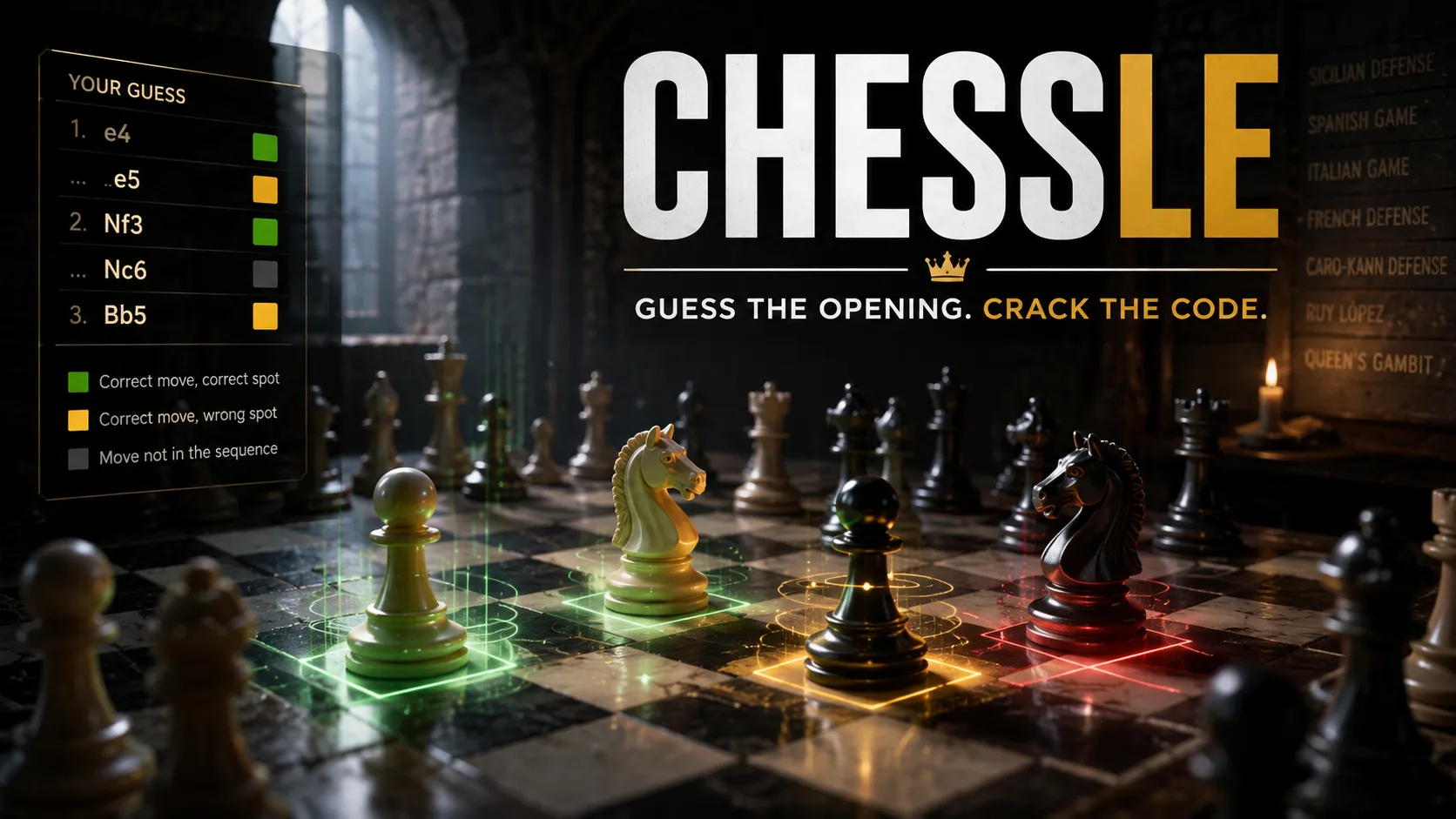
You submit a full line of moves and Chessle responds with color-coded feedback:
- 🟩 Correct move in the correct position.
- 🟨 Correct move, but placed in the wrong spot.
- ⬛ Move does not appear anywhere in the solution.
Example:
Player Guess:
1. e4 e5 2. Nf3 Nc6 3. Bb5
Game Response:
e4 🟩
e5 🟨
Nf3 🟩
Nc6 ⬛
Bb5 🟨
What This Means:
e4andNf3are LOCKED IN.e5exists somewhere else in the sequence.Bb5belongs to the opening, but not here.Nc6is completely ELIMINATED.
The real danger comes from move order. In Chessle, knowing the opening is not enough. You must reconstruct the exact timeline of the position.
How To Play chessle?
Step 1 — Open With a Familiar Setup
Most players begin with a common opening shell.
Player Guesses:
e4 e5 Nf3 Nc6
Game Response:
🟩 🟨 🟩 ⬛
You immediately learn part of the structure is correct, but the sequence is unstable.
Step 2 — Rebuild the Move Order
You now test whether Black responded differently.
Player Guesses:
e4 c5 Nf3 d6
Result:
🟩 🟩 🟨 ⬛
Now the board starts revealing a Sicilian-style structure.
Step 3 — Hunt for the Missing Piece
You adjust development timing.
Player Guesses:
e4 c5 Nf3 Nc3
Result:
🟩 🟩 🟩 🟨
You finally know the first three moves are LOCKED IN.
Step 4 — Finish the Line
One final adjustment completes the puzzle.
Player Guesses:
e4 c5 Nf3 d4
Result:
🟩 🟩 🟩 🟩
Victory. The opening collapses into place like a solved tactical combination.
Strategy & Tips
- Start with ultra-common opening skeletons before experimenting.
- Move order matters more than opening names.
- If several moves turn 🟨, the structure is probably right but scrambled.
- Use elimination aggressively. One ⬛ can destroy an entire opening family.
- Think like a tournament player: what move naturally follows the current position?
Chessle becomes far more addictive once you stop treating it like trivia and start treating it like reconstruction. You're not guessing random moves — you're reverse-engineering chess logic itself.