What is Chronle?
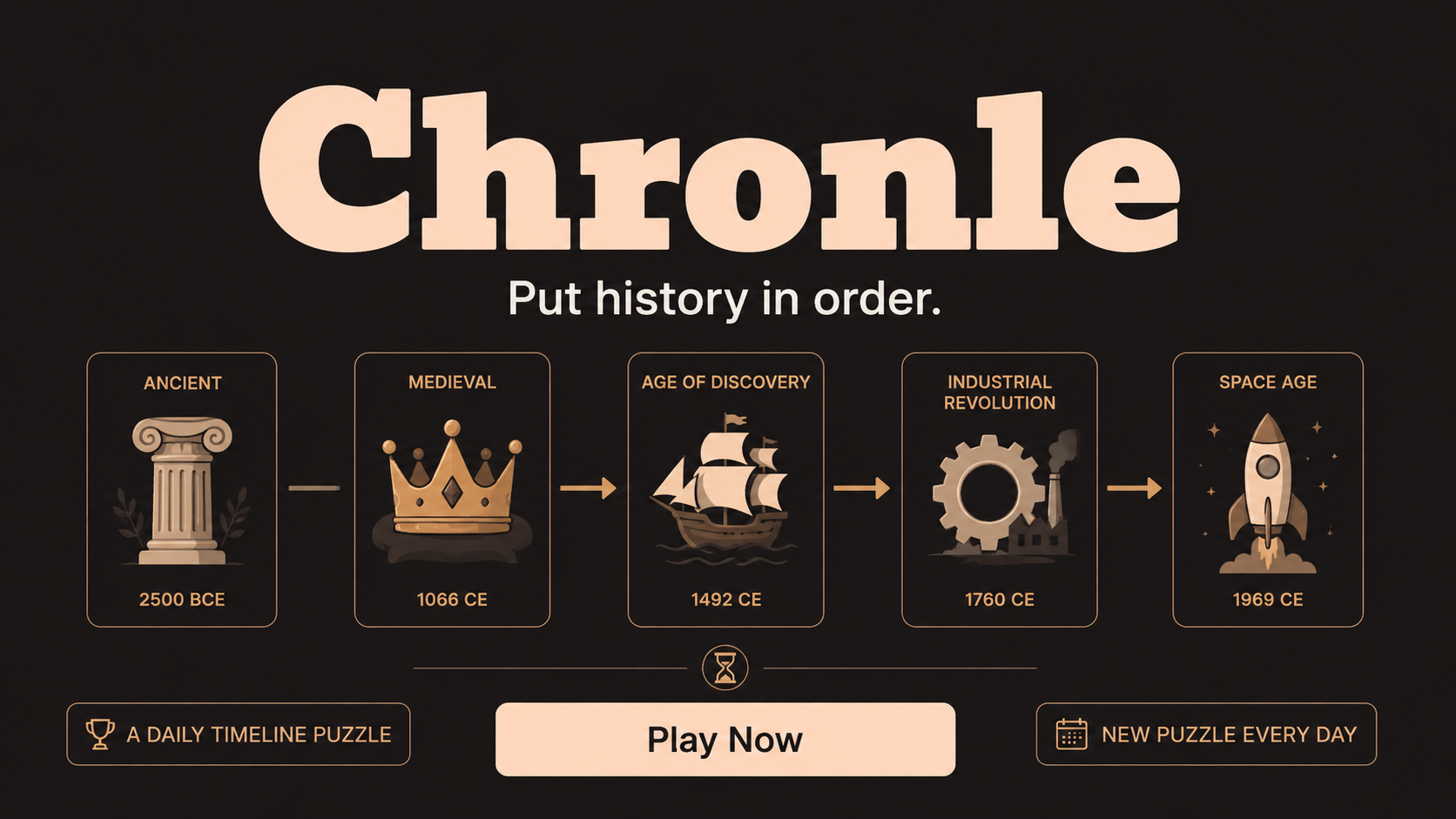
Chronle is a daily chronological timeline game where you are given a set of historical events and must arrange them in the correct order. Instead of guessing a word or identifying a picture, the challenge is to think through when each event happened and build the timeline from earliest to latest.
The fun comes from the gaps between what you recognize and what you can actually date. Some events may feel obvious, while others force you to compare eras, rulers, wars, inventions, discoveries, and cultural moments. Chronle is quick to play, but it rewards broad historical knowledge and careful sequencing.
Chronle Game Rules
Chronle is built around ordering events correctly:
- You are shown several historical events.
- Your goal is to place them in chronological order.
- The timeline should usually run from earliest to latest.
- Each event must be compared with the others, not solved alone.
- A daily puzzle gives you a new set of events to arrange.
- Your result depends on how accurately you build the final timeline.
The catch is that knowing the event is not always enough. You may know what happened, but still be unsure whether it came before or after another similar historical moment.
How To Play Chronle?
Step 1: Read every event
Player Action: Look through the full list before moving anything.
Game Response: The game presents the historical events you need to arrange.
What You Learn: Do not rush. One familiar event can become an anchor for the whole timeline.
Step 2: Find the obvious anchors
Player Action: Identify events that clearly belong near the beginning or end of the timeline.
Game Response: You can start building the order around the events you know best.
What You Learn: Even if you do not know every exact year, strong anchors make the rest easier.
Step 3: Compare the uncertain events
Player Action: Think about which events are likely earlier or later based on historical context.
Game Response: The puzzle becomes a sequence challenge rather than a simple memory test.
What You Learn: Relative timing matters. You can often solve a puzzle by comparing eras instead of remembering exact dates.
Step 4: Submit your timeline
Player Action: Finalize the order once the events feel correctly arranged.
Game Response: Chronle checks your timeline and shows how well you did.
What You Learn: Each mistake helps you sharpen your sense of historical sequence for future puzzles.
Strategy & Tips
Start with the events you are most confident about. If you know one event happened in ancient history and another happened in the modern era, place those first and use them as boundaries.
Look for clues in the wording. Names of countries, technologies, rulers, wars, or inventions can hint at the period even when you do not know the exact date.
Think in broad eras before fine details. Ancient, medieval, early modern, industrial, twentieth century, and digital age are useful mental buckets.
When two events feel close, compare what had to happen first. For example, a political event may depend on an earlier war, invention, movement, or discovery.
Chronle FAQ
Is Chronle free to play?
Yes, Chronle can be played online in a browser.
What kind of game is Chronle?
Chronle is a daily history trivia puzzle focused on arranging historical events in chronological order.
How do you play Chronle?
Read the events, place them on a timeline from earliest to latest, submit your order, and see how accurate your chronology is.
Is Chronle like Wordle?
Chronle has a similar daily puzzle habit, but the gameplay is based on history and timelines instead of word guessing.
Who should play Chronle?
Chronle is a good fit for players who enjoy history, trivia, timelines, educational games, and quick daily brain challenges.
Final Take
Chronle is a smart daily puzzle for anyone who likes history but wants something more active than reading facts. It tests whether you can connect events across time, spot historical relationships, and build a clean timeline from scattered clues.