
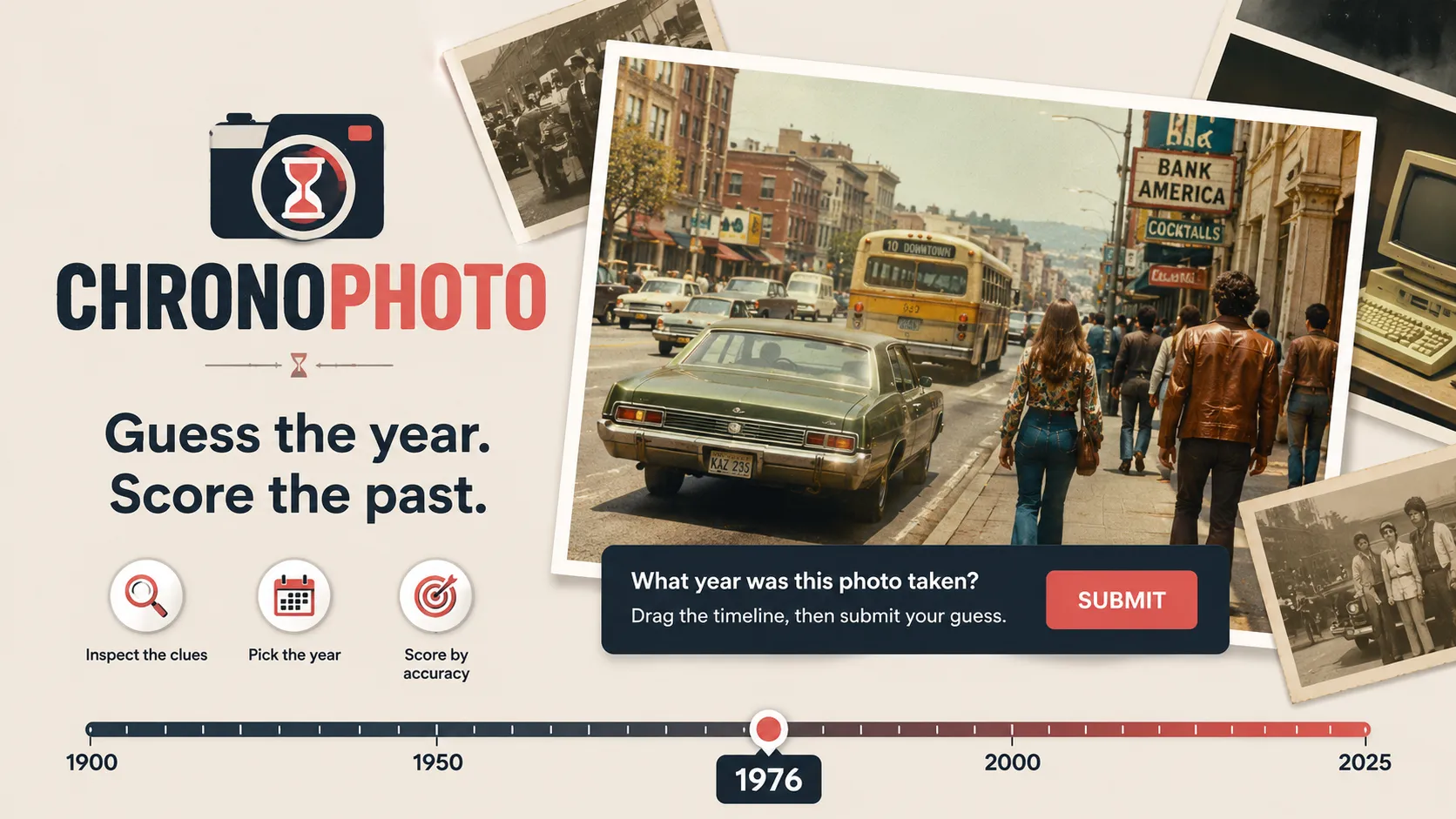
What is Chronophoto?
Chronophoto places a real photograph in front of you and removes the one detail you desperately need: the date. Your mission is to inspect the image, drag a timeline slider to the year you believe it was taken, and submit your answer before doubt talks you into another decade.
The challenge is pure visual detective work. A hairstyle might whisper 1968, a car might insist on 1974, and the photograph's color palette might drag you somewhere else entirely. Chronophoto tests your knowledge of history, fashion, popular culture, and technology through five-photo challenges, with a separate Daily mode for players who want a fresh shared puzzle each day.
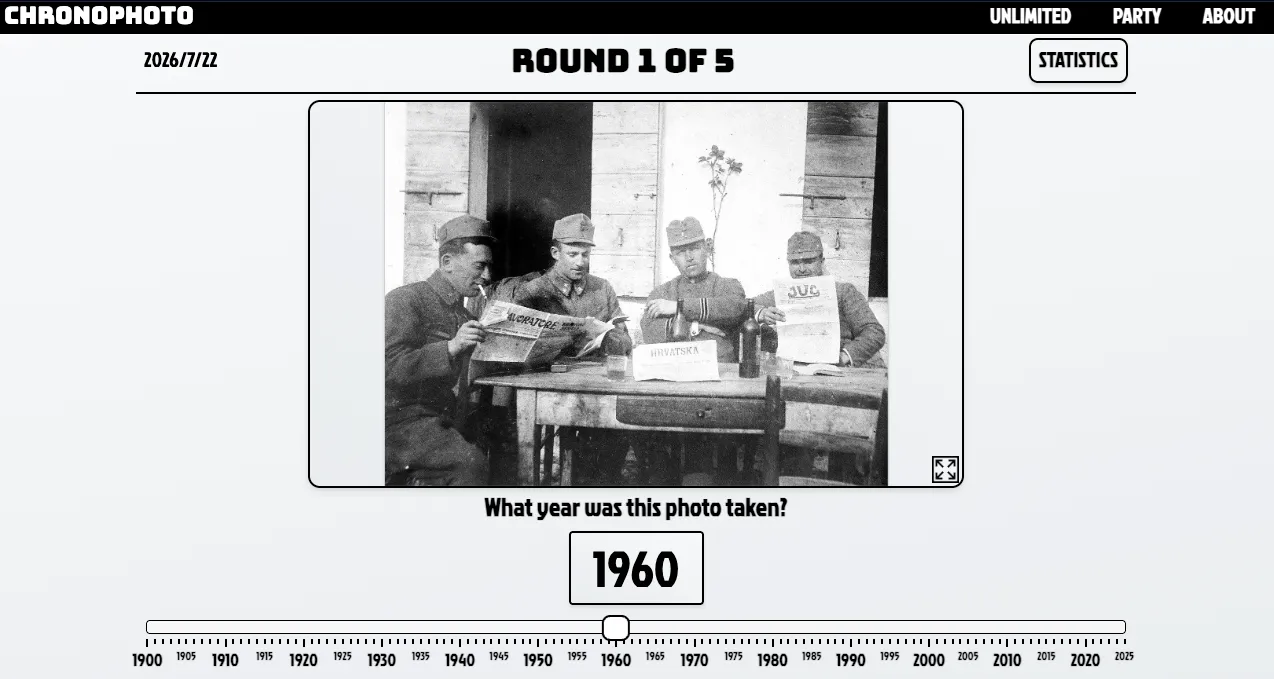
Chronophoto Game Rules (The Catch / The Trap)
Each round follows a simple but unforgiving loop:
PHOTO → INSPECT CLUES → CHOOSE YEAR → SUBMIT → REVEAL
- Study the entire photograph: Clothing, vehicles, buildings, signs, hairstyles, image quality, and visible technology can all matter.
- Choose one year: Move the timeline control to your best estimate.
- Submit to lock it in: Once submitted, your guess CANNOT be adjusted for that photo.
- The real year is revealed: You immediately discover how far your estimate missed.
- Closer guesses earn more points: Landing near the true year produces a stronger score than missing by several decades.
- Continue through the photo set: Your points accumulate across the challenge.
The trap is that knowing the correct decade is not always enough. A guess of 1988 may feel brilliant until the answer appears as 1979. Chronophoto rewards precision, so every tiny clue can become the difference between a near-perfect hit and a painful historical detour.
How To Play Chronophoto?
Step 1: Examine the time capsule
Photo shown: A crowded city street with boxy cars, flared trousers, large sunglasses, and slightly faded color film.
What you notice:
Cars: early 1970s?
Fashion: flared trousers
Photo look: aging color film
Your first instinct is somewhere between 1971 and 1977.
Step 2: Place your year
Player selects: 1976
You drag the slider to 1976 and press Submit. The choice is now locked in.
Step 3: Read the reveal
Actual year: 1973
Difference: 3 years
Game response: A close guess earns a strong score.
What this means: Your decade analysis was solid, but the vehicles and clothing appeared slightly later to you than they really were.
Step 4: Use the lesson on the next photo
Next photo shown: A living room containing a bulky television, wood-paneled walls, and an early home computer.
Instead of trusting the furniture alone, you identify the computer model and narrow the image to the early 1980s.
Player guesses: 1982
Result: The answer is revealed, points are added, and the hunt continues until the full photo set is complete.
Chronophoto Strategy & Tips
Start with objects that have limited production windows. Cars, phones, computers, military equipment, logos, and public transport designs are usually more reliable than the general mood of a photograph.
Separate the date of the scene from the age of the objects inside it. A photograph taken in 1995 can still contain a car from 1978, old furniture, or traditional clothing. Look for the newest identifiable clue rather than assuming everything was newly made.
Use photographic technology as supporting evidence. Black-and-white does not automatically mean ancient, and faded color does not guarantee the 1970s. Treat film grain, aspect ratio, sharpness, and color rendering as clues—not final verdicts.
Finally, resist last-second panic. Your first decade estimate is often built from the whole scene, while a late change may be triggered by one misleading object. Adjust only when you find a clue strong enough to justify the jump.