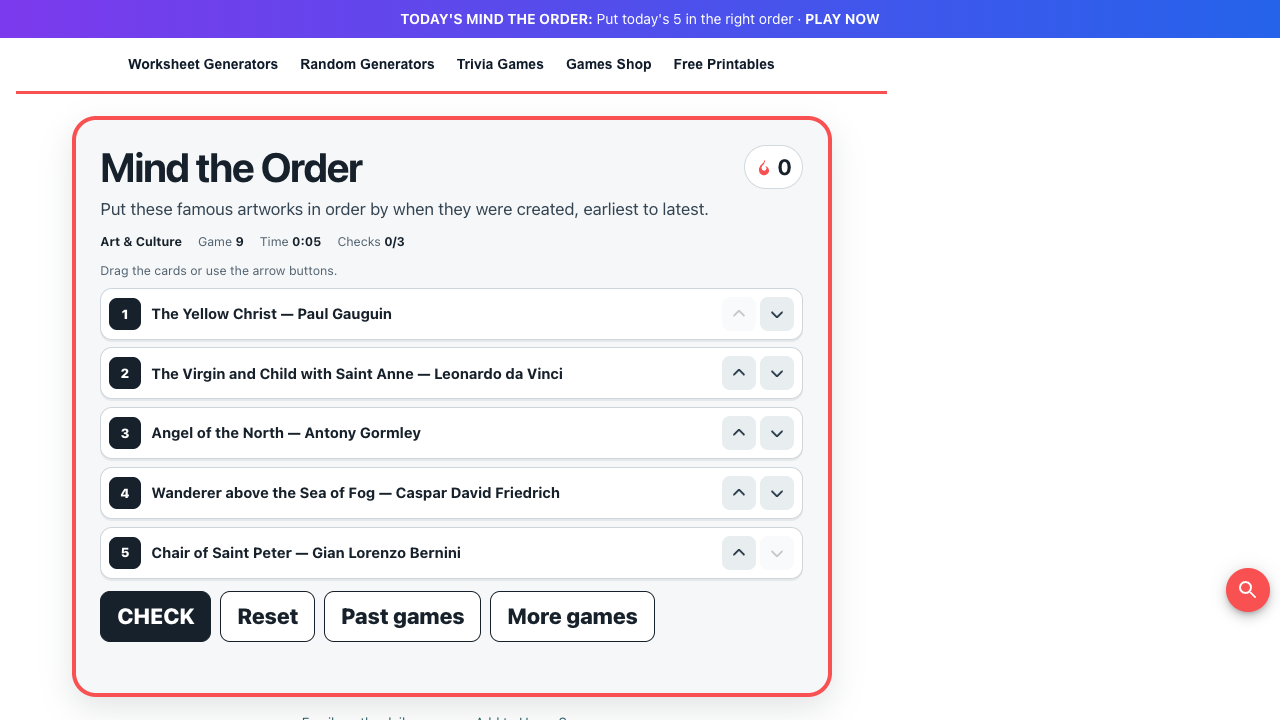

What is Mind the Order?
Mind the Order is a daily trivia puzzle in which you arrange five given items into the correct sequence. You do not have to invent the answers: the challenge is comparing the supplied items against a shared rule, such as the order in which works of art were created.
The category and ordering instruction are part of the puzzle. A familiar set of items can become challenging when you need to distinguish the middle positions rather than simply recognize the oldest or largest example.
Read the direction before moving anything
The rule tells you what is being compared and which direction to use. Earliest to latest is different from latest to earliest, just as smallest to largest reverses a size ranking. Read the full instruction before relying on an intuitive order.
The game lets you drag the cards or move them with arrow buttons. Check submits the sequence, while Reset gives you a way to start arranging again. Past games are available from the game panel.
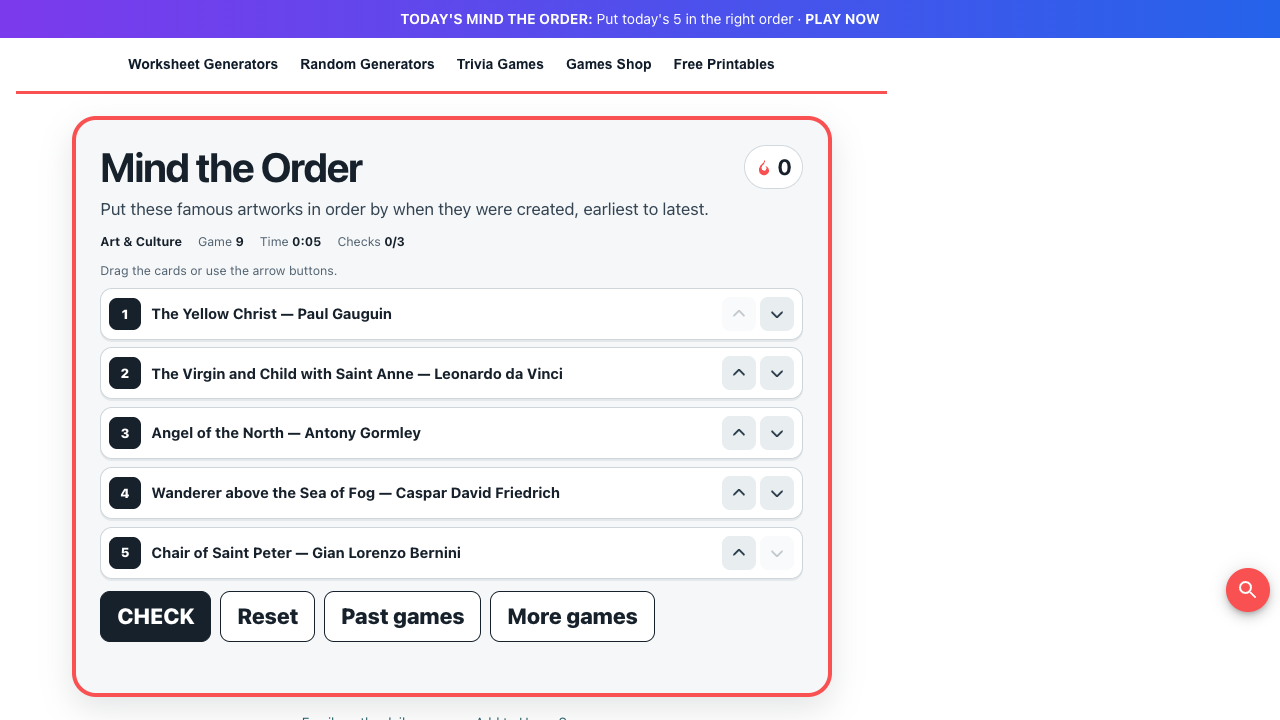
How to solve the daily ranking
- Read the category and the exact ordering rule above the five cards.
- Identify any item you can confidently place at the beginning or end.
- Drag the remaining cards or use their arrows to build a full sequence.
- Compare adjacent pairs against the rule before selecting Check.
- Review the feedback and use the available controls to continue or open an earlier game.
Tips for sorting the uncertain middle
Break the task into smaller comparisons. If you know that A belongs before B and B belongs before C, you already have a useful chain even if their exact dates or measurements are uncertain.
Keep the ranking criterion separate from fame or personal preference. A better-known work is not necessarily older, and a place that feels more important is not necessarily larger by the measurement being used. Mind the Order works well as a short daily discussion puzzle because explaining why one item should precede another is often the most interesting part of solving it.