What is cocdle?
Cocdle is a daily Clash of Clans guessing game built for players who have memorized far more troop trivia than they probably intended to. Instead of guessing letters, you are hunting down a hidden troop or building using information pulled from the Clash of Clans universe.
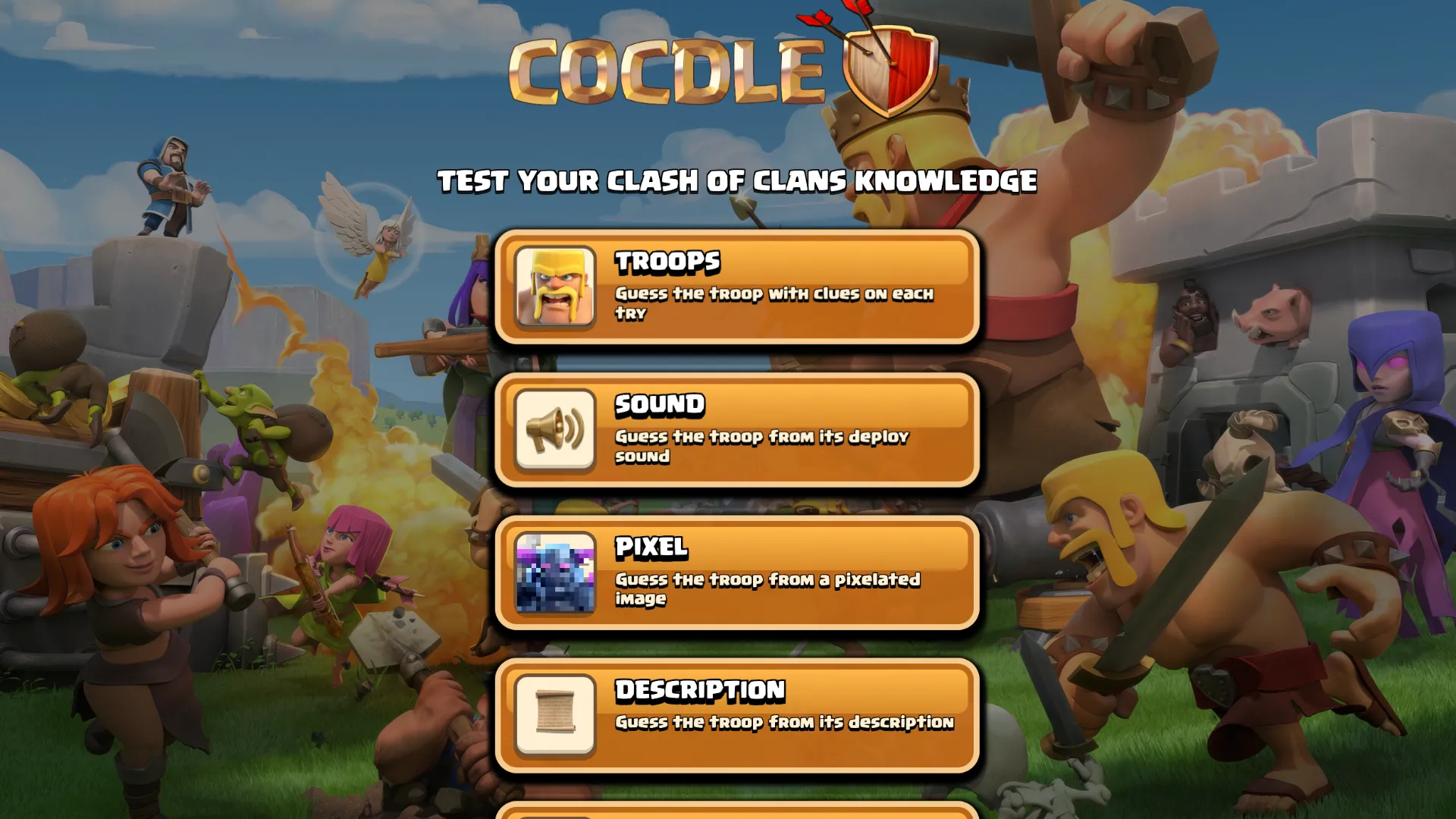
The dangerous part is that Cocdle does not rely on just one kind of knowledge. Its current game selector includes Troops, Sound, Pixel, Description, and Buildings challenges. One round might reward knowing housing space and attack speed; another might ask whether you can recognize a troop from a few blurry pixels or a familiar deployment sound.
cocdle Game Rules (The Catch / The Trap)
The main Troops challenge is the most deduction-heavy mode. Pick a Clash of Clans troop and Cocdle compares it with the hidden answer across attributes including Village, Damage Type, Target, Range, Attack Speed, and Housing.
A typical result works something like this:
Your Guess → Village ✅ | Damage Type ❌ | Target ✅ | Range ↑ | Atk Speed ↓ | Housing ↑
- Green / correct: that attribute matches the secret troop.
- Red / incorrect: that attribute does not match.
- ↑ Higher: the hidden troop has a higher numeric value than your guess.
- ↓ Lower: the hidden troop has a lower numeric value than your guess.
The trap is treating each clue separately. A candidate troop must survive the combined evidence from every previous guess. If Village and Target are already correct while Housing needs to increase, your next choice should respect all three constraints rather than simply chasing one arrow.
Other Cocdle modes change the battlefield:
- Sound: listen to a Clash of Clans troop sound and identify its owner.
- Pixel: identify a troop from a heavily pixelated portrait; wrong guesses make the image clearer.
- Description: identify the troop from a partial in-game description, with more text revealed after wrong guesses.
- Buildings: switch from troop knowledge to identifying the daily Clash of Clans building.
How To Play cocdle?
Choose your battlefield. Open Cocdle and select a mode such as Troops, Sound, Pixel, Description, or Buildings.
Make an opening guess. In Troops mode, suppose you choose a familiar troop from the searchable list.
Player Guesses:
WizardGame Responds:
Village ✅ | Damage ❌ | Target ✅ | Range ↑ | Atk Speed ↓ | Housing ↑You now know several things about the mystery troop without seeing it directly.
Turn feedback into constraints. Your next troop should keep the matching attributes while moving in the directions shown by the arrows.
What You Learned:
same Village + same Target + longer Range + slower/faster value as indicated + more HousingThe available candidates should now shrink dramatically.
Attack again. Make another guess and combine the new row of feedback with everything already revealed. Do not discard old clues—the winning troop has to satisfy the whole puzzle.
Find the answer and protect the streak. Continue narrowing the possibilities until you identify the hidden troop or building. Cocdle tracks statistics including wins, average tries, one-shot solves, current streak, and best streak.
cocdle Strategy & Tips
For Troops mode, make your first guess informative rather than obscure. A troop whose stats you understand well gives you a useful baseline across several categories at once.
Numeric arrows are especially powerful. If Housing must go ↑ while Range must go ↓, you can eliminate troops that fail either condition before worrying about the remaining attributes. Exact-match categories such as Village, Damage Type, and Target should be treated as hard filters once they turn green.
Pixel and Description modes reward patience. An early wild guess costs you an attempt but also reveals more visual detail or another piece of text, so sometimes the puzzle becomes a battle between solving immediately and collecting enough information to be certain.