What Is Commander Codex?
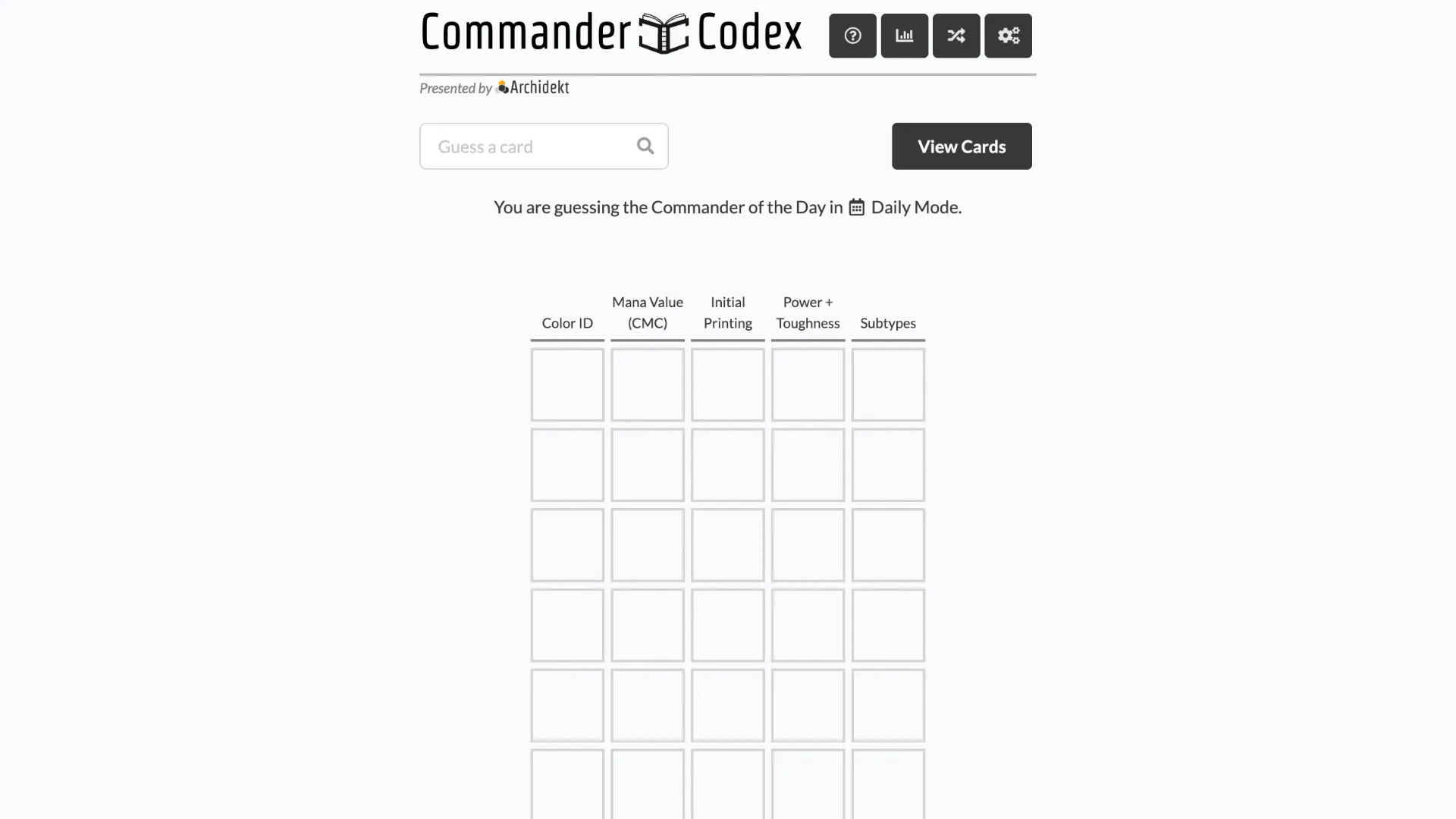
Commander Codex is a Magic: The Gathering guessing game created by the Archidekt team. Inspired by Wordle, it replaces letters with Commander card attributes: you have up to six guesses to identify one hidden Commander drawn from a pool based on the top 500 Commanders on EDHREC.
You do not need to guess card text or build a deck. Instead, every submitted Commander becomes a comparison point. The game tells you how the hidden card differs from your guess across five categories, allowing you to narrow the possibilities step by step.
Commander Codex has both a shared Daily puzzle and an Infinite mode. Daily gives players the same hidden Commander for the day, while Infinite generates another puzzle when you want to keep playing.
The Core Commander Codex Twist
Every guess produces five pieces of card information:
- Color ID: compares the Commander's color identity. Green means an exact match, yellow indicates partial overlap, and gray means there is no matching color.
- Mana Value (CMC): green means the mana value is correct. An up or down arrow tells you whether the hidden Commander has a higher or lower mana value than your guess.
- Initial Printing: compares when the cards were first printed. The arrow tells you whether the target's first printing is newer or older than the Commander you entered.
- Power + Toughness: compares the combined power and toughness value. An arrow points toward a higher or lower total when it is not an exact match.
- Subtypes: compares creature subtypes such as Human, Wizard, Dragon, or Elf. Partial overlap can help identify the target's creature family even when the complete subtype line is different.
The result is closer to a card-database deduction puzzle than ordinary trivia. A guess does not need to be close by name; it is useful when its attributes help eliminate a large group of Commanders.
How To Play Commander Codex
- Choose a Commander as your opening guess. Pick a card you know well, ideally one whose colors, mana value, release period, stats, and subtypes give you useful reference points.
- Read all five feedback columns. Note exact matches, partial color or subtype matches, and the direction of every numerical or chronological arrow.
- Narrow the candidate pool. If the target has a lower mana value, was printed later, shares only part of your color identity, and has higher combined power and toughness, look for a Commander satisfying all of those conditions at once.
- Submit a more targeted Commander. Use the new row to confirm or eliminate possibilities, and continue until you identify the hidden card or use all six guesses.
- Try another mode after the puzzle. Daily tracks the once-per-day challenge, while Infinite lets you immediately hunt another hidden Commander.
A Realistic Deduction Example
Suppose you guess a red-green six-mana creature and receive feedback showing:
Color ID: partial match
Mana Value: lower
Initial Printing: newer
Power + Toughness: lower
Subtypes: no match
You now know the hidden Commander shares at least some of the guessed colors but does not have exactly the same color identity, costs less than six mana, debuted later, has a lower combined power and toughness total, and does not share the guessed creature subtypes.
Your next guess should satisfy as many of those constraints as possible. The goal is not simply to name another popular Commander; it is to choose a card that tests the remaining possibilities.
Daily Mode and Infinite Mode
Daily Mode gives everyone the same hidden Commander for that puzzle. It is the mode for streaks, guess-count statistics, and spoiler-free result sharing.
Infinite Mode uses the same deduction rules but selects a new hidden Commander for another game. It is useful for practice or for players who do not want to stop after the daily puzzle.
Because both modes use the same attribute system, learning how to interpret one grid immediately transfers to the other.
Strategy Tips
Open With a Commander You Know Well
A famous card with memorable attributes is often more useful than a random guess. If you already know its color identity, approximate release era, mana value, stats, and creature types, you can interpret the first row immediately.
Treat Arrows as Hard Constraints
Do not waste later guesses on cards that contradict confirmed information. Once the game tells you the target costs less than five mana, for example, six- and seven-mana candidates can be removed from consideration.
Use Color Identity to Shrink the Search Space
Color feedback is one of the fastest ways to reduce the field. An exact color identity match can turn hundreds of possible Commanders into a much smaller group. A partial match is also useful because it tells you which colors may overlap without confirming the complete combination.
Watch the First-Printing Clue
Players often know a Commander's colors and mana cost but forget that release chronology is also a powerful filter. If one guess establishes that the target is newer than an older staple and another establishes that it predates a recent Commander, you have created a useful release window.
Combine Power and Toughness
Commander Codex compares the total of power plus toughness rather than asking you to separately solve both numbers. Think in totals when following this clue.
Use Subtypes Late in the Solve
Creature subtypes become especially useful once the color and mana-value possibilities are narrow. A partial subtype match can distinguish Human, Wizard, Dragon, Elf, Vampire, and other Commander families that otherwise share similar statistics.
What Is the View Cards Option?
Commander Codex can be difficult even for experienced Magic players because its answer pool contains hundreds of possible cards. The built-in View Cards option shows the Commander pool used by the game.
This is useful when your deduction has become very specific but you cannot remember the name of a card matching the clues. It also makes Commander Codex playable as a learning game: repeated rounds introduce Commanders you may never have encountered at a table.
Using the list makes the final search easier, so players who want the toughest memory challenge may prefer to avoid it until they are stuck.
Who Will Enjoy Commander Codex?
Commander Codex is best for Magic: The Gathering players who know the Commander format and enjoy card trivia, database-style deduction, or Wordle-inspired daily games. Newer MTG players can still play with the card list as a reference, but the game becomes substantially easier when you already recognize popular legendary creatures and remember their basic stats.
It is a particularly good fit if normal Wordle variants feel too vocabulary-focused and you would rather turn your knowledge of mana values, color identities, creature types, and Magic release history into a six-guess deduction puzzle.