
What Is Daily Prog Club?
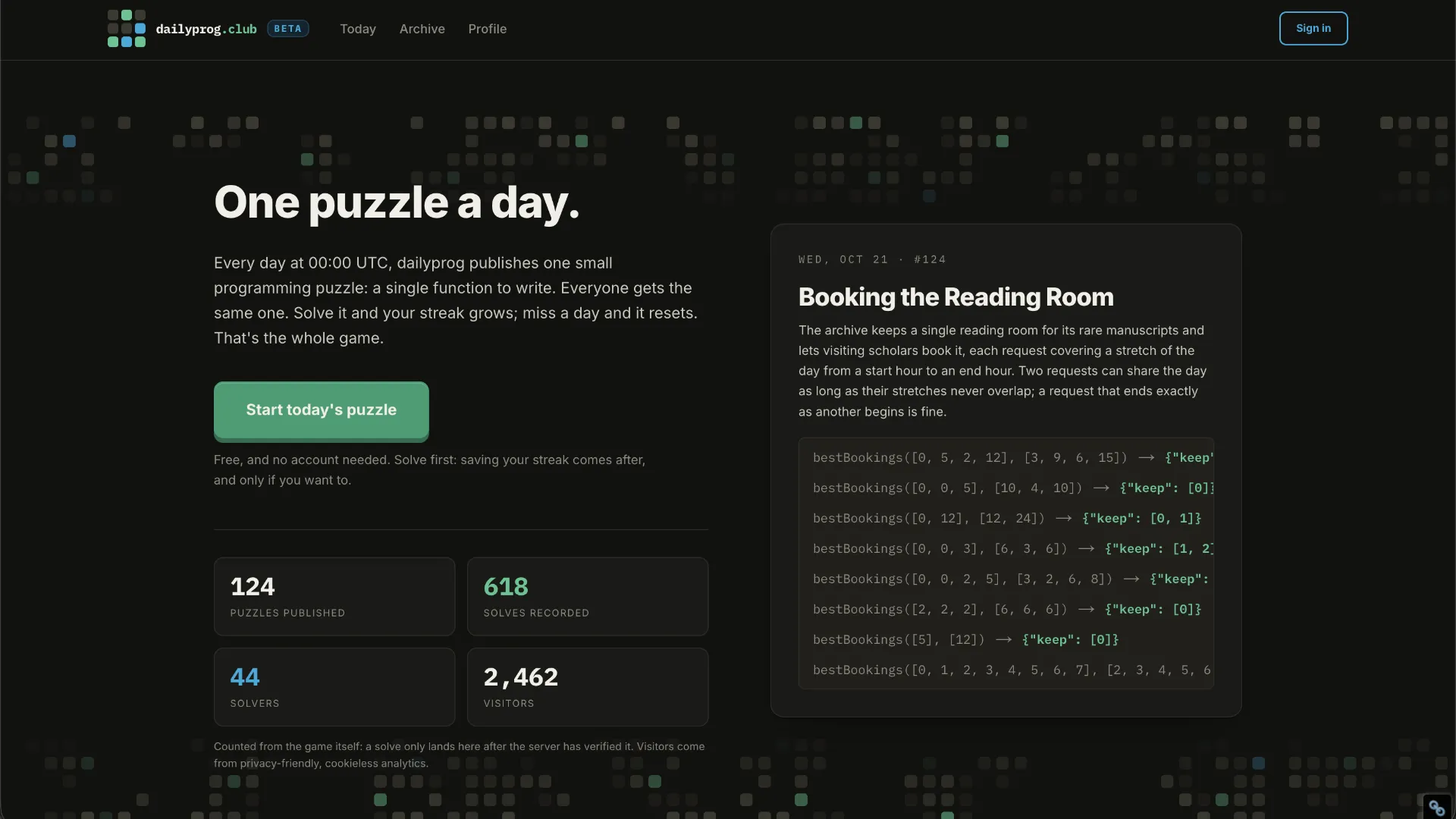
Daily Prog Club, also known as dailyprog.club, is a free daily programming puzzle game that challenges players to solve one algorithmic problem every day. Instead of guessing words, matching colors, or answering trivia, players write a working function that must pass a series of automated tests.
Every day at 00:00 UTC, Daily Prog Club publishes a new challenge consisting of a short story-based problem, a required function signature, input constraints, and example test cases. Everyone receives the same puzzle, making it a shared daily coding challenge.
The central objective is simple: write a function that correctly handles all valid inputs, not just the examples displayed on the page. Players can test their code as many times as they want before submitting an official solution, but they receive only five Solve attempts per daily puzzle.
Daily Prog Club supports eight programming languages: JavaScript, Python, C, Go, Clojure, APL, Lua, and Ruby. Solutions can be written directly in the browser's built-in code editor without installing a development environment.
The game is particularly appealing to programmers who enjoy algorithm challenges, logical problem-solving, and building a consistent daily coding habit. It combines the daily streak motivation of Wordle with the programming challenges of competitive coding platforms.
How Does Daily Prog Club Work?
Daily Prog Club is built around a straightforward challenge loop: read a problem, write a function, test it, submit it, and maintain your streak.
Each daily puzzle presents a real-world-inspired scenario that can be solved using programming logic and algorithms.
For example, a challenge might ask you to schedule non-overlapping room reservations, determine which objects can be divided into equal-weight groups, or calculate how many numerical totals can be constructed from a collection of stamps.
The goal is not simply to produce an answer for one example. You must write a general solution that works for every input permitted by the problem's constraints.
One Function, One Problem
Every challenge specifies a function name, its expected parameters, and the required output.
Instead of building an entire application, you focus on implementing that function correctly.
For example, an actual Daily Prog Club puzzle published on October 21, 2026, titled Booking the Reading Room, asks players to choose a collection of non-overlapping room bookings that maximizes the total reserved time.
A sample input and output are:
bestBookings([0, 12], [12, 24])

Expected output:
{"keep": [0, 1]}
The first array contains booking start times, while the second contains corresponding end times.
The example has two reservations: one runs from hour 0 to hour 12, and another runs from hour 12 to hour 24. Because the first booking ends exactly when the second begins, both reservations can be accepted.
The puzzle also specifies how to resolve ties between solutions with equal total booking time.
This illustrates the game's core mechanic: translating a natural-language problem into precise algorithmic logic.
Run vs. Solve: The Most Important Rule
Daily Prog Club provides two different ways to execute your code.
Run checks your implementation against the visible example tests. It runs locally in your browser, gives immediate feedback, and can be used without limit. Running code does not consume any of your official attempts.
Solve submits your code to the game's server, where it is executed inside a sandbox against both visible examples and hidden tests. Each Solve submission consumes one of your five daily attempts.
The distinction matters because passing the examples does not guarantee that your function is completely correct.
Hidden tests can include unusual inputs, boundary conditions, and larger datasets that expose mistakes or inefficient approaches.
A solution may pass every visible example but still fail when submitted if it does not handle all the required cases.
Five Attempts to Find a Correct Solution
You receive five official Solve attempts for each new daily puzzle.
If your code passes the complete test suite, the puzzle is solved and your daily completion is recorded.
If your submission fails, you can revise the function and submit again, provided you have attempts remaining.
Using all five attempts without passing the tests locks that day's puzzle. The next daily challenge provides a fresh set of attempts.
This creates an interesting balance between experimentation and careful reasoning. You can freely test ideas with Run, but official submissions require more confidence.
How to Play Daily Prog Club
Daily Prog Club runs directly in your browser, so you can start solving without installing software or creating an account.
- Open today's puzzle. Visit Daily Prog Club and select the current challenge. Read the story, required function signature, input constraints, and worked examples.
- Choose your programming language. Use the language selector in the built-in editor to choose JavaScript, Python, or another supported language. Write a function that accepts the specified inputs and returns the required output.
- Test your code with Run. Execute your solution against the visible examples. Examine the results, correct errors, and repeat as often as necessary. These local tests do not use official attempts.
- Submit with Solve. When the visible examples pass and you have considered potential edge cases, press Solve. The server checks your implementation against additional hidden tests. You have five official attempts to achieve a passing result.
- Record your win and return tomorrow. A successful submission counts toward your daily streak. Share your spoiler-free result, explore older puzzles for practice, and return after the next UTC reset for a new challenge.
The game rewards correct reasoning rather than typing speed. Taking time to understand the problem and test edge cases can be more valuable than rushing to submit.
Eight Supported Programming Languages
Daily Prog Club allows players to solve challenges using several different programming languages.
| Language | Runtime | Notes |
|---|---|---|
| JavaScript | V8 / Node 24 | Browser Run uses the local JavaScript engine; official verification uses server-side V8. |
| Python | Pyodide / CPython 3.14 | Python compiled to WebAssembly, including standard-library support. |
| C | PicoC | A subset of C rather than a complete native C environment. |
| Go | Yaegi 0.16 | An interpreted Go subset with some limitations. |
| Clojure | SCI / Scittle | A lightweight ClojureScript-flavored interpreter. |
| APL | ngn/apl | Array-oriented programming with a built-in glyph keyboard. |
| Lua | Wasmoon / Lua 5.4 | Lua running through WebAssembly. |
| Ruby | ruby.wasm / CRuby 3.4 | Ruby compiled to WebAssembly. |
Language availability can depend on the individual puzzle, and some runtimes support only subsets or dialects of their respective languages.
These differences matter when implementing advanced features. For example, C players should not assume that the complete C standard library is available, while Go players may encounter limitations involving generics.
The editor preserves in-progress code separately for each language, allowing players to switch languages without immediately losing their work.
It also includes optional Vim keybindings for players who prefer modal keyboard editing.
Real Examples of Daily Prog Club Challenges
Daily Prog Club uses short narrative scenarios to introduce algorithmic problems. The underlying challenge is to identify the correct computational approach.
Booking the Reading Room
In the October 21, 2026 puzzle, a reading room receives multiple reservation requests. Players must select compatible bookings that maximize total reserved time.
The problem involves interval scheduling, checking overlapping ranges, maximizing an objective, and applying tie-breaking rules.
A correct implementation must handle cases where bookings touch at their endpoints, bookings overlap, or several different selections achieve the same total duration.
Balancing the Sample Tray
An October 20, 2026 puzzle involves a collection of laboratory samples with different weights.
Players must determine which sample can be removed so the remaining samples can be divided into two groups with equal total weight.
For example:
removableForBalance(
  ["a", "b", "c"],
  [1, 1, 2]
)

Expected output:
["c"]
Removing sample c leaves two samples of weight 1, which can be placed on opposite sides of the balance.
This problem requires reasoning about subsets, sums, and possible arrangements rather than simply calculating the total weight.
The Stamp Dealer's Run
An October 19, 2026 puzzle asks players to calculate the largest consecutive range of postage amounts that can be constructed from available stamps.
For example:
largestCoverage([1, 2], [1, 1])

Expected output:
3
With one stamp worth 1 and one worth 2, you can form postage totals of 1, 2, and 3 without gaps.
The challenge involves understanding how different values extend the range of achievable sums and how to handle limited quantities efficiently.
These examples demonstrate the variety of topics covered by Daily Prog Club, including scheduling, combinatorial reasoning, and numerical algorithms.
Strategy Tips for Solving Daily Prog Club
1. Understand the Problem Before Coding
Read the entire problem statement, including its input constraints and output requirements.
Pay attention to details such as whether intervals can touch, whether duplicate values are allowed, and how ties must be resolved.
Many incorrect submissions result from overlooking a single sentence rather than choosing the wrong overall algorithm.
Before writing code, try explaining the problem in your own words and identifying the exact result the function must return.
2. Study the Constraints
Input limits often reveal which algorithmic approaches are practical.
If a puzzle contains only a handful of items, enumerating possible combinations may be reasonable.
If the input can contain hundreds or thousands of values, an exponential approach may be too slow. A sorting-based, greedy, or dynamic-programming solution may be more appropriate.
The correct technique depends on the individual puzzle, so use its constraints to guide your decision.
3. Test Edge Cases Before Submitting
Visible examples demonstrate intended behavior, but they rarely cover every possible situation.
Consider edge cases such as:
- The smallest allowed input.
- Repeated or equal values.
- Inputs where no valid selection exists.
- Inputs where multiple answers tie.
- Already sorted or reverse-sorted data.
- Large inputs that could expose inefficient code.
For instance, a booking-scheduling function must handle requests that begin exactly when another ends, while a subset-sum function must consider whether equal partitions are possible after removing each candidate item.
Think through these scenarios before spending an official Solve attempt.
4. Use Run Without Fear
The Run button does not consume your five attempts, so there is no advantage to skipping the local testing stage.
Use it while developing the function to identify syntax errors, incorrect return formats, and logical mistakes exposed by the visible examples.
However, remember that Run checks only visible tests for the active daily puzzle. A successful local run is necessary evidence of progress, not proof that the implementation is complete.
5. Avoid Hardcoding Example Answers
A solution that simply recognizes the displayed example inputs and returns their known outputs may pass local tests, but it will fail on different hidden inputs.
Instead, identify the rule that connects inputs to outputs and implement that rule generally.
This is the core skill Daily Prog Club tests: transforming individual examples into a correct and reusable algorithm.
6. Watch Algorithmic Complexity
Hidden tests can contain larger inputs and unusual cases.
An implementation that performs well on five small examples may become extremely slow when processing hundreds of values or exploring large numbers of combinations.
Whenever possible, estimate the time complexity of your solution before submitting.
For example, an O(n²) algorithm may be reasonable for small inputs, but an O(2^n) approach can become impractical as the number of elements grows.
7. Learn From Failed Submissions
A failed Solve attempt indicates that the submitted implementation did not satisfy the full test suite.
Return to the problem statement and reconsider assumptions that may not hold for all inputs.
Check edge cases, output structure, runtime limitations, and performance before submitting again.
Because only five submissions are allowed, systematic debugging is more effective than repeatedly making minor changes without understanding the cause.
What Is the Growth Meter?
Daily Prog Club includes a distinctive performance-analysis feature called the growth meter.
After successfully solving most puzzles, players can run their code on increasingly large inputs to observe how execution time changes.
The growth meter doubles the input size between measurements and compares your implementation with a reference solution.
The general interpretation is:
- Approximately 2× slower per doubling: Often consistent with linear-time growth, O(n).
- Approximately 4× slower per doubling: Often consistent with quadratic-time growth, O(n²).
- Much steeper growth: May indicate an algorithm that scales poorly as input sizes increase.
These are approximate indicators rather than definitive complexity proofs because actual runtime also depends on the input data, implementation, and execution environment.
The growth meter runs locally in your browser. It does not change your official verdict, consume Solve attempts, or affect your streak.
This makes it especially useful for players who want to improve their algorithms after obtaining a correct answer.
Daily Puzzles, Archives, and Streaks
Daily Prog Club uses a one-puzzle-per-day format designed to encourage consistent practice.
One New Puzzle at Midnight UTC
A new problem appears every day at 00:00 UTC.
Everyone receives the same challenge, allowing players to discuss approaches and compare results.
Only successfully solving the current daily puzzle counts toward your consecutive-day streak.
Five Official Attempts
Each daily puzzle allows five Solve submissions.
A successful submission completes the challenge. Using all five attempts without passing locks the puzzle until the next day's fresh challenge becomes available.
Unlimited local Run checks let you experiment before making an official submission.
Play Past Puzzles in the Archive
Daily Prog Club maintains a public puzzle archive containing previous daily challenges.
When a puzzle's scheduled day ends, its hidden tests become visible. You can then use Run to check your solution against the complete set of tests.
Archived puzzle completions are tracked separately from official daily solves. They provide useful programming practice but cannot restore a missed daily streak.
The archive also offers a Surprise Me option for discovering older challenges without choosing a particular date.
Build Your Coding Streak
Successfully completing the daily puzzle on consecutive days increases your streak.
Missing a day resets the consecutive-day count.
The streak is based on verified solves rather than self-reported progress, adding credibility to the achievement.
After solving, you can share a spoiler-free result that shows your performance without revealing the code or solution.
Is Daily Prog Club Free?
Yes. Daily Prog Club is free to play in a browser.
There is no mandatory subscription, software installation, or account registration for attempting the daily puzzles.
The built-in editor, local testing, official submissions, and archive are available through the website.
Players can begin solving anonymously, with progress initially stored on their device.
If you want your streak and puzzle history to persist across devices, Daily Prog Club provides optional identity features.
You can sign in using a supported developer account from GitHub, GitLab, or Codeberg, or opt into a 24-word recovery phrase to keep an anonymous identity.
Because the recovery phrase is not recoverable by the service, players choosing that method must store it securely.
The game does not require an email address or password for basic participation.
Who Should Play Daily Prog Club?
Daily Prog Club is especially appealing to developers, computer science students, programming enthusiasts, and players who enjoy algorithmic problem-solving.
It is a good choice for programmers who want a structured daily challenge without committing to lengthy competitive programming contests.
Beginners with some programming knowledge can use the archive to practice implementing functions and understanding input constraints.
More experienced programmers may enjoy optimizing solutions, exploring alternative algorithms, and comparing performance with the growth meter.
The game is less suitable for players who want conventional point-and-click puzzles or completely code-free gameplay. Writing and understanding actual source code is essential to solving the challenges.
However, for anyone interested in strengthening computational thinking, Daily Prog Club offers an engaging combination of practical coding and daily puzzle mechanics.
What Makes Daily Prog Club Different?
Daily Prog Club combines features of coding challenge platforms with the simplicity of a daily puzzle game.
Its distinguishing features include:
- One shared daily challenge: Every player receives the same programming puzzle at midnight UTC.
- Real code submissions: Players must write a working function rather than select a multiple-choice answer.
- Eight programming languages: JavaScript, Python, C, Go, Clojure, APL, Lua, and Ruby are supported, subject to puzzle and runtime limitations.
- Unlimited local testing: Run visible examples as often as necessary without consuming attempts.
- Five official attempts: Hidden server-side tests make correct, general solutions more important than memorizing examples.
- Algorithmic variety: Challenges involve scheduling, arrays, numerical reasoning, subsets, and other computational problems.
- Daily streak tracking: Consecutive verified solves build a meaningful coding habit.
- Replayable archive: Past puzzles become available with their complete test cases revealed.
- Growth meter: Players can investigate how their solutions scale on increasingly large inputs.
- Optional accounts: Anonymous participation and several ways to preserve progress are available.
Unlike traditional coding exercise websites with enormous problem catalogs and complex ranking systems, Daily Prog Club concentrates on a small, consistent daily challenge.
Frequently Asked Questions
How many puzzles does Daily Prog Club release each day?
One new programming puzzle is published every day at 00:00 UTC.
How many Solve attempts are allowed?
Players receive five official attempts per daily puzzle. Local Run tests are unlimited and do not consume attempts.
Which programming languages are supported?
Daily Prog Club supports JavaScript, Python, C, Go, Clojure, APL, Lua, and Ruby, although available languages and runtime capabilities can vary by puzzle.
What is the difference between Run and Solve?
Run checks your code locally against visible examples. Solve submits the function to the server for verification against both visible and hidden tests.
Can you solve previous daily puzzles?
Yes. The archive allows players to revisit previous challenges. Once a puzzle's day has ended, its hidden tests become available for practice.
Do archived puzzles count toward your streak?
No. Only successful solutions to the current daily puzzle count toward the daily streak.
Do you need a GitHub account to play?
No. You can play without creating an account. Optional GitHub, GitLab, or Codeberg sign-in helps preserve progress across devices.
Can beginners play Daily Prog Club?
Yes, provided they understand the basics of at least one supported programming language. Some challenges can be approached with simple loops and conditionals, while others require more advanced algorithms.
Conclusion
Daily Prog Club turns programming practice into a focused daily puzzle experience. With one new challenge each day, unlimited local testing, five official submissions, and a streak system, it encourages players to develop stronger algorithmic thinking through consistent practice.
Its browser-based editor, multiple supported languages, replayable archive, and performance growth meter offer useful depth without requiring complicated setup.
Whether you are learning to solve algorithm problems or want a daily challenge to keep your coding skills sharp, Daily Prog Club provides a practical and engaging way to exercise your problem-solving abilities.
Ready to write today's solution? Play Daily Prog Club and see if you can pass every hidden test within five attempts.
For detailed rules, language runtime limitations, and account options, visit the official Daily Prog Club FAQ.