What is Daydle?
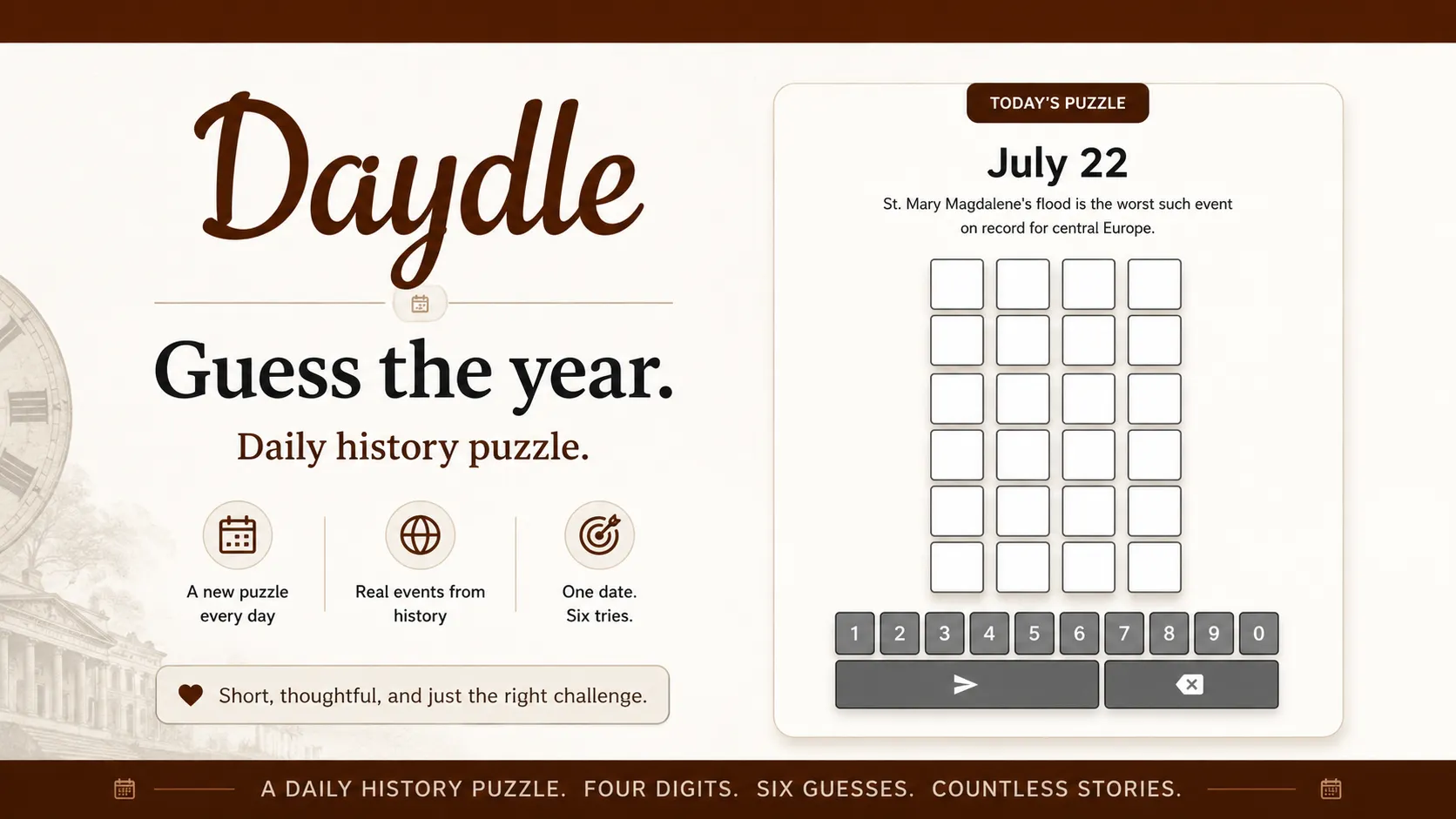
Daydle reaches into the archives, selects an event that occurred on today's month and day, and hides its year. Your mission is to read the historical clue and identify the missing four-digit date before six guesses disappear.
The event might be famous enough to trigger instant recognition—or obscure enough to send your internal timeline into free fall. Each failed attempt produces colored numerical feedback, so Daydle is not purely a history quiz. It is also a deduction puzzle where individual digits can pull you toward the answer even when your historical memory refuses to cooperate.
Daydle Game Rules (The Catch / The Trap)
The daily investigation follows this pattern:
HISTORICAL EVENT → ENTER YEAR → READ DIGITS → GUESS AGAIN
- One event per day: The mystery event happened on the current calendar date in a hidden year.
- Enter four digits: Submit the year in standard four-digit form.
- Six attempts: You MUST find the exact year before the final row is used.
- Green digit: The number is correct and occupies the correct position.
- Blue digit: Your number is close to the corresponding answer digit, generally one value away.
- Red digit: The number is incorrect at that point in the evaluation.
- White digit: The position has not provided useful confirmation and may remain unevaluated after an earlier miss.
- Share the result: After solving or exhausting the board, you can compare the day's performance with friends.
The trap is that Daydle does not simply announce earlier or later. Its colors judge the four digits, meaning a promising-looking year can still be centuries away while an awkward numerical pattern quietly points toward the solution.
🟩 Exact | 🟦 One away | 🟥 Wrong | ⬜ Unconfirmed
How To Play Daydle?
Step 1: Read the historical clue
Imagine today's event is:
The first modern Olympic Games open in Athens.
You remember that it happened near the end of the nineteenth century, but the exact year is hiding.
Step 2: Test the broad era
Player Guesses: 1875
Feedback:
1 🟩 8 🟩 7 🟥 5 ⬜
What This Means: The year begins with 18, but the third digit is not 7. The final digit has not yet given you reliable information.
Step 3: Probe the remaining digits
Player Guesses: 1885
Feedback:
1 🟩 8 🟩 8 🟦 5 🟦
What This Means: The third digit is one away from 8, and the fourth digit is one away from 5.
The likely target becomes:
18 ? ? → 1896
Step 4: Lock in the historical year
Player Guesses: 1896
Result:
1 🟩 8 🟩 9 🟩 6 🟩
The year is correct, the event is revealed in full, and the daily Daydle is defeated before the six-attempt limit.
Daydle Strategy & Tips
Begin with the event itself. Identify its broad century, political era, technological stage, or cultural movement before entering a number. A sensible first guess produces far more useful feedback than a random date.
Preserve every green digit. Once a position is confirmed, treat it as LOCKED IN and spend future guesses testing the uncertain positions.
Use blue digits carefully. A blue 8 suggests a neighboring value such as 7 or 9; it does not mean the entire year is only one year away.
Finally, watch the evaluation order. A red digit can leave later positions without meaningful feedback, so your next guess should repair the earliest unresolved position before drawing conclusions from the boxes that follow.