
What Is DSMdle?
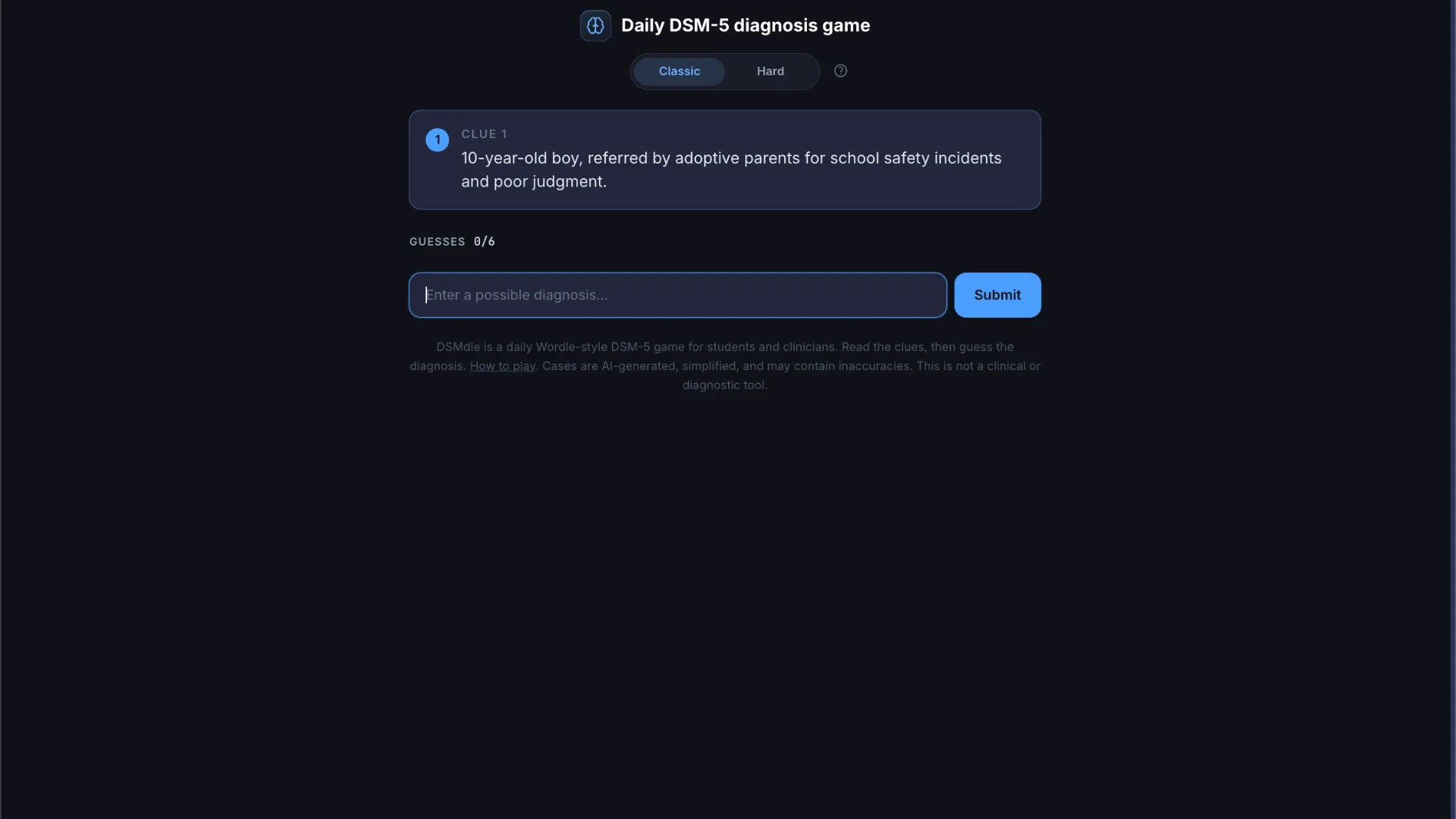
DSMdle is a daily browser game built around DSM-5 clinical reasoning. Instead of guessing a hidden word from letter colors, you are given a short fictional clinical presentation and try to identify the diagnosis that best matches it.
A new case appears each day. The clues become progressively more specific as the round continues, making the game feel closer to solving a short clinical vignette than playing a traditional word puzzle.
The game is especially suited to psychology students, clinicians, and players who already know common diagnostic terminology. Players without that background can still try it, but the answers can be considerably harder to recognize.
DSMdle states that its cases are AI-generated, simplified, and not clinically validated. It is intended for learning and entertainment rather than diagnosing real people or providing medical advice.
How the Daily Case Works
In Classic mode, the round begins with Clue 1, which gives you an initial patient presentation. You enter the DSM-5 diagnosis that you think best fits the case.
If your answer is incorrect, DSMdle reveals another clue. Each additional clue gives you more information and helps narrow the range of possible diagnoses.
You can receive up to six clues and make up to six guesses. Solving the case with fewer clues produces a better result.
A typical round works like this:
- Read the initial clinical presentation.
- Enter your first diagnosis.
- If it is incorrect, review the newly revealed clue.
- Narrow your differential diagnosis and submit another answer.
- Continue until you solve the case or use all six attempts.
Unlike Wordle, DSMdle does not use green, yellow, or gray letter tiles. The important feedback is the new clinical information revealed after each incorrect guess.
How to Play DSMdle
- Read the first clue carefully. Look for age, symptoms, duration, context, impairment, and any unusual details.
- Choose a likely diagnosis. Enter the DSM-5 condition that appears to fit the presentation best.
- Use the next clue after a wrong answer. Do not simply guess randomly; compare the new information against your original reasoning.
- Narrow the differential. Eliminate diagnoses that no longer fit and focus on details that separate closely related conditions.
- Solve within six guesses. The Classic round ends when you identify the intended diagnosis or use all available attempts.
Classic and Hard Mode
Classic mode is the standard daily game. You can submit multiple diagnoses, and every incorrect guess unlocks another clue, up to six attempts.
Hard mode puts more emphasis on confidence and timing. Instead of repeatedly testing diagnoses, the challenge is deciding when you have enough information to commit to a final answer. Using fewer clues leads to a stronger result.
This makes Hard mode feel less like trial and error and more like deciding how much evidence you need before making a diagnosis.
Strategy Tips
Build a Differential Before Guessing
Do not immediately submit the first diagnosis that comes to mind. Consider two or three plausible alternatives first. That makes later clues much easier to interpret.
Focus on Discriminating Details
Broad symptoms can fit many diagnoses. Duration, triggers, impairment, exclusions, associated symptoms, and specific behavioral patterns are often much more useful.
Use Wrong Guesses Productively
An incorrect answer unlocks more information in Classic mode. Treat each new clue as evidence that should update your reasoning rather than as a signal to make another random guess.
Avoid Overfitting a Single Symptom
One striking symptom may point toward several conditions. Look at the entire presentation and consider whether the full pattern matches your proposed diagnosis.
Remember That It Is a Game
DSMdle uses simplified and AI-generated fictional cases. It is useful as a knowledge and reasoning challenge, but it should not be treated as a substitute for professional assessment or real-world diagnostic practice.
Who Should Try DSMdle?
DSMdle is a strong fit for players who enjoy specialized daily games and want something more knowledge-heavy than a typical word puzzle. Psychology students can use it as lightweight review, experienced players can challenge themselves to solve cases from early clues, and clinicians may enjoy testing their recognition of different presentations.
Its specialized vocabulary creates a higher barrier to entry than most casual daily games, but that is also what makes DSMdle distinctive: it turns diagnostic reasoning into a short daily puzzle.