What Is fanimoji?
fanimoji is a daily animal trivia game created by Lost Art Games, LLC. Instead of asking you to identify a mystery animal, the game reveals the animal's name immediately and challenges you to demonstrate how much you actually know about it.
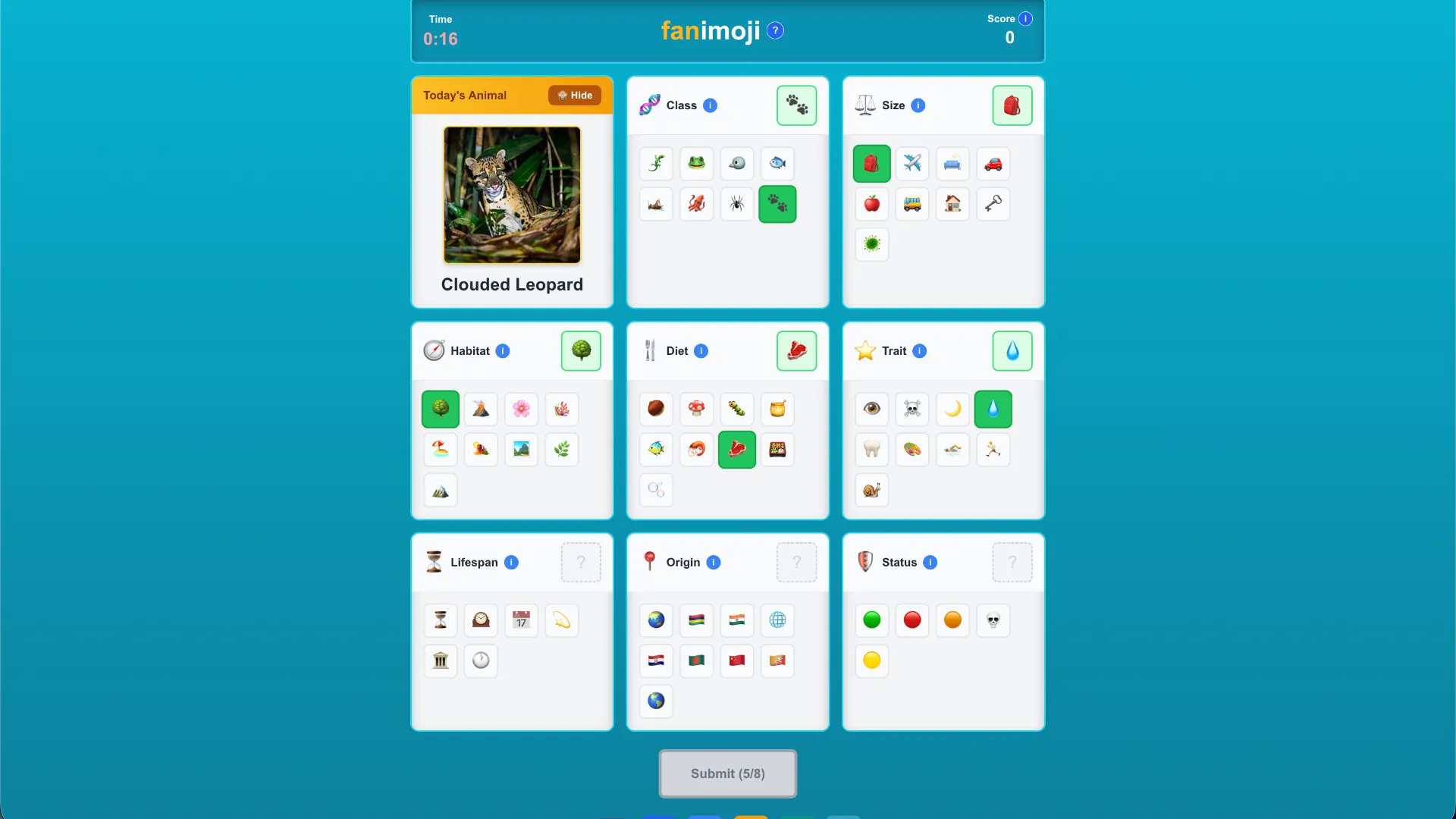
Every day, a different animal takes center stage. Your mission is to select the most accurate emoji for each of eight characteristics: Class, Size, Habitat, Diet, Trait, Lifespan, Origin, and Conservation Status.
It sounds straightforward until you realize how much there is to know about even familiar animals. You might recognize a species instantly but struggle to identify its typical lifespan, geographic origin, or conservation classification.
The game combines wildlife knowledge, visual multiple-choice questions, and a timed scoring challenge. Correct emoji matches earn points, while completing the puzzle quickly can provide a speed bonus.
Unlike Wordle-style animal guessing games, the animal itself is never the mystery. The challenge is understanding its biology, environment, and characteristics.
How fanimoji Works: Eight Animal Categories
Each daily puzzle presents a named animal alongside eight property cards. Every card contains emoji choices representing possible answers.
| Category | What You Need to Identify |
|---|---|
| Class 🧬 | The animal's biological group, such as mammal, bird, reptile, amphibian, or fish |
| Size ⚖️ | Its approximate physical size, represented by comparative emoji choices |
| Habitat 🧭 | The environment where the animal typically lives |
| Diet 🍴 | What the animal eats, such as plants, meat, insects, or a specialized food source |
| Trait ⭐ | A distinctive biological feature, behavior, or adaptation |
| Lifespan ⏳ | How long the animal typically lives |
| Origin 📍 | Its geographic origin or native region |
| Status 🛡️ | Its conservation classification or level of extinction risk |
Your job is to choose the emoji that best represents the featured animal in every category.
Some questions are relatively easy. Identifying a lion as a mammal is straightforward, but estimating the typical lifespan of a particular species or distinguishing between conservation categories may require more specialized knowledge.
The choices are expressed through emoji rather than traditional text answers, adding a visual interpretation challenge to the quiz.
How to Play fanimoji
- Open the daily puzzle. Visit fanimoji and start today's animal challenge. The featured animal's name appears at the top of the game board.
- Examine the featured animal. Read its name and use the Peek option if you want to view its photograph. You do not need to guess its identity.
- Match the eight categories. Work through Class, Size, Habitat, Diet, Trait, Lifespan, Origin, and Status. Select the emoji that best describes the animal in each category.
- Check your choices and submit. Fill all eight answer slots while keeping an eye on the countdown timer. Use the small information buttons when you need clarification about unfamiliar category terminology.
- Review your score. Submit the completed animal profile to see how accurately you matched its characteristics. Correct answers contribute to your score, and faster completion can earn a speed bonus.
The game features a new animal every day, giving players another opportunity to test their wildlife knowledge.
Example: Describing an Animal With Emojis
Imagine a hypothetical fanimoji puzzle featuring an African elephant.
The game already tells you the animal is an elephant. Instead of identifying the species from clues, you must choose emoji that accurately represent its characteristics.
A simplified example might look like this:
| Property | Example Answer | Why It Fits |
|---|---|---|
| Class | 🐾 Mammal | Elephants are mammals |
| Size | 🐘 Very large | Elephants are among the largest living land animals |
| Habitat | 🌿 Savanna or forest | African elephant habitats vary by species |
| Diet | 🌱 Herbivore | Elephants eat grasses, leaves, bark, and other vegetation |
| Trait | 🦷 Tusks | Tusks are a recognizable elephant characteristic |
| Lifespan | ⏳ Several decades | Elephants can live for many decades |
| Origin | 🌍 Africa | African elephants are native to Africa |
| Status | 🛡️ Conservation concern | African elephant species face significant conservation threats |
This example illustrates the type of knowledge the game tests. The actual emoji choices and accepted answers depend on the featured species and the game's category definitions.
Notice how knowing that elephants eat plants is relatively easy, while selecting the correct conservation status requires distinguishing between species and understanding wildlife protection classifications.
That mix of familiar facts and surprising biological details is what makes fanimoji interesting.
fanimoji Scoring and Time Challenge
fanimoji rewards accurate answers and efficient play.
The game's scoring is based on two important factors:
- Answer accuracy: Selecting the ideal emoji for each category earns points. The more accurately you describe the animal, the better your result.
- Completion speed: The game includes a countdown timer, and finishing faster can award additional points through a speed bonus.
Your current score and the remaining time are displayed on the game board. The submission control also indicates how many of the eight category slots have been filled.
This creates a balance between thinking carefully and answering quickly. Spending too much time debating a difficult conservation-status question may reduce your potential speed reward, but rushing through familiar categories can also lead to avoidable mistakes.
Tips and Strategies for Higher Scores
1. Answer the Easy Categories First
Start with characteristics you recognize immediately, such as an animal's biological class, general size, or typical diet. This helps you make progress before spending time on more difficult questions.
2. Distinguish Habitat From Origin
Habitat describes the type of environment an animal lives in, while origin concerns its native geographic region.
For example, a species might live in tropical forests but originate from a particular continent or group of countries. These categories are related but not interchangeable.
3. Pay Attention to Specialized Diets
Not every animal fits neatly into herbivore, carnivore, or omnivore categories. Some species primarily eat plankton, leaves, insects, fish, or other specific foods.
If an unfamiliar dietary term appears, use the category's information button to understand what it means before selecting an emoji.
4. Think About Realistic Lifespans
An animal's lifespan can be less intuitive than its appearance. Size alone does not reliably predict longevity: some small animals live surprisingly long lives, while some much larger species have shorter typical lifespans.
Use what you know about the species rather than assuming all large animals live longer.
5. Learn Conservation Categories
Conservation status is often one of the trickiest parts of the game.
Common classifications include Least Concern, Near Threatened, Vulnerable, Endangered, and Critically Endangered. These categories describe different levels of extinction risk.
Familiarity with these terms can help you select the most appropriate status emoji.
6. Use Peek and Information Buttons Strategically
The Peek feature lets you view the featured animal's photograph, which may help with its appearance or distinguishing characteristics.
Information buttons explain category terminology. They are particularly useful for unfamiliar biological vocabulary, although spending time reading explanations can affect your speed bonus.
7. Review What You Learned
After completing a puzzle, compare your selections with the correct animal characteristics. Reviewing mistakes can improve your understanding of wildlife and make future puzzles easier.
What Makes fanimoji Different From Other Animal Games?
Most animal-themed guessing games ask players to identify a hidden species using pictures, clues, or progressively revealed information.
fanimoji reverses that formula.
The animal is revealed at the beginning, so there is no mystery about its identity. Instead, the challenge is to construct an accurate biological profile using emoji.
This difference makes the game educational without feeling like a conventional school quiz. It encourages players to think about ecological relationships, feeding behavior, geographic distribution, biological adaptations, and conservation.
The emoji interface also makes the questions more visual and approachable than a traditional list of written multiple-choice answers.
Daily Puzzles and Playing With Friends
fanimoji belongs to the Lost Art Games collection of daily browser puzzles, alongside games such as Letterbox and D3C1PH3R.
A new featured animal appears each day, providing a short wildlife knowledge challenge that can become part of a regular puzzle routine.
The daily game can be played without creating an account. Lost Art Games also offers optional Squads features for players who want to compete with friends, family, or coworkers on private leaderboards and access additional puzzle history.
Squads is a separate premium offering with a free trial, so it should not be confused with the free daily game.
Is fanimoji Free to Play?
Yes. The daily fanimoji puzzle is available for free through the official Lost Art Games website.
You can open the game directly in a web browser without downloading an app or signing up for an account.
Lost Art Games describes its daily puzzle collection as ad-free and focused on short, thoughtful challenges rather than lengthy gaming sessions.
Who Should Play fanimoji?
fanimoji is especially suitable for wildlife enthusiasts, animal trivia fans, nature lovers, and players who enjoy short educational challenges.
It is also a good option for people who enjoy visual quizzes and want something different from conventional word-guessing games.
Players do not need expert zoological knowledge to participate. Familiar animals provide approachable entry points, while less obvious properties such as lifespan and conservation status create opportunities to learn something new.
Conclusion
fanimoji transforms animal trivia into a colorful daily emoji challenge. By revealing the animal first and asking players to describe eight of its characteristics, it tests a different kind of wildlife knowledge than traditional guessing games.
The combination of biological facts, emoji choices, a countdown timer, and accuracy-based scoring makes each puzzle a quick but engaging test of what you really know about the animal kingdom.
Play fanimoji and see how accurately you can describe today's featured animal using just eight emojis.