
What Is Flagle?
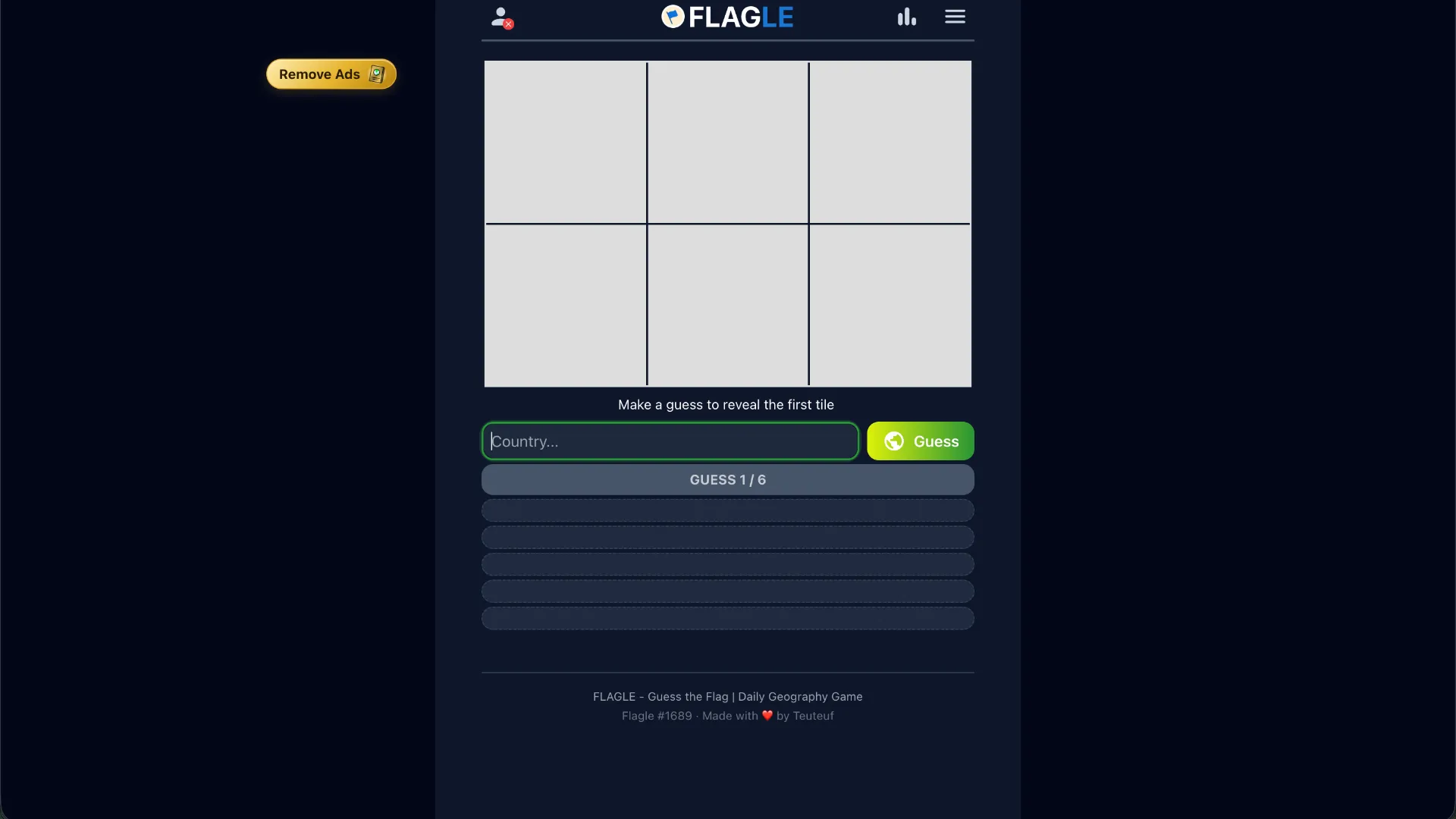
Flagle is a daily geography guessing game built around national flags. The challenge is to identify the mystery country or territory within six guesses. Rather than showing the complete flag immediately, the game makes you guess to reveal flag sections, turning each attempt into an extra visual clue.
The game also gives geographic feedback after guesses: distance, direction, and a proximity percentage show how close your chosen country is to the target. That combination makes Flagle more than a simple flag quiz—you can solve a difficult flag by combining visual recognition with geography.
Flagle Rules and Core Twist
The goal is simple: identify the hidden flag before you run out of six guesses.
- Every guess must be a valid country or territory.
- You begin without the complete flag and reveal flag information as you make guesses.
- After a guess, geographic feedback indicates how far your choice is from the target and which direction the target lies.
- A proximity percentage gives another indication of how close you are.
- Guess the correct country or territory within six attempts to solve the daily puzzle.
- A new Flagle is available each day.
The important twist is that visual and geographic clues work together. A red-and-white fragment might fit several flags, but a direction arrow showing that the answer lies southeast of your guess can eliminate entire regions.
How to Play Flagle
- Make an opening guess. Type a country or territory into the search field. On the current game, your first guess reveals the first flag tile.
- Read the geographic feedback. Check the distance, direction arrow, and proximity percentage. A higher proximity means your guess is geographically closer to the mystery location.
- Study the revealed flag. Look for stripe orientation, unusual colors, stars, crosses, crescents, coats of arms, or other distinctive details as more of the design becomes visible.
- Combine both clue types. Use the flag fragments to create a shortlist, then use distance and direction to decide which candidate makes geographic sense. Continue until you find the answer or use all six guesses.
Example of the Geography Clues
Flagle's official rules demonstrate the feedback with guesses such as Chile, shown as 13,557 km from an example target with a northeast direction and 32% proximity, followed by Finland at 3,206 km with a southeast direction and 83% proximity. A correct guess such as Lebanon then shows 0 km and 100% proximity.
A round can therefore develop like this:
- Guess 1: Only limited flag information is available. Your guess is far away, so both the flag clue and geographic feedback suggest changing regions.
- Guess 2: Another part of the flag becomes useful and the proximity score rises sharply.
- Guess 3: The visible pattern now resembles one or two likely countries. Direction and distance break the tie.
- Correct guess: The target country is identified before the sixth attempt.
Flagle Strategy Tips
Use geography instead of guessing random flags. If the visual clue could belong to several countries, the direction arrow is often more useful than another speculative flag guess.
Think in flag families. Nordic crosses, horizontal tricolors, vertical tricolors, pan-African colors, crescents, and Union Jack cantons can quickly narrow the possibilities.
Pay attention to symbol placement. Many countries share the same colors. A star in the canton, a centered crest, an off-center circle, or the position of a triangle can be much more informative than color alone.
Compare proximity between guesses. Moving from a low proximity score to a much higher one tells you that your geographic reasoning is improving even before the flag becomes obvious.
Do not ignore territories. Flagle's official rules state that guesses can be countries or territories, so avoid assuming every target must be an independent sovereign state.
Flagle is a good fit for players who enjoy daily geography games but want something more visual than map-outline guessing. Its combination of progressively revealed flag clues and geographic feedback gives knowledgeable players several different ways to reach the answer.