What Is Floe?
Floe is a free daily browser-based logic puzzle game where you guide a penguin across slippery ice to collect fish. The catch is simple but surprisingly challenging: once the penguin starts sliding, it cannot stop until it hits a rock or reaches the edge of the ice.
Every move sends the penguin traveling in a straight line, so solving each puzzle requires careful planning. You must figure out which directions to slide, where the penguin will stop, and how to reach every fish without wasting moves.
Floe features three new puzzles every day, ranging from easier layouts to more demanding challenges. Each puzzle has a par score representing the mathematically proven minimum number of slides needed to collect every fish.
Created by Yuki Andersen and released in July 2026, Floe combines simple controls with thoughtful route-planning puzzles. It runs directly in modern desktop and mobile browsers, with no download or account registration required.
How Does Floe Work?
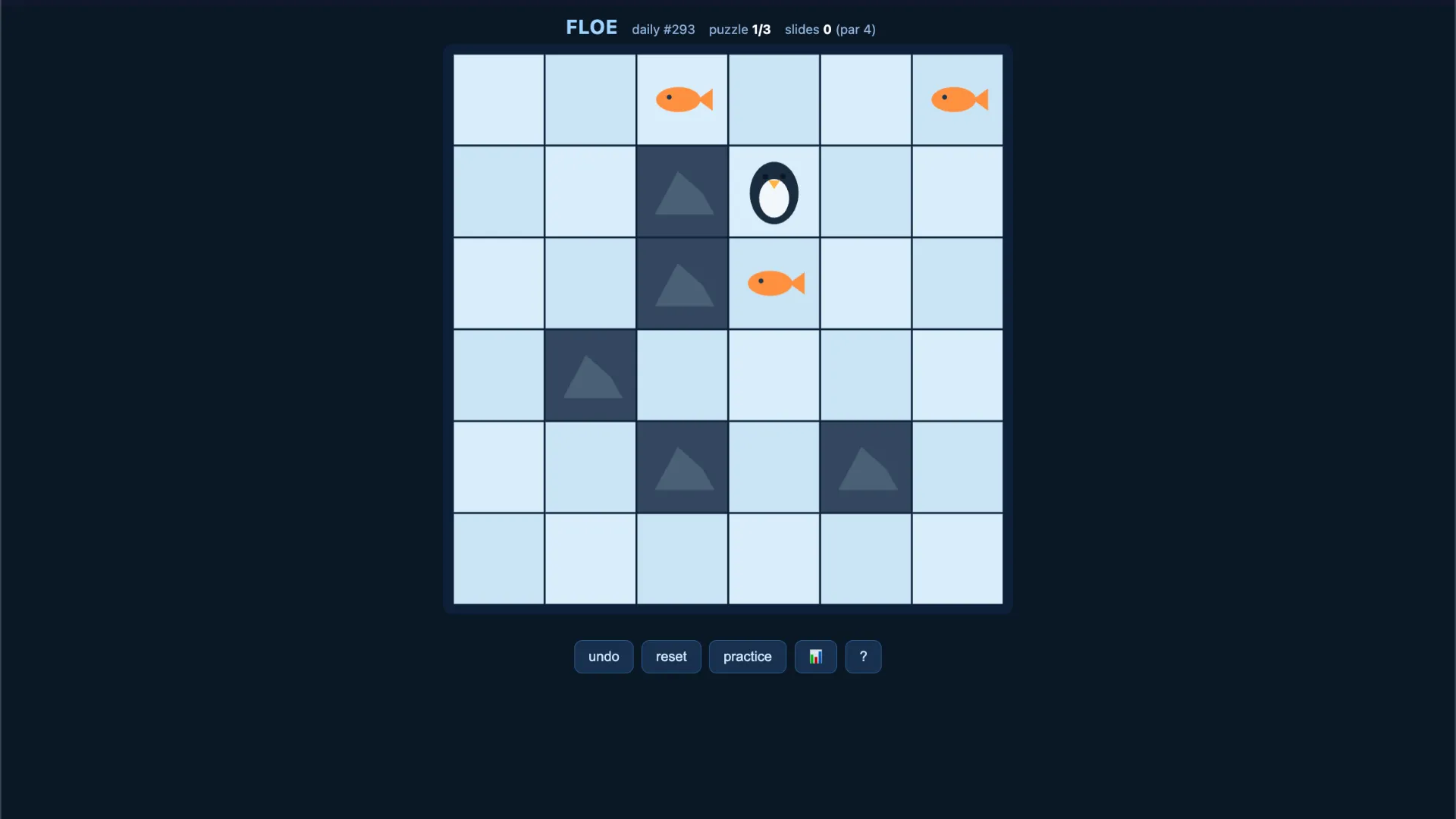
Floe takes place on a grid of ice containing a penguin, collectible fish, and rocks that block movement.
Unlike a traditional grid-based puzzle where you move one square at a time, Floe uses an ice-sliding mechanic. Every directional input moves the penguin as far as possible in that direction.
The Ice-Sliding Rule
When you press an arrow key or swipe in a direction, the penguin immediately starts sliding.
It continues traveling until one of two things happens:
- A rock blocks its path: The penguin stops on the square immediately before the rock.
- The edge of the ice is reached: The penguin stops at the last available square along that direction.
You cannot stop voluntarily between those points.
This restriction is the central challenge of Floe. A fish might be only one square away, but reaching it can require several slides because the penguin cannot simply step onto an adjacent square and stop.
Collect Every Fish
Fish are scattered across the ice. Your objective is to collect all of them by moving the penguin through their positions.
A fish is collected whenever the penguin slides over it or stops on its square.
You do not necessarily need to stop directly on a fish. A single slide can collect multiple fish if they lie along the same unobstructed route.
The puzzle is complete when every fish has been collected.
Rocks Are Obstacles and Tools
Rocks prevent the penguin from sliding through certain squares, but they also create useful stopping points.
For example, imagine a horizontal row with the following arrangement:
🐧 · 🐟 · 🪨
If the penguin slides right, it travels across the fish and stops immediately before the rock. The fish is collected along the way.
Now imagine the fish is located on a different row. You may need to use a rock to stop at the correct column before sliding vertically toward it.
This is why rocks are more than obstacles: they help establish the precise positions needed to change direction.
Understanding Par
Every Floe puzzle displays a par score.
Par represents the fewest possible slides required to collect every fish, as verified by a puzzle-solving algorithm.
For example, if a puzzle has a par of five, at least five slides are necessary to collect every fish. Completing it in five slides is a perfect solution, while finishing in seven slides means you used two more moves than the optimum.
Beating par is impossible because par is already the proven minimum. The challenge is to match it.
How to Play Floe
Floe uses simple directional controls, so beginners can start immediately.
- Open today's puzzles. Visit Floe in your browser. Start the daily challenge, which contains three puzzles with different levels of difficulty.
- Study the ice grid. Locate the penguin, every fish, the rocks, and the outer boundaries. Identify where the penguin can stop after moving in each direction.
- Choose a sliding direction. Press an arrow key or WASD on your keyboard, or swipe on a touchscreen. The penguin slides until it reaches a rock or the edge, collecting any fish along its path.
- Plan your next slides. From the new stopping position, choose another direction. Think about how rocks and boundaries can help you reach fish that seem difficult to access. Use Undo or Reset if you want to try another route.
- Collect all the fish. Continue until every fish is gone. Compare your total slide count with par, complete the remaining daily puzzles, and share your results with friends.
The controls are straightforward, but finding the minimum-move solution can be much harder than simply finishing the puzzle.
Floe Controls
Floe supports both keyboard and touchscreen input.
| Action | Keyboard | Touchscreen |
|---|---|---|
| Slide up | Up arrow or W | Swipe up |
| Slide down | Down arrow or S | Swipe down |
| Slide left | Left arrow or A | Swipe left |
| Slide right | Right arrow or D | Swipe right |
| Undo a slide | U or Z | Undo button |
| Restart puzzle | R | Reset button |
Touchscreen players can also tap the side of the board corresponding to the direction they want the penguin to travel.
These controls make Floe accessible on laptops, desktop computers, smartphones, and tablets.
Three New Floe Puzzles Every Day
The daily challenge is the main feature of Floe. Each day introduces three fresh ice-sliding puzzles, progressing from easy through medium to hard.
Easy Puzzle
The first puzzle provides a relatively approachable introduction to the day's challenge.
It is a good opportunity to practice basic sliding routes, understand where the penguin can stop, and become familiar with the relationship between rocks and fish placement.
Medium Puzzle
The second puzzle requires more deliberate route planning.
A useful stopping position may be several slides away, and collecting a nearby fish immediately may not be the most efficient strategy.
Players need to consider how their position after each slide affects future possibilities.
Hard Puzzle
The third puzzle presents the most demanding challenge of the daily set.
Finding any successful route may require experimentation, while matching par can demand careful optimization of the complete sequence of moves.
A route that appears promising early may eventually require additional slides to reach the final fish.
Shared Daily Challenges
Everyone receives the same three puzzles for a given calendar date, making it possible to compare results with friends.
The daily puzzles reset at midnight in your local timezone.
Completing all three challenges maintains your daily streak and unlocks a spoiler-free result summary that you can share without revealing the solutions.
A full daily session typically takes only a few minutes, making Floe a convenient addition to a daily puzzle routine.
Strategy Tips for Solving Floe
1. Plan Around Stopping Positions
The most important Floe strategy is to focus on where the penguin will stop, not just the squares it passes through.
A slide may cross several useful squares, but your next move begins only after the penguin stops.
Before choosing a direction, ask two questions:
- Where will this slide end?
- What directions will be useful from that stopping position?
Thinking this way helps avoid moves that collect a fish but leave the penguin in an inconvenient location.
2. Use Rocks to Change Direction
Rocks create controlled stopping positions in the middle of the board.
Suppose a fish is located in an interior column that cannot be reached by sliding directly from the edge.
A rock may allow the penguin to stop in that column, making it possible to slide vertically across the fish afterward.
When a fish seems unreachable, identify the nearby rocks and determine whether one can position the penguin correctly.
3. Look for Multiple Fish Along One Route
Because the penguin collects fish while sliding over them, a single move can sometimes collect two or more fish.
Look for fish sharing a row or column with an unobstructed path between them.
Collecting multiple fish in one slide can help reduce your total move count and bring you closer to par.
However, make sure the resulting stopping position is useful for the next part of the puzzle.
4. Work Backward From Difficult Fish
When one fish looks especially hard to reach, start by examining the routes that pass through its square.
Identify possible horizontal and vertical approaches, then determine which stopping positions would allow the penguin to take those routes.
From there, work backward to figure out how to reach one of those positions.
This reverse-planning technique can make apparently complicated layouts much easier to understand.
5. Consider the Order of Collection
Although every fish must eventually be collected, the order in which you reach them can affect the total number of slides.
For example, collecting a nearby fish first might force you to return across the board later. A longer initial route could instead position the penguin to collect several fish efficiently in succession.
Try to build a route that minimizes repeated travel between the same stopping points.
6. Use Undo to Experiment
Floe includes an Undo feature that lets you reverse your previous slide.
If a particular route turns out to be inefficient, return to an earlier position and experiment with another direction.
You can also reset the puzzle entirely to try a new solution from the starting configuration.
These controls are especially useful when attempting to match the optimal par score.
7. Separate Solving From Optimization
For a difficult puzzle, first concentrate on finding any route that collects every fish.
Once you understand how the board works, try removing unnecessary slides from your solution.
Compare your result with par to determine how much improvement is possible.
A solution that finishes two slides above par provides a clear optimization target for your next attempt.
Daily, Practice, and Archive Modes
Floe offers several ways to play beyond the current daily challenge.
Daily Mode
Daily mode contains three date-based puzzles that are identical for all players on the same day.
Each puzzle has a mathematically verified par score. Complete the daily set to maintain your streak and share your performance.
Unlimited Practice
Practice mode generates unlimited random puzzles, allowing players to continue sliding and solving after finishing the daily set.
Practice puzzles do not affect your daily streak.
This mode is especially useful for learning how stopping positions influence route planning, practicing efficient solutions, and experimenting with different approaches.
Puzzle Archive
Floe includes an archive of previous daily challenges.
You can revisit earlier dates and replay their original three-puzzle sets, making it possible to improve past results or catch up on puzzles you missed.
Archived games do not restore a missed daily streak, but they provide additional challenges without waiting for tomorrow.
What Makes Floe Different?
Floe combines the familiar structure of a daily puzzle game with an ice-sliding mechanic that creates unusually interesting movement restrictions.
Unlike games where players move characters one square at a time, Floe forces every move to continue until a physical obstacle stops it.
This creates several distinctive features:
- Commitment-based movement: Every directional input moves the penguin to the next rock or boundary.
- Route-planning challenges: Reaching the correct stopping position is often more important than moving directly toward a fish.
- Multiple collectibles: Players must collect every fish, not simply reach one destination.
- Proven optimal solutions: Every puzzle includes a solver-verified minimum slide count.
- Three daily puzzles: Easy, medium, and hard challenges provide a short progression each day.
- Unlimited practice: Players can generate additional puzzles whenever they want.
- Replayable archive: Previous daily challenges remain available.
- Simple controls: Keyboard, swipe, and touch input make the game approachable across devices.
The combination of minimal controls and meaningful route optimization gives Floe more strategic depth than its simple appearance might suggest.
Is Floe Free to Play?
Yes. Floe is completely free to play online.
The game does not require an account, payment, or software installation. According to its official website, it currently has no advertisements.
Players can access the daily challenge, unlimited practice mode, and archived puzzles directly through a modern web browser.
Floe also works on mobile devices and school Chromebooks, provided they support a modern browser.
Who Should Play Floe?
Floe is ideal for players who enjoy logic puzzles, spatial reasoning, route planning, and grid-based challenges.
Its simple movement rules make it easy for beginners to understand, while the search for minimum-move solutions provides a deeper challenge for experienced puzzle fans.
The game particularly rewards players who enjoy thinking several steps ahead, experimenting with alternative paths, and finding elegant solutions to restrictive movement problems.
It is also suitable for players looking for a short daily mental challenge that does not depend on vocabulary, trivia knowledge, or fast reflexes.
If you prefer thoughtful puzzle solving over action-heavy gameplay, Floe offers a satisfying experience in a compact format.
Frequently Asked Questions
How many puzzles does Floe have each day?
Floe offers three daily puzzles: easy, medium, and hard. All players receive the same puzzles for the same calendar date.
What is the goal of Floe?
Collect every fish on the ice by sliding the penguin horizontally or vertically. Try to finish using the fewest possible slides.
Can the penguin stop in the middle of a slide?
No. Once the penguin starts moving, it continues until blocked by a rock or the edge of the ice.
What does par mean in Floe?
Par is the mathematically proven minimum number of slides needed to solve a puzzle. Matching par means you have found an optimal solution.
Can you play more than three puzzles?
Yes. Practice mode offers unlimited randomly generated puzzles, and the archive allows you to replay previous daily challenges.
When does Floe reset?
New daily puzzles become available at midnight in your local timezone.
Can you play Floe on a phone?
Yes. Floe supports touchscreen controls, including swiping to move the penguin.
Conclusion
Floe transforms a simple idea—a penguin that cannot stop sliding—into an engaging daily logic challenge.
By using rocks as stopping points, planning routes around the board, and collecting every fish efficiently, players must think carefully about the consequences of each move.
With three daily puzzles, solver-verified par scores, unlimited practice, and an archive of previous challenges, Floe offers plenty of opportunities to sharpen your problem-solving skills.
Ready to hit the ice? Play Floe and see if you can match par on all three of today's puzzles.