
What Is Guess the Chain?
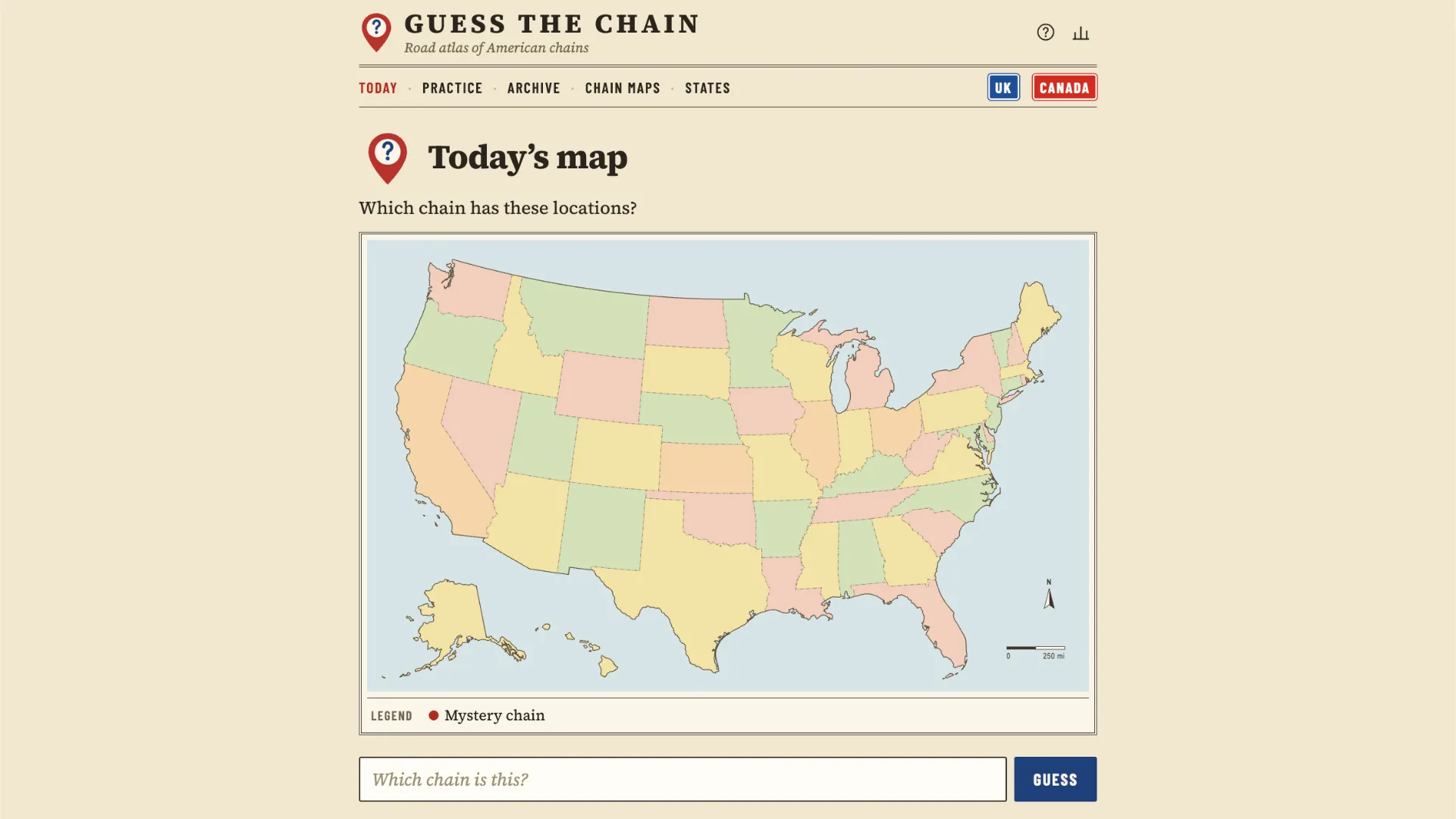
Guess the Chain is a free daily geography and brand-identification game that challenges players to recognize an American business chain from the geographic distribution of its locations.
Instead of showing a logo, storefront photograph, or company name, the game displays a map of the United States covered with dots. Each dot represents a mapped location belonging to one mystery chain. Your task is to figure out which business operates those locations.
The mystery business might be a restaurant, retail store, gas station, bank, or gym. Some chains have thousands of locations spread across the country, while others are concentrated in just a few states.
For example, a dense cluster across the southeastern United States might suggest a regional restaurant chain, while locations distributed across nearly every state could indicate a major national retailer.
You get six guesses to identify the correct chain. Each incorrect guess provides information about the business category, relative number of locations, and geographic overlap between your guess and the mystery chain.
Guess the Chain also offers optional clues, an archive of previous daily puzzles, and an unlimited practice mode.
Guess the Chain Rules
The goal is to identify the business represented by the dots on the map before using all six guesses.
The main rules are:
- One mystery chain: The US map displays locations belonging to a single hidden business chain.
- Six guesses: You have up to six attempts to identify the correct brand.
- Business-name guesses: Enter the name of a restaurant, retailer, gas station, bank, gym, or another supported chain.
- Flexible spelling: Close spellings are accepted, with the game matching your entry to the most likely chain.
- Category feedback: Learn whether your guess belongs to the same, a similar, or a different business category.
- Store-count feedback: Find out whether the mystery chain has more or fewer locations than your guess.
- Geographic overlap: See how closely your guessed chain's distribution matches the mystery map.
- Optional clues: Reveal additional facts when you need help, including the business category, location count, founding year, headquarters state, and first letter.
- Daily puzzle: A new mystery map becomes available at midnight in your local time zone.
The challenge is not simply recognizing a famous brand. You must interpret its geographical footprint and use the feedback to narrow the possibilities.
How to Play Guess the Chain
- Open the daily map: Visit Guess the Chain and examine the dots across the United States. Look for states with many locations, areas with few locations, and regions where the chain is completely absent.
- Make your first guess: Type the name of a chain that matches the geographic pattern into the guessing field and click Guess. You can submit close spellings because the game matches them to recognizable chain names.
- Read the comparison feedback: If your answer is incorrect, examine the category indicator, store-count arrow, and map-overlap information. These clues reveal how your guess compares with the target.
- Compare maps or request a clue: Use Compare to overlay your guessed chain's locations in blue. If you remain stuck, press Get a clue to reveal another fact about the mystery business.
- Identify the chain: Combine all the information and continue guessing until you find the correct brand or exhaust your six attempts. Afterward, share your spoiler-free result, try a practice puzzle, or explore previous daily maps.
Understanding the Guess the Chain Map
The map is the central feature of the game. Learning to recognize different business-distribution patterns is the most useful skill for improving your guesses.
National Chains
Some businesses operate across almost the entire country.
Their maps contain dots in many states, often with particularly dense clusters around major population centers and transportation corridors.
A nationwide distribution might suggest a major fast-food restaurant, supermarket chain, pharmacy, convenience store, or discount retailer.
However, widespread coverage does not identify a specific business by itself. Use the number of locations and the relative density of different regions to distinguish between possible answers.
Regional Chains
Other businesses are concentrated in particular parts of the United States.
For example, Waffle House is strongly associated with the southeastern United States, while In-N-Out Burger is especially associated with the western and southwestern states.
Recognizing these regional identities can make certain puzzles easier to solve.
A regional chain's map may also contain isolated dots outside its primary territory, so pay attention to the overall concentration rather than assuming every location must be inside one region.
Location Density
The number of dots can help distinguish a chain with relatively few branches from one with thousands of locations.
A dense nationwide map suggests a very different business scale from a map containing only a few dozen points.
Remember that location density is influenced by both the number of stores and the areas where those stores operate. Large population centers naturally support more business locations.
Geographic Gaps
Empty areas are often just as informative as dense clusters.
If a chain has a strong presence in the eastern United States but very few locations on the West Coast, that distribution can eliminate businesses with established nationwide networks.
Likewise, a chain present throughout the Midwest but largely absent from the Northeast may indicate a more specific regional identity.
What Do the Feedback Clues Mean?
After each incorrect guess, Guess the Chain provides three main types of comparison feedback.
| Feedback | Meaning | How to Use It |
|---|---|---|
| Category ✓ | Same type of business | Focus on chains in that category. |
| Category ≈ | Similar business category | Consider related types of businesses. |
| Category ✗ | Different business category | Explore another category. |
| Stores ↑ | The mystery chain has more locations | Consider larger chains. |
| Stores ↓ | The mystery chain has fewer locations | Consider smaller chains. |
| Map Overlap | Geographic similarity between the two chains | Compare their regional coverage. |
Category Feedback
Category feedback tells you whether you are guessing the right kind of business.
If you guess a restaurant and receive a matching category indicator, other restaurant chains become promising candidates.
If the category is different, it may be time to consider retail stores, banks, gas stations, or gyms instead.
A similar-category indicator suggests that the two businesses have related classifications without being exactly the same type.
Stores: Higher or Lower
The store-count arrow compares the mystery chain's number of locations with the number operated by your guessed chain.
An upward arrow means the target has more locations. A downward arrow means it has fewer.
This feedback is particularly useful when the map's number of dots is difficult to estimate visually.
For example, if your guessed chain operates many locations but the game indicates that the mystery chain is smaller, you can start considering more regional businesses.
Map Overlap
Map overlap measures how much the two chains cover the same geographical areas.
High overlap suggests that your guess and the mystery chain have similar geographic footprints. Low overlap suggests that they operate in different regions or have substantially different coverage patterns.
The Compare feature allows you to display the guessed chain's dots in blue alongside the mystery locations.
This makes it easier to spot differences in state coverage and regional concentration.
Example: Solving a Mystery Chain
Imagine a hypothetical puzzle with the following characteristics:
- Most locations appear in the southeastern United States.
- There are many dots around Georgia and neighboring states.
- The map has relatively little coverage on the West Coast.
- The mystery appears to belong to a familiar consumer-facing business category.
You decide to begin with a well-known national restaurant chain.
The game indicates that your guess belongs to the correct category but that the mystery business has fewer locations.
Next, you guess a smaller regional restaurant chain.
This time, the store-count comparison is more promising, and the map-overlap feedback shows stronger geographic similarity.
You press Compare and notice that the blue dots broadly align with the mystery map across several southeastern states.
That suggests you should concentrate on restaurant chains with a similar regional footprint rather than jumping to unrelated national businesses.
If you still cannot identify the answer, you can request a clue revealing the headquarters state or first letter.
This example illustrates the deduction process rather than reproducing an actual daily puzzle. The exact feedback depends on the chains selected and the game's underlying location dataset.
How the Optional Clues Work
Guess the Chain provides five optional clues that can be revealed one at a time using the Get a clue button.
| Clue | Information Revealed |
|---|---|
| Category | The mystery chain's business category |
| Locations | The number of mapped business locations |
| Founded | The year the chain was founded |
| Headquarters | The US state where the business is headquartered |
| First Letter | The first letter of the chain's name |
The game allows you to reveal these clues progressively rather than requiring you to use them immediately.
Clue usage is recorded in your shared result, so solving with fewer clues provides an additional personal challenge.
For players who enjoy difficult puzzles, a good approach is to make one or two evidence-based guesses before requesting extra information.
For players who are unfamiliar with American business chains, revealing the category early can make the game much more approachable.
Guess the Chain Strategy and Tips
1. Examine the Empty States First
Do not focus exclusively on where the dots appear.
The absence of locations in large parts of the country can be a more distinctive clue than their presence in major cities.
A chain missing from the West Coast, for example, may be easier to identify than one with branches across most states.
2. Distinguish National and Regional Brands
Before entering your first guess, decide whether the map represents a broadly national network or a smaller regional business.
A map with tens of thousands of dots suggests a different group of possible businesses from one with only a few dozen locations.
This distinction can prevent wasting guesses on brands with completely different operating scales.
3. Use Your First Guess to Test a Category
When the business type is unclear, select a plausible chain that also has an informative geographic footprint.
The resulting category feedback can eliminate entire groups of businesses, while the store count and overlap information help refine your search.
A useful guess should tell you something even when it is wrong.
4. Combine Store Count With Map Overlap
Neither metric should be interpreted alone.
Two chains may have similar numbers of locations but operate in different states. Alternatively, two chains may share a geographic region but have very different numbers of branches.
The most promising candidates match both the approximate size and regional distribution of the mystery chain.
5. Use Compare Instead of Relying on Memory
The Compare button displays your guessed chain's locations in blue.
Look for areas where the blue dots align with the mystery distribution and areas where they differ significantly.
This can reveal whether you are close to the right chain or whether your guess only resembles the target in a few population centers.
6. Think Beyond Restaurants
Restaurants are recognizable and may be natural first guesses, but the game includes other business categories.
A dense map could represent a retailer, gas station, bank, or gym rather than a food chain.
If repeated restaurant guesses produce poor category feedback, reconsider your assumption about the business type.
7. Save Specific Clues Until Later
The first-letter and headquarters clues can narrow the possibilities considerably.
Consider using broader evidence, such as location patterns and category comparisons, before revealing these more direct identifying details.
This makes successful deductions more satisfying and can reduce your reliance on hints over time.
Daily, Practice, and Archive Modes
Guess the Chain offers several ways to play.
Daily Mode
The main game provides one new mystery map every day, refreshing at midnight in your local time zone.
You have six guesses to solve the current map and can share your result without revealing the answer to other players.
Practice Mode
Practice mode generates random mystery maps and allows you to play additional rounds without a daily limit.
It is useful for learning the geographic footprints of different chains and improving your ability to interpret store-location patterns.
Archive Mode
The archive contains previous daily maps, allowing players to revisit older puzzles instead of waiting for the next challenge.
UK and Canada Editions
The website also offers regional editions based on business locations outside the United States.
The UK edition challenges players to identify British chains such as shops, restaurants, pubs, petrol stations, and banks.
The Canada edition focuses on Canadian businesses, including stores, restaurants, gas stations, banks, and liquor stores.
Both editions use a similar six-guess map-identification format, with clues adapted to their respective regions.
Where Does Guess the Chain Get Its Data?
Guess the Chain primarily uses location information from All the Places, an open-data project that collects business locations from chains' store locators.
The US game also uses OpenStreetMap to fill some gaps in the underlying location data. State boundaries and population information come from the US Census Bureau.
Because real businesses open, close, and relocate branches, the mapped information may not always reflect every current location perfectly.
Players should treat the dots as a representation of the available location dataset rather than a guarantee of complete, real-time coverage.
For more details, see the game's official instructions and data notes.
Is Guess the Chain Free to Play?
Yes. Guess the Chain is a free browser game that does not require a download or account to play its daily puzzles.
Your results and streak information are saved locally in your browser on the device you use.
This means clearing browser data may reset your saved statistics. Progress is not automatically synchronized across different browsers or devices.
The game also supports spoiler-free result sharing, so players can compare their performance without revealing the mystery business.
Frequently Asked Questions
What is Guess the Chain?
Guess the Chain is a daily geography puzzle where players identify a mystery business chain from a map showing its locations across the United States.
How many guesses do you get?
You have six guesses to identify the correct chain in each puzzle.
What types of businesses appear?
The US edition includes restaurants, retail stores, gas stations, banks, gyms, and other supported chains.
What does the upward arrow mean?
An upward arrow means the mystery chain has more locations than your guessed business. A downward arrow means it has fewer.
What does map overlap mean?
Map overlap measures how much the geographic footprints of your guessed chain and the mystery chain cover similar areas. You can use Compare to see your guessed locations in blue.
How many clues can you reveal?
There are five available clues: category, location count, founding year, headquarters state, and first letter. They are revealed one at a time.
Does Guess the Chain have a new puzzle every day?
Yes. A new daily mystery map appears at midnight in your local time zone.
Can you play unlimited Guess the Chain puzzles?
Practice mode offers unlimited random maps. Previous daily puzzles are also available through the archive.
Can you play Guess the Chain outside the United States?
Yes. The main edition focuses on US chains, and the website also provides dedicated UK and Canada editions with local businesses and maps.
Does the game accept misspelled chain names?
Yes. The game attempts to match close spellings to the intended chain name, making it more forgiving than games that demand exact spelling.
Are the business locations accurate?
The game uses open location datasets from All the Places and other geographic sources. Some locations may be missing or outdated as businesses change their physical networks.
Do you need an account to save your stats?
No. Results are saved in your browser on your device. Clearing your browser data can reset those statistics.
Who Should Play Guess the Chain?
Guess the Chain is particularly appealing to players who enjoy US geography, maps, road trips, brand recognition, and deduction games.
It rewards familiarity with where businesses operate, but players do not need to memorize exact store addresses or company statistics.
Instead, the challenge comes from identifying geographic patterns, testing plausible guesses, and combining the comparison feedback with optional clues.
Fans of daily geography games such as Worldle or Travle may appreciate its map-based format, while players interested in American restaurant and retail culture will find the business-identification mechanic especially engaging.
Conclusion
Guess the Chain turns ordinary business-location data into an engaging daily geography challenge. By hiding a chain's identity behind a map of dots, the game encourages players to notice regional patterns, compare store networks, and think about the geography of familiar brands.
With six guesses, informative feedback, five optional clues, an archive, and unlimited practice puzzles, it offers both a quick daily challenge and opportunities to improve your geographic intuition.
Can you recognize a business by its footprint alone? Play Guess the Chain for free and see whether you can identify today's mystery chain in six guesses or fewer.