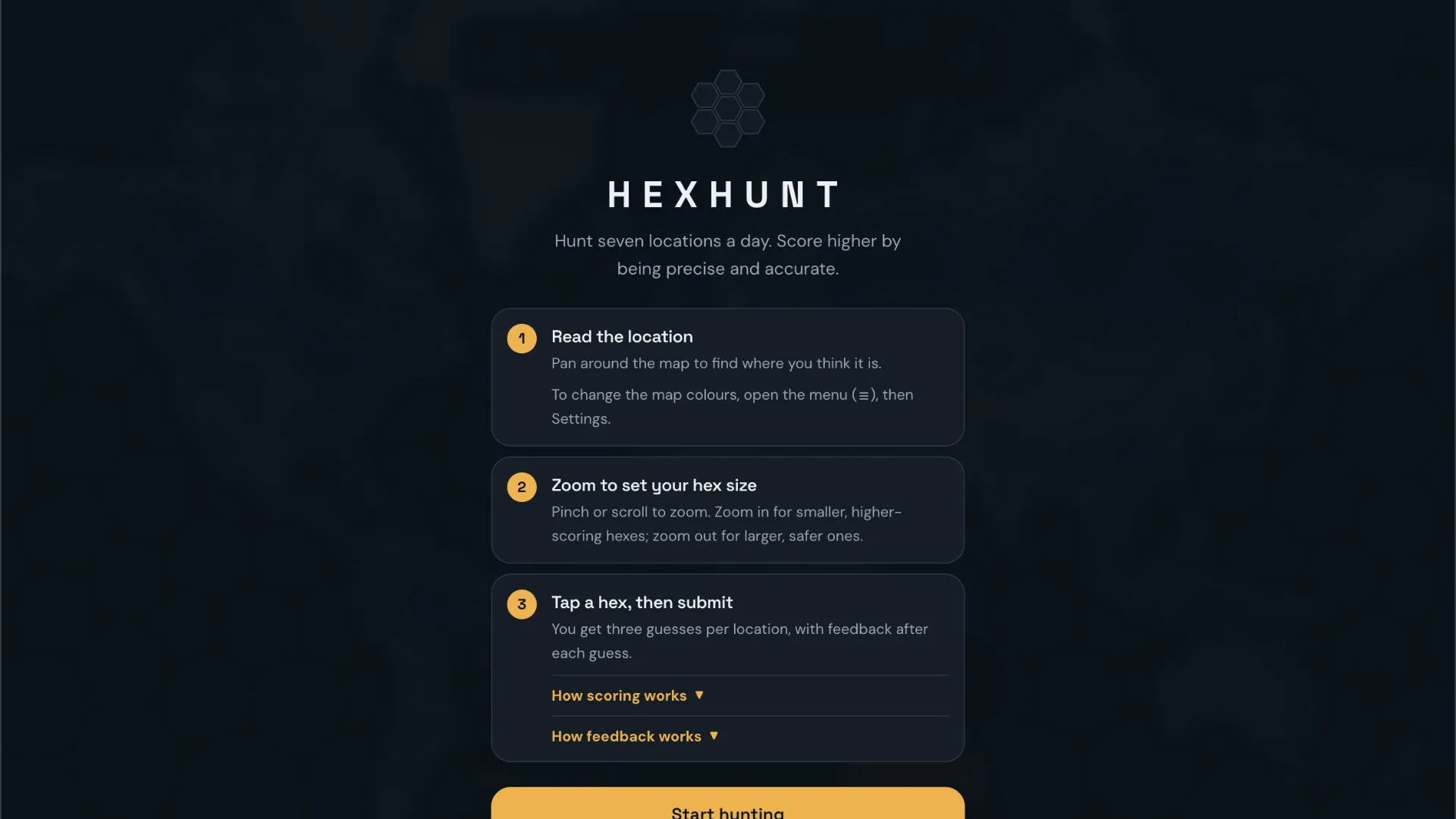
What Is HexHunt?
HexHunt is a daily geography game from Teuteuf Games, the team behind Worldle, Statele, Mapster, and other map-based puzzles.
Each game asks you to hunt down seven locations around the world. Instead of dropping a precise pin, you select a hexagonal map cell that you believe contains the target location.
The clever part is that you control how precise your answer becomes. At a broad world view, the hexes cover large areas and are relatively forgiving. Zoom in and the map divides into smaller hexes, allowing you to make a more precise guess and compete for more points.
This creates a geography confidence game rather than a simple map quiz: how accurately do you really know where a place is?
The Core HexHunt Twist
HexHunt combines location knowledge with risk and confidence.
The basic loop is:
Location name -> inspect the world map -> choose your zoom level -> select a hex -> score the attempt
A large hex gives you more room for error but offers less scoring potential. A smaller hex demands better geographic precision but can reward you more heavily.
That means recognizing the correct country is not always enough. If you decide to zoom deeper, you may need to know which part of the country contains the target city or location.
For example, suppose the target is a place you know is somewhere in northern Italy. You could stay at a broad zoom level and choose a large hex covering much of northern Italy, or zoom further and try to isolate the area more precisely. The second approach has greater upside, but only if your mental map is accurate.
How To Play HexHunt
- Read the target location. Identify the country, region, or approximate part of the world where you think it belongs.
- Find the area on the map. Pan around the world map until the correct region is visible.
- Choose how far to zoom in. Stay zoomed out when you only know the broad region, or zoom closer when you are confident about the exact area. Smaller hexes increase the precision required and the potential reward.
- Select the hex containing the location. Commit to the cell where you believe the target sits, then see how your geographic judgment performs.
- Repeat across all seven locations. Balance safe guesses and ambitious high-precision attempts to build the strongest total score you can.
Why Zoom Level Matters
The zoom mechanic is what separates HexHunt from ordinary click-the-map games.
Imagine that you know a target is in Argentina but cannot remember exactly where. Selecting a broad hex over the correct part of South America gives you a better chance of containing the location.
If the target is Buenos Aires and you know its position well, you can zoom much farther into eastern Argentina and choose a substantially smaller hex.
The decision is therefore not simply about knowing the answer. It is about deciding how much confidence to place in your knowledge.
Low confidence -> larger hex -> safer attempt
High confidence -> smaller hex -> harder attempt with greater scoring potential
This makes every target a small risk-management puzzle.
Strategy Tips
Identify the Country Before Chasing Precision
Start with the broadest information you know for certain. Country, continent, coastline, and major region are more important than immediately trying to remember an exact coordinate.
If you are unsure whether a location is in eastern or western Europe, zooming deeply is usually premature.
Use Major Cities as Mental Anchors
Knowing the approximate positions of major cities makes less familiar locations easier to place. If you know where London, Paris, Cairo, Tokyo, Sydney, and other major anchors sit, you can estimate nearby targets relative to them.
Know When to Stop Zooming
HexHunt rewards confidence, but unnecessary precision can turn a good geographic answer into a miss. If you know the country but not the region, consider selecting a larger hex rather than gambling on a tiny cell.
Pay Attention to Coastlines
Coastal geography provides some of the strongest visual reference points on a world map. Peninsulas, bays, islands, and distinctive coastlines can help you position a target much more accurately than political borders alone.
Build a Mental Map of Regions
Learning where places sit within countries is especially valuable. Knowing that Barcelona is in northeastern Spain, Vancouver is on Canada's Pacific coast, or Cape Town is near the southwestern tip of South Africa lets you confidently use smaller hexes.
What Skills Does HexHunt Test?
HexHunt goes beyond country recognition. The game rewards several layers of geographic knowledge:
- recognizing which country contains a location;
- knowing where countries sit relative to one another;
- understanding the positions of major cities;
- remembering regional geography inside large countries;
- judging latitude and longitude approximately;
- deciding how confident you are in your own answer.
That last skill matters more here than in many geography games. Two players may know roughly where the same location is, but the player who correctly judges when to zoom deeper can earn the stronger result.
How HexHunt Differs From Other Geography Games
Worldle asks you to identify a country from its shape. WhereTaken challenges you to locate places using photographs. Mapster asks you to draw national borders from memory.
HexHunt focuses instead on positional knowledge. You are given a location and must decide which section of a hex-covered world map contains it.
The adjustable precision also gives it a different rhythm from conventional map-pin games. Instead of always being judged against one fixed level of accuracy, you effectively choose how difficult your own answer will be.
Is HexHunt Worth Playing?
HexHunt is a good choice for players who enjoy geography games but want something more strategic than simply naming countries. Its seven-location format gives enough variety for a satisfying daily session, while the zoom mechanic makes familiar and unfamiliar places interesting for different reasons.
Beginners can stay relatively zoomed out and focus on learning where locations belong. Experienced geography players can push into smaller hexes and test how precise their mental world map really is.
HexHunt was introduced as a new Teuteuf geography game in 2026 and has been undergoing early testing and tweaks, so some interface or scoring details may continue to evolve. The central idea remains straightforward: find the right hex, and only zoom as far as your geography knowledge can support.