
What Is HoopGrids?
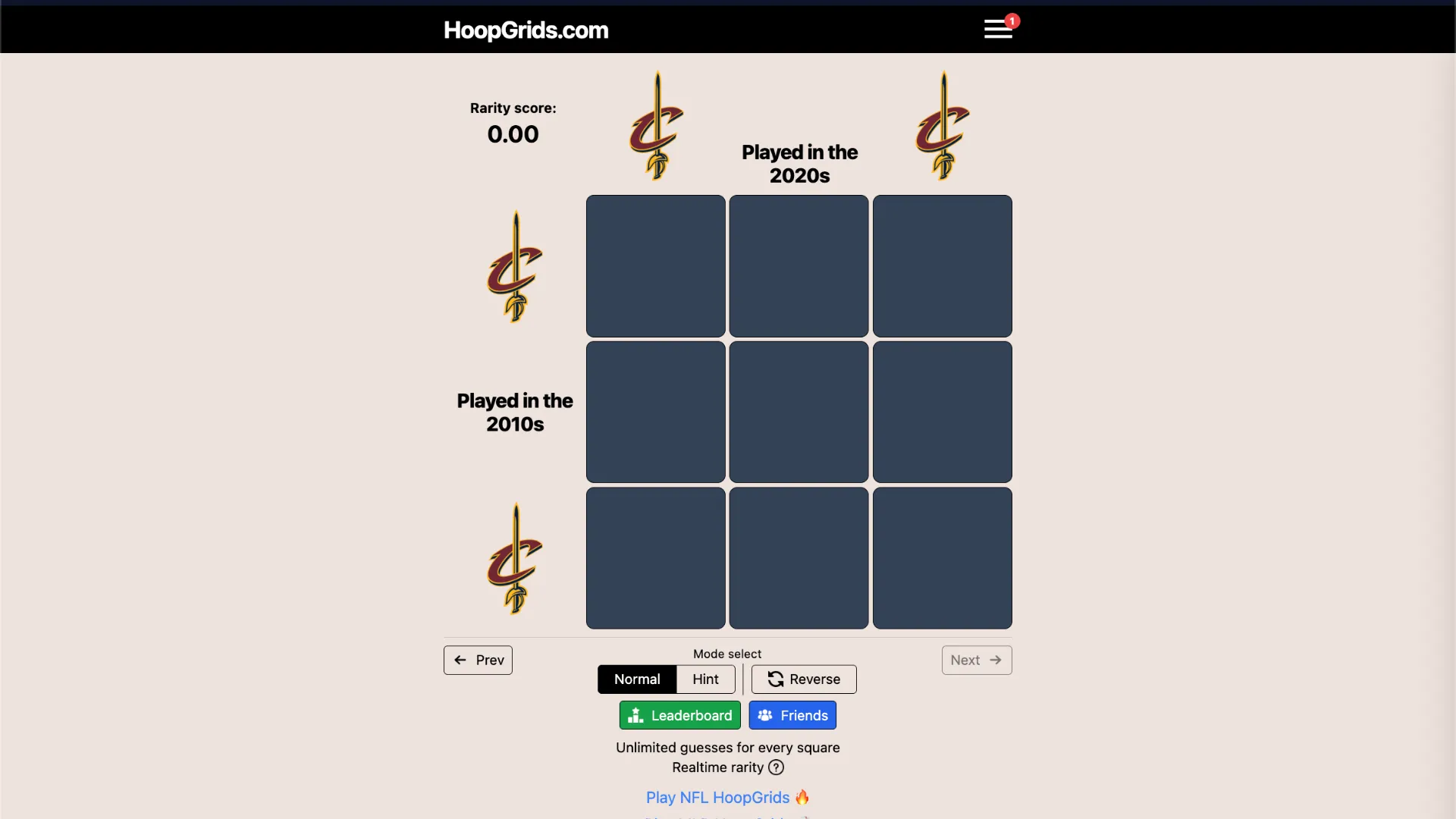
HoopGrids is a daily NBA knowledge game built around a 3×3 grid. Each row and column represents a basketball criterion, and every empty square is the intersection of two criteria. Your job is to enter an NBA player who satisfies both conditions. HoopGrids
Criteria can involve NBA teams, teammates, eras, statistics, career totals, season achievements, and accolades. For example, if one side of a square says Played for Chicago Bulls and the other says 1000+ Points (Season), a valid player must have appeared in at least one regular-season or playoff game for Chicago and must have scored 1,000 or more points in some NBA season. The 1,000-point season does not have to have happened while that player was with Chicago. HoopGrids
Rules and the Rarity Twist
The most important HoopGrids rule is that the two criteria are generally independent. A player needs to satisfy both somewhere in their career, but the achievements do not normally need to happen for the same team or during the same season unless the wording of the category specifically requires it. HoopGrids
HoopGrids currently allows unlimited guesses for each square, so an incorrect answer does not automatically ruin the puzzle. Correct answers receive a rarity based on how frequently that player is chosen by other players. Common stars are easier to remember, while obscure but valid players can produce much rarer results. HoopGrids
The game also includes a Hint mode. When enabled, a square can show six possible players, including the answer most commonly selected by other players. Submitted answers can also be changed by selecting the square again, even after completing the grid. HoopGrids
Example Grid Logic
Imagine a square created by these two criteria:
- Row: Played for the Los Angeles Lakers
- Column: Played for the Miami Heat
You need an NBA player who recorded a regular-season or playoff appearance for both franchises. A famous answer may be easy to find, but HoopGrids rewards deeper NBA knowledge because a less frequently chosen valid player produces a rarer result.
Another square might combine:
- Row: Played for the Chicago Bulls
- Column: 1000+ Points in a Season
The player only needs to have played for Chicago at some point and separately recorded a 1,000-point NBA season. Those two accomplishments do not need to occur together. HoopGrids
How to Play HoopGrids
- Read all six criteria first. Check the three row labels and three column labels before entering players. This often reveals which intersections will be hardest.
- Choose a square and combine its two requirements. Think of players whose careers satisfy both sides of that intersection.
- Search for and submit a player. If the player qualifies, the square is filled and their rarity is shown. If not, try another answer—normal play has no guess limit per square. HoopGrids
- Complete all nine intersections. Work through the remaining squares while looking beyond obvious superstars when you want better rarity results.
- Review or improve your picks. You can reopen completed squares and replace an answer with another qualifying player, making it possible to chase rarer selections after finishing the grid. HoopGrids
Strategy Tips
Solve restrictive intersections first
A square combining two specific teams or an unusual accolade with a franchise usually has fewer obvious candidates than a broad era or career-stat category. Solving those intersections early can make the rest of the board easier to plan.
Separate the two criteria mentally
One of the easiest mistakes is assuming both conditions must have happened simultaneously. If the grid combines a team with a season statistic, first identify players who appeared for the team, then ask whether any of them reached the statistical threshold at any point in their career. HoopGrids
Think about journeymen
Players who spent time with many franchises are especially useful for team-versus-team intersections. Remembering role players, short stints, late-career moves, and bench players can also lead to substantially rarer selections than choosing obvious stars.
Do not stop at the first correct answer
If your goal is simply to finish the board, recognizable stars are perfectly useful. If you are chasing rarity, treat the first valid name as a starting point and think about less obvious alternatives before moving on.
Try Reverse Mode for a different challenge
HoopGrids also offers Reverse Mode, where the objective changes: instead of hunting for obscure players, you try to identify the most commonly guessed answer for each square. The game ranks answers against the six most common selections, turning the usual rarity strategy on its head. HoopGrids
HoopGrids works best for players who enjoy NBA history, roster knowledge, player movement, and statistical trivia. Completing the nine squares is approachable with general basketball knowledge, while chasing extremely rare answers gives experienced NBA fans a much deeper challenge.