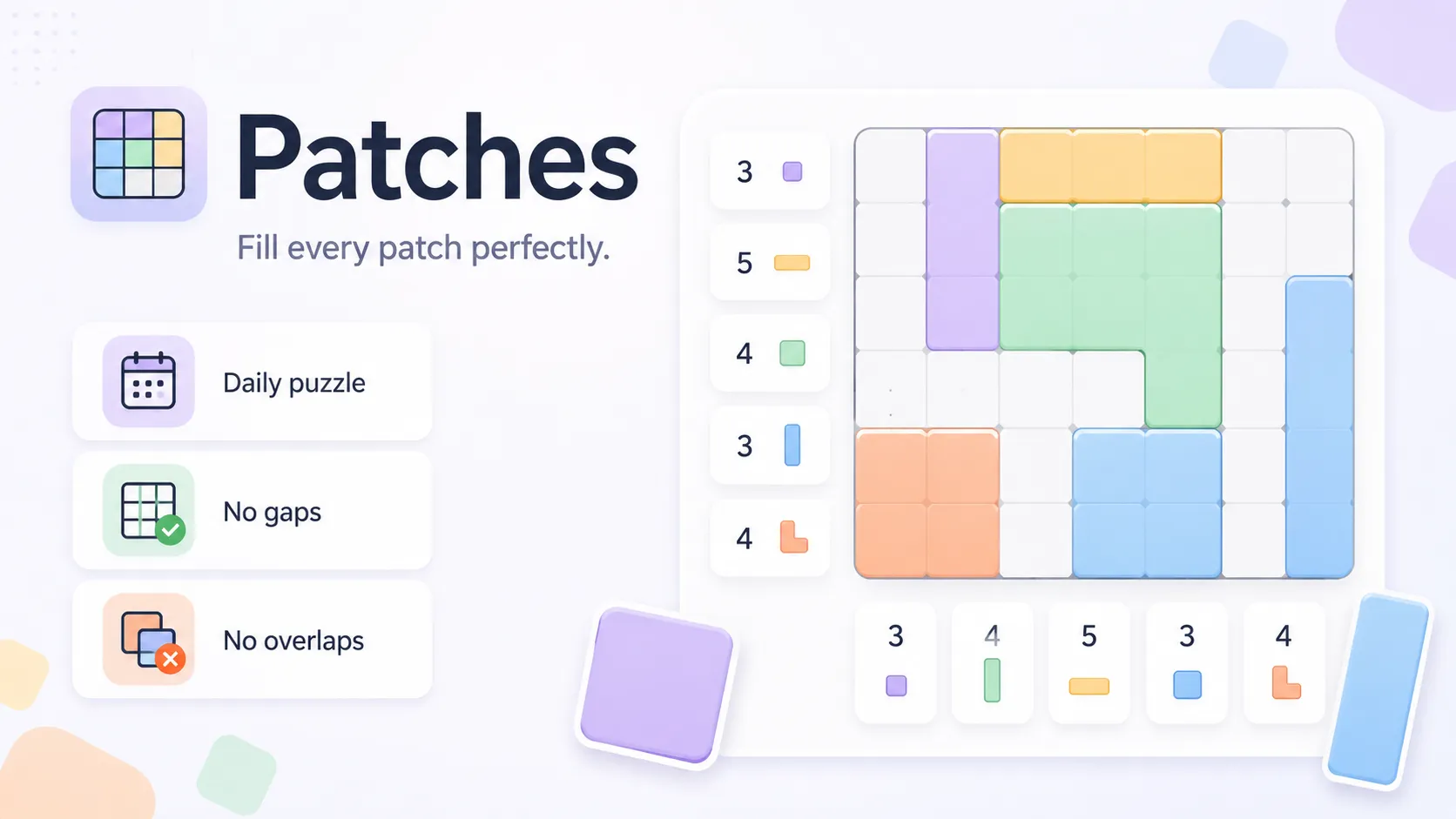
What is Patches?
Patches is a daily spatial logic puzzle from LinkedIn where the board is a grid of unfinished regions, numbers, and shape clues. Your mission is to “stitch” the grid together by drawing the correct patches until every cell belongs to exactly one shape.
The twist is that the clues do not simply tell you where to click. They tell you what kind of shape must be completed: how large it is, whether it is square, tall, wide, or flexible. Patches feels calm at first, then turns into a satisfying little geometry trap where one wrong shape can block the entire board.
Patches Game Rules (The Catch / The Trap)
Patches is about completing shapes on a grid.
A clue might look like this:
□ 4
That means a patch must cover 4 cells and match the clue’s shape requirement.
Typical shape logic:
- Square clue: the patch must form a square.
- Wide clue: the patch must be wider than it is tall.
- Tall clue: the patch must be taller than it is wide.
- Free-size clue: the patch can take different shapes, but must match the required cell count.
- Every cell must be covered exactly once.
- Shapes cannot overlap.
- No empty gaps can remain.
Visual idea:
🟦🟦🟦🟦
This could satisfy a square 4 clue.
But this:
🟩🟩🟩
could satisfy a wide 3 clue.
The trap is that a valid patch is not always the right patch. A rectangle may satisfy one clue, but if it steals cells needed by another clue, the whole grid collapses. Patches is won by fitting the entire board, not just solving one shape at a time.
How To Play Patches?
Inspect the clue cells
Board Shows: numbered clues with shape icons.
What You Learn: Each clue tells you how many cells its patch needs and what shape style it must follow.Draw a possible patch
Player Action: Drag across nearby cells to create a rectangle.
Game Response: The patch fills those cells if the shape follows the clue.
Next Constraint: Make sure it does not block another clue.Use forced areas first
Player Sees: a corner clue with only one possible direction.
Action: Fill that obvious patch first.
What This Means: Corners and edges often reveal the structure of the puzzle.Fit the remaining patches together
Board State: several clues solved, but open spaces remain.
Player Action: Adjust shapes so every open cell belongs somewhere.
Goal: No overlaps, no gaps, no stranded cells.Complete the full grid
Result: every patch fits perfectly.
Victory Feeling: You did not guess — you stitched the whole board together.
Strategy & Tips
Start with the most restricted clues. Corners, edges, and large numbers often have fewer possible placements, so they can anchor the solution.
Think in rectangles. Before dragging, imagine every possible shape that could satisfy a clue, then eliminate the ones that would block neighboring clues.
Do not trust a shape just because it is allowed. A patch can be legal locally and disastrous globally.
When stuck, look for leftover spaces. If an empty area cannot match any nearby clue, one of your earlier patches is probably too greedy.