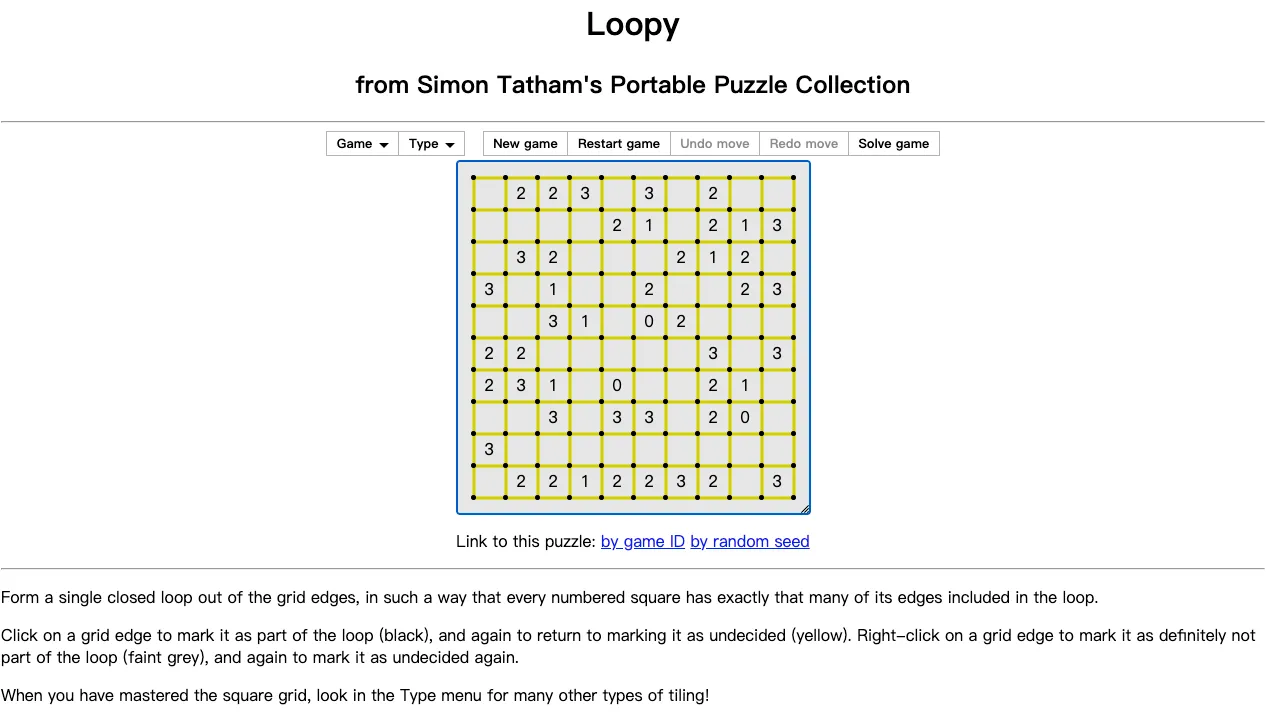
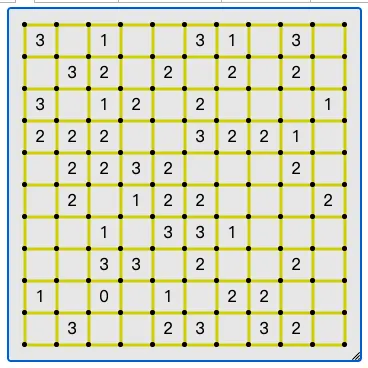
What is Loopy?
Loopy gives you a grid of dots, a scattering of numbered clues, and one uncompromising mission: draw a single unbroken loop through the available edges. The board begins quietly, but every line you confirm changes what can happen around several nearby cells.
The puzzle is closely related to Slitherlink, but Loopy expands the battlefield beyond ordinary squares. Once you understand the standard grid, you can face triangular, hexagonal, Cairo, kite-shaped, and other unusual tilings that twist familiar deductions into new geometric traps.
Loopy Game Rules (The Catch / The Trap)
Build one closed loop by selecting edges between neighboring dots.
NUMBERED CELLS → CONFIRM EDGES → BLOCK IMPOSSIBLE EDGES → ONE CLOSED LOOP
Every numbered cell tells you exactly how many of its surrounding edges belong to the loop:
- A
0means none of the cell’s edges can be used. - A
1means exactly one surrounding edge belongs to the loop. - A
2means exactly two surrounding edges belong to the loop. - A
3means exactly three surrounding edges belong to the loop.
The finished path MUST obey all of these conditions:
- Every numbered clue is satisfied exactly.
- The line CANNOT branch at a dot.
- The line CANNOT stop at a dead end.
- Separate miniature loops are FORBIDDEN.
- Every confirmed segment must belong to one continuous closed loop.
A clue might appear like this:
· ─ ·
│ 3 │
· ? ·
Three sides are already confirmed around the 3, so the fourth edge MUST be excluded. But confirming lines without checking the wider board can close a small loop too early and isolate the remaining clues.
Use a normal click to mark an edge as part of the loop. Use a right-click to mark an edge as definitely excluded, helping you separate deductions from undecided possibilities.
How To Play Loopy?
Attack the strongest clues.
Board Shows: a3beside a0.
What You Learn: the shared edge is blocked by the0, forcing the other three edges around the3into the loop.Extend the path safely.
Player Marks: three black edges around the3.
Game Response: nearby dots now have limited legal exits, revealing where the line must continue.Block impossible branches.
At a dot already touched by two confirmed segments, exclude every remaining edge.
Result: the path can pass through the dot but CANNOT split into three directions.Avoid the premature-loop trap.
Possible Move: connect two nearby endpoints.
Problem: this would create a closed loop while several clues remain outside it.
Next Constraint: exclude that edge and route the path through the unsolved area instead.Close the final gap.
Once every clue is satisfied and all confirmed lines belong to the same route, connect the last two endpoints.
Result:ALL CLUES SATISFIED | NO BRANCHES | ONE COMPLETE LOOP.
Loopy Strategy & Tips
Start with 0 and 3 clues because they usually force the most immediate decisions. A 0 eliminates all surrounding edges, while a 3 often becomes nearly solved when even one neighboring edge is ruled out.
Watch the dots as closely as the numbers. A valid loop enters and leaves every used dot, so a dot can have exactly zero or two confirmed connections—never one in the final solution and never three.
Delay any move that would close a loop unless the entire board is already accounted for. Small completed circles are tempting, neat, and almost always fatal when clues remain elsewhere.