What is MapTap?
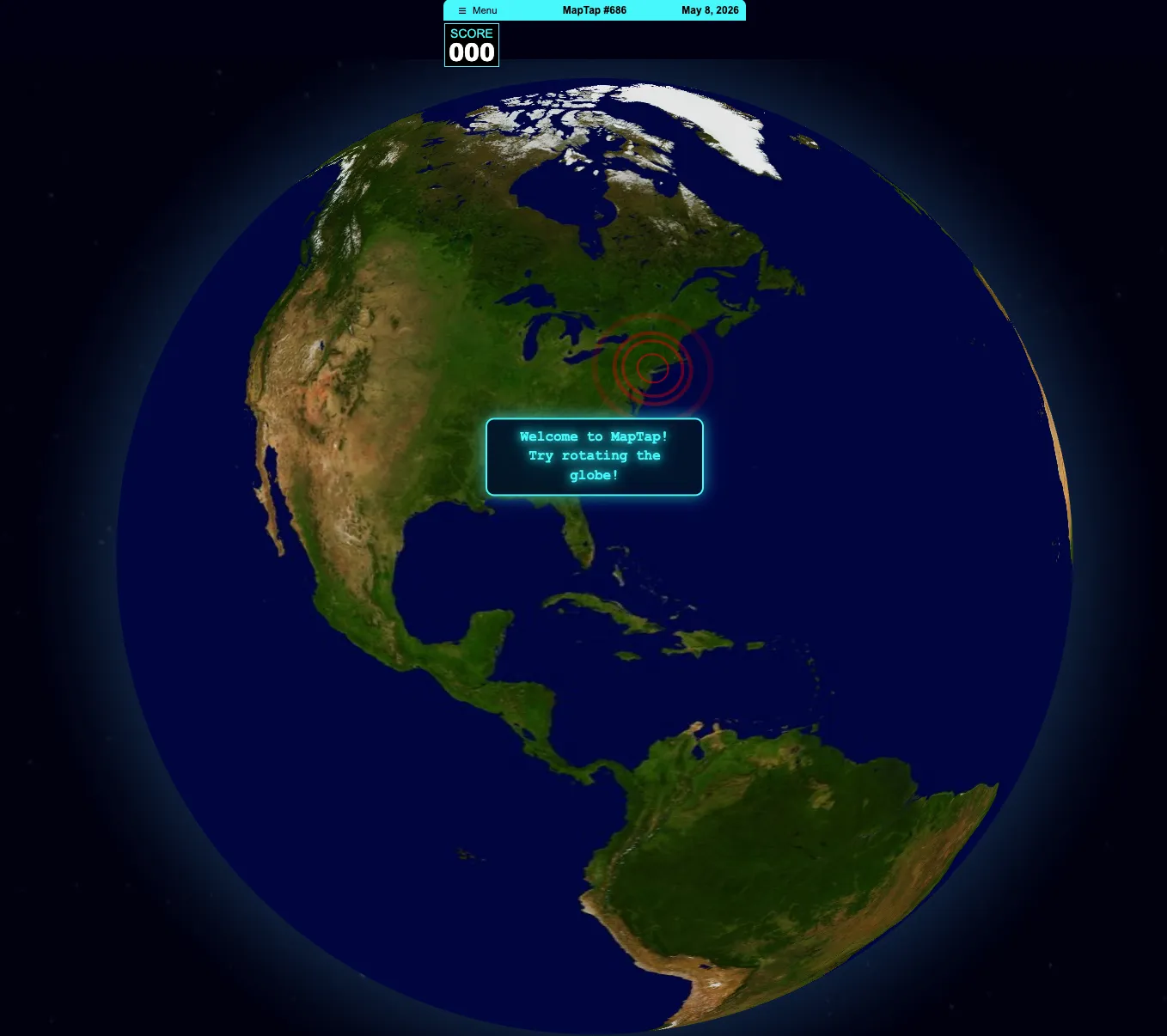
MapTap turns world geography into a high-pressure global hunt. Every day, the game drops you onto a smooth interactive 3D globe and challenges you to pinpoint real-world locations tied to history, famous events, cities, and hidden corners of the planet.
The real danger is confidence. You think you know where a place is — until the globe starts spinning, continents blur together, and your "close enough" guess lands hundreds of miles away. MapTap constantly creates that painful mix of certainty and doubt that makes geography games impossible to quit.
Unlike static map quizzes, MapTap feels physical. You rotate the Earth, zoom into coastlines, scan mountain ranges, and desperately search for tiny countries before locking in your answer. Every round becomes a race between memory and panic.
MapTap Game Rules (The Catch / The Trap)
MapTap is all about geographic precision.
Your Objective
- The game gives you a location prompt.
- You rotate and zoom the 3D globe.
- You tap the exact spot where you believe the location exists.
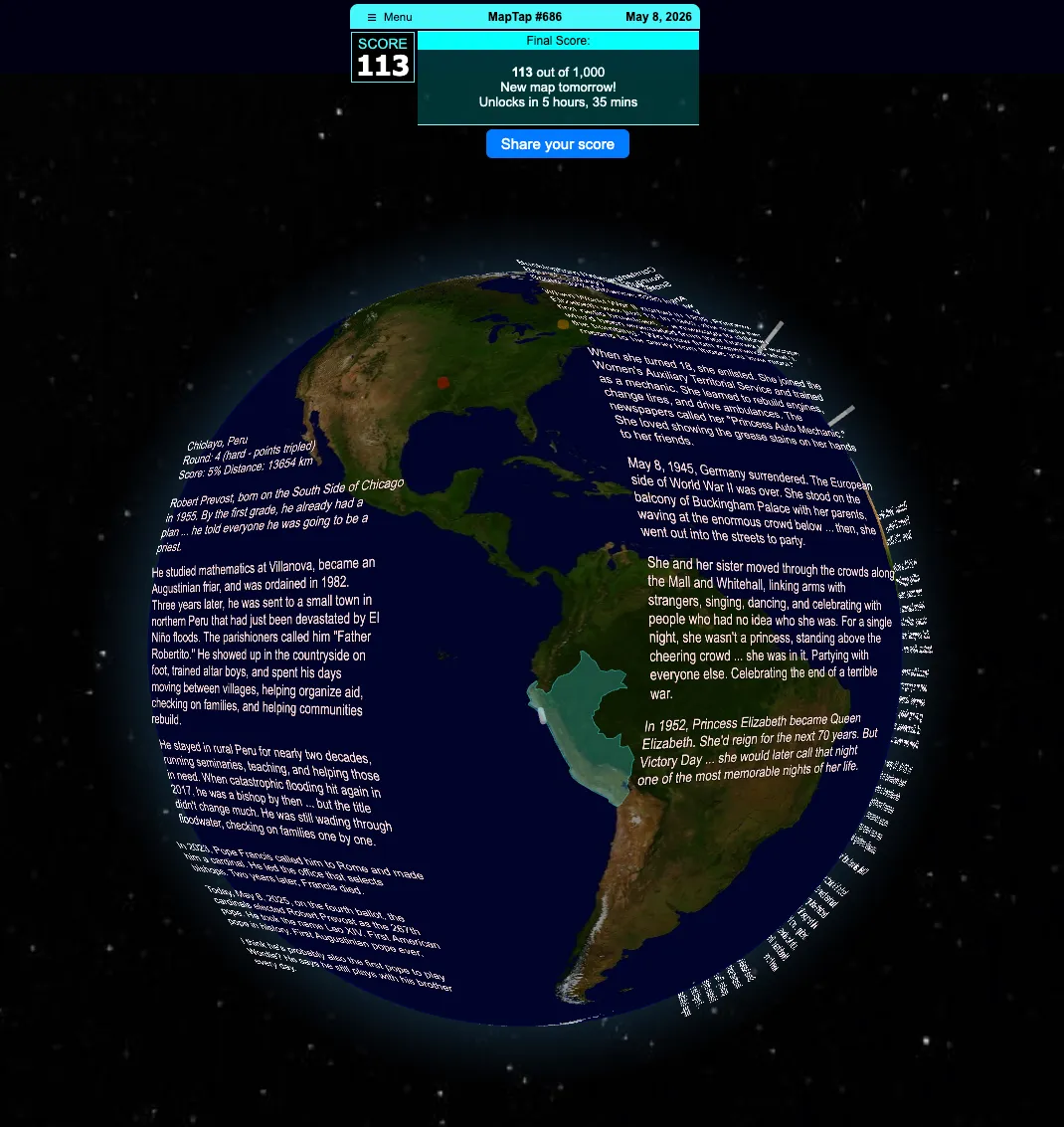
- The closer your guess, the higher your score.
The Trap
The globe is designed to expose weak mental maps.
You WILL eventually:
- confuse neighboring countries
- underestimate distances
- panic-spin the Earth the wrong direction
- realize tiny islands are your mortal enemy
Typical Round Example
Prompt: Reykjavik, Iceland
Player Action:
- Spins toward northern Europe
- Clicks near Norway ❌
Result:
Distance: 1,200+ km away
What This Means:
- Wrong island
- North Atlantic geography failed you
- Score takes heavy damage
Another Example
Prompt: Tokyo, Japan
Player Action:
- Zooms into East Asia
- Correctly taps eastern Japan ✅
Result:
Very close guess
What This Means:
- Strong regional awareness
- Fast identification bonus
- Momentum survives another round
Important Constraints
- You CANNOT type answers.
- Precision matters more than vague continent knowledge.
- Tiny countries and islands are brutal score traps.
- Faster decisions usually outperform endless overthinking.
How To Play MapTap?
Step 1 — Read The Target
A real-world location appears.
Example Prompt: Bern, Switzerland
Your brain instantly starts processing:
- Central Europe
- Near the Alps
- Smaller than France or Germany
The timer already feels dangerous.
Step 2 — Rotate The Globe
You drag the Earth and hunt for the correct region.
Player Action:
- Rotate toward Europe
- Zoom near France and Germany
- Search for Switzerland
Game Response:
Marker placed
Now comes the moment of truth.
Step 3 — Lock In The Guess
You tap your final location.
Result:
87 km away ✅
What You Learn:
- Correct country
- Slightly wrong city position
- Geography instincts were close enough to survive
Step 4 — Face Harder Locations
The game escalates fast.
Next Prompt: Ulaanbaatar, Mongolia
Suddenly the globe feels enormous again.
Next Constraint:
- Must recognize inland Asia quickly
- Must avoid clicking China or Kazakhstan
- Hesitation becomes deadly
Step 5 — Build Geographic Instincts
After enough rounds, players stop memorizing labels and begin recognizing:
- coastline shapes
- continental spacing
- island positioning
- regional patterns
That is when MapTap becomes dangerously addictive.
Strategy & Tips
Use Big Countries As Anchors
Strong MapTap players navigate using giant reference points.
Examples:
- Brazil anchors eastern South America
- India anchors South Asia
- Greenland anchors the North Atlantic
This massively improves globe navigation speed.
Memorize Dangerous Tiny Countries
Places like:
- Luxembourg
- Malta
- Singapore
- Iceland
...cause constant disasters for new players.
Think In Regions First
Do NOT immediately hunt for the exact city.
Instead:
- Find the continent
- Find the surrounding countries
- Narrow the zone
- Then refine your tap
Trust Fast Recognition
MapTap punishes endless hesitation.
Your first geographic instinct is often more accurate than your panicked correction five seconds later.