What Is Nonodle?
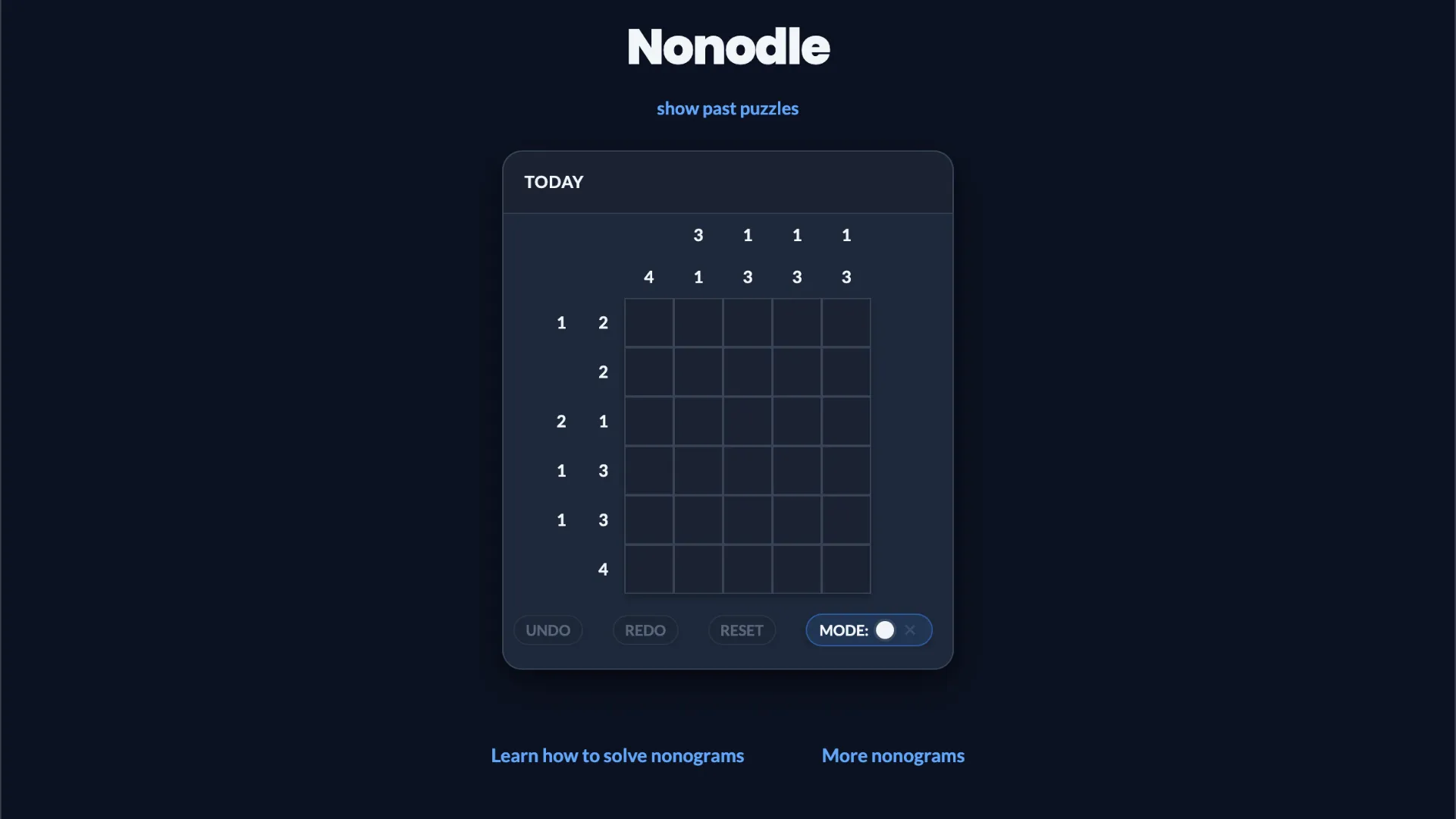
Nonodle is a daily browser-based nonogram puzzle. Each day gives you a fresh grid with numbers along its rows and columns, and your goal is to determine which cells should be filled to reveal a hidden pixel-art image.
It is designed as a compact daily challenge rather than a huge puzzle collection. The puzzles vary in difficulty and density, work on both desktop and mobile, and are intended to be solvable through logical deduction rather than blind guessing.
How the Nonogram Clues Work
Every number beside a row or above a column tells you the length of a consecutive group of filled cells.
For example, a clue of:
3
means that somewhere in that row there must be exactly three connected filled cells:
[ ][■][■][■][ ][ ]
If a line has multiple clues, such as:
2 1
it contains a group of two filled cells followed later by a separate group of one, with at least one empty cell between them:
[■][■][×][ ][■]
The exact positions are not given directly. You determine them by combining information from both the horizontal and vertical clues.
The Logic-Only Twist
Nonodle emphasizes deduction. You should fill a cell only when the clues prove that it must be occupied, and mark cells with crosses when you know they must remain empty.
Suppose a five-cell row has the clue 5. There is only one possible arrangement:
[■][■][■][■][■]
But if the clue is 1, you cannot immediately know which cell is filled. Instead of guessing, you move to another row or column where the clues provide more certainty and return later with additional information.
This back-and-forth between rows and columns is the heart of the puzzle.
How to Play Nonodle
- Read the row and column clues. Start with lines where the placement of filled cells is obvious or heavily constrained.
- Fill certain cells. Mark squares that must belong to one of the numbered groups. A large clue in a short row is often a useful starting point.
- Mark confirmed empty cells. Use crosses to show squares that cannot contain part of a group, especially around groups you have already completed.
- Alternate between rows and columns. Every new filled or crossed cell provides information for the intersecting line. Keep using these deductions until the entire grid is resolved.
- Reveal the picture. When every clue is satisfied, the filled squares combine into the day's hidden pixel image.
A Simple Solving Example
Imagine a five-cell row with this clue:
3
At first, the group of three could start in several places:
[■][■][■][ ][ ]
[ ][■][■][■][ ]
[ ][ ][■][■][■]
Notice that the center cell is filled in every valid arrangement. Even though you do not yet know the complete row, you can safely fill that center square.
Later, information from the column clues may rule out one side of the row, allowing you to place the remaining two cells and cross out the spaces that cannot be used.
That style of deduction is much more useful in Nonodle than trying possible answers at random.
Strategy Tips
Start with the largest clues
Large groups have fewer possible positions. If a clue nearly fills an entire row or column, look for cells that overlap across every possible placement.
Mark empty cells aggressively
Crosses are not just bookkeeping. Once a numbered group is complete, cells immediately outside that group often must be empty. Those crosses can unlock deductions in intersecting columns or rows.
Use completed lines
If a row's required groups are all accounted for, mark every remaining square in that row as empty. This often provides several new clues elsewhere on the board at once.
Avoid guessing
If a line still has several valid possibilities, leave it alone temporarily. Another part of the grid will usually provide the information you need to return and solve it logically.
Recheck both directions
When progress stalls, scan every row and column again. One newly filled or crossed cell can turn a previously ambiguous clue into an obvious move.
Why Play Nonodle?
Nonodle is a good fit for players who enjoy Picross-style logic but want something short enough to become a daily habit. There are no vocabulary requirements or trivia questions to know—the puzzle is entirely about interpreting numerical clues and making deductions.
Its compact format also makes it approachable for newcomers while still allowing harder daily boards to require more careful use of crosses, overlaps, and elimination. If you like Sudoku, Minesweeper, Picross, or other deduction puzzles, Nonodle offers a quick daily variation on the classic nonogram formula.