
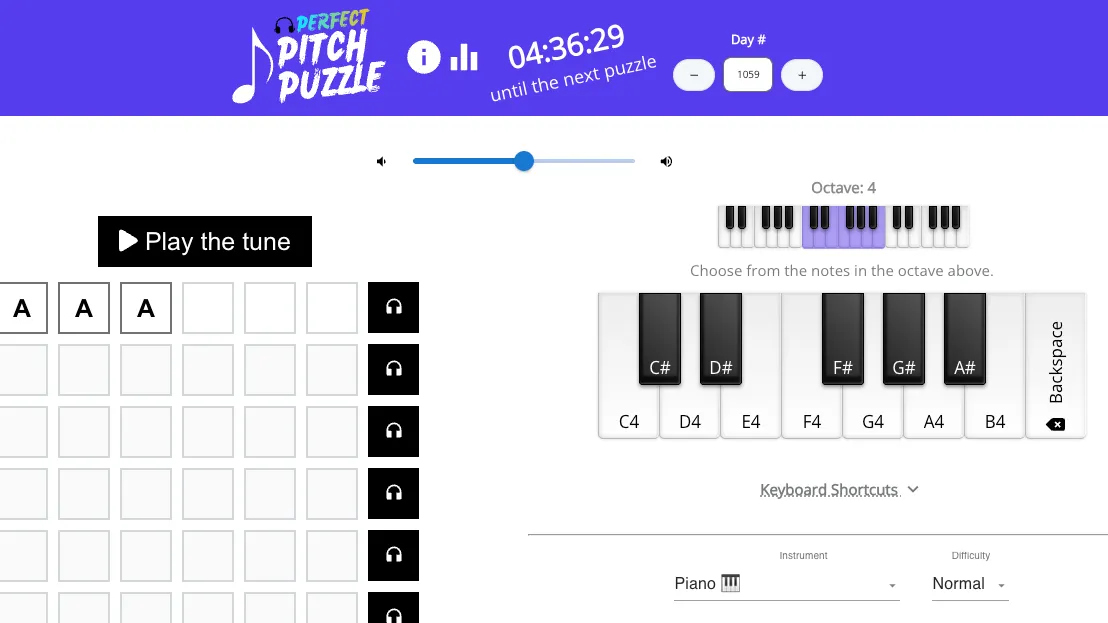
What is Perfect Pitch Puzzle?
Perfect Pitch Puzzle is Wordle for your ears: the game plays a short melody, and your mission is to identify the first six notes before your guesses run out. Instead of letters, you are fighting with pitch memory, musical intuition, and that tiny voice in your head saying, “Wait… was that a G or an A?”
The twist is that every guess becomes musical evidence. You can listen, build a six-note answer, submit it, then use the colored feedback to hunt down the hidden tune. It is relaxing for anyone who loves music, but it can also feel brutally personal when one wrong note keeps dodging you for five rounds.
Perfect Pitch Puzzle Game Rules (The Catch / The Trap)
Your goal is to solve the melody’s first six notes in six tries.
- Listen to the tune. The melody is your main clue, and you can replay it while you think.
- Enter six notes. Build a sequence using note names from the available octave.
- Submit your guess. The game checks your six-note sequence against the hidden answer.
- Use color feedback. Correct notes in the correct position are marked as hits; notes that belong somewhere else become clues for later guesses; wrong notes are eliminated from your strategy.
- You have six attempts. Each guess should narrow the melody, not just randomly poke at the keyboard.
Visual language:
Plays: ♪ ♪ ♪ ♪ ♪ ♪
Guess: C E G F D C
Feedback: hit / misplaced / wrong
The trap is that the melody may feel obvious when you hear it, but translating that sound into exact note names is the real boss fight.
How To Play Perfect Pitch Puzzle?
Listen first, guess second.
Plays: a short six-note melody.
What you learn: the contour — does it climb, fall, repeat, or jump?Build a six-note guess.
Player Guesses:C E G F D C
Game Response: your notes are checked against the hidden melody.Read the feedback like a detective.
Result: some notes are correct, some are present but misplaced, and some are not useful.
What This Means: keep the strong notes, move the misplaced ones, and stop trusting the eliminated ones.Preview and adjust.
Player Action: listen to your guessed melody before wasting a try.
Next Clue: if your version sounds close but one note feels off, target that position.Solve before the sixth guess.
Goal: turn sound into a locked-in note sequence before the daily puzzle escapes.
Strategy & Tips
Hum the melody back before touching the notes. Your voice can help separate the shape of the tune from the panic of the interface.
Start by catching repeated notes and big jumps. Repeats are usually easier to identify than tiny stepwise movement, and large leaps give you stronger anchors for the rest of the sequence.
Do not ignore the preview button. Hearing your own guess played back is like holding your answer next to the original melody. If it sounds wrong, it probably is.
Use feedback aggressively. A wrong note is not a failure; it is one less suspect in the lineup. A misplaced note is even better because it tells you the sound belongs in the melody, just not where you put it.