
What Is PoopGuessr?
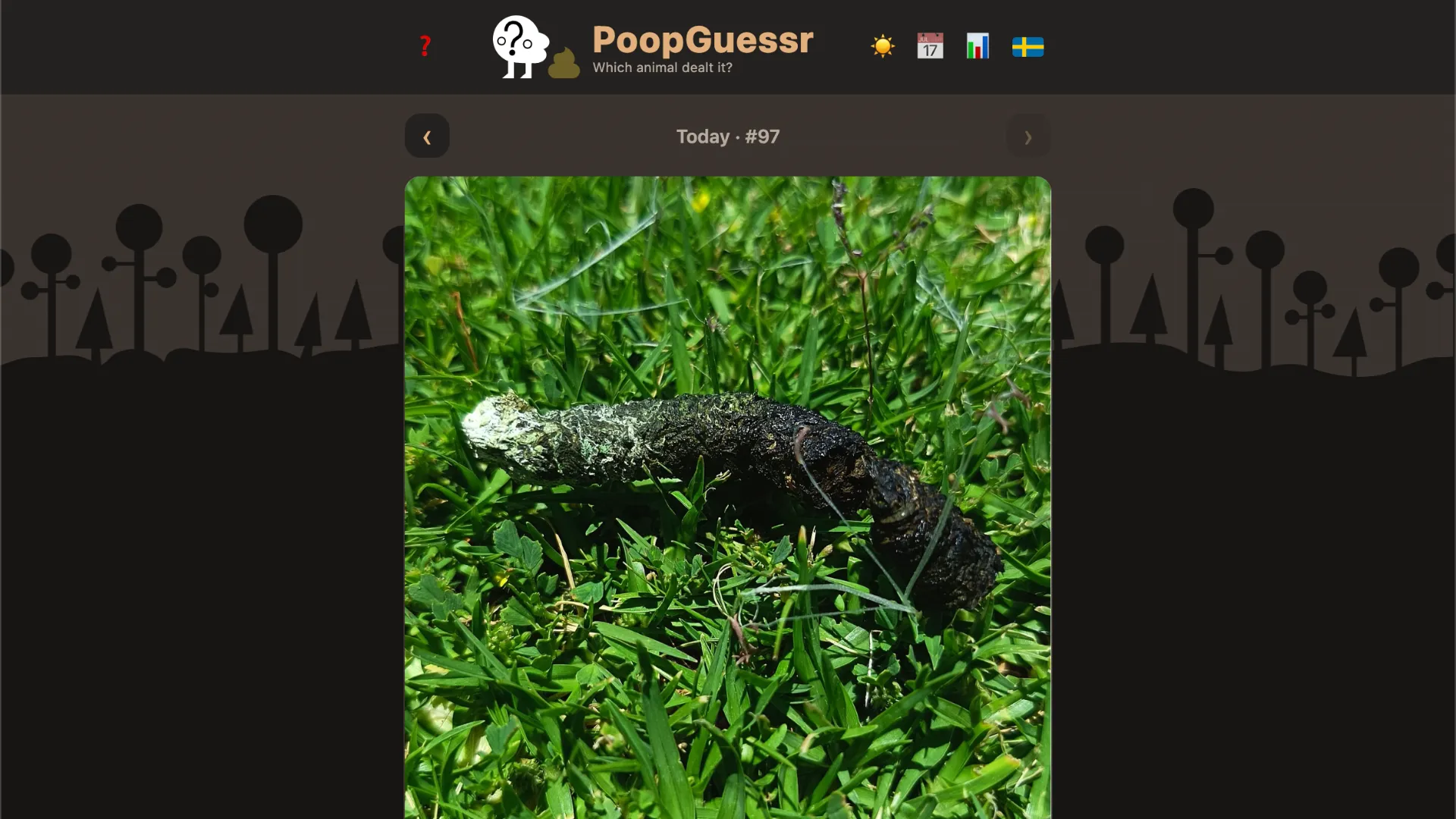
PoopGuessr is a daily wildlife identification game with a deliberately unusual premise: you are shown a photo of animal droppings and must work out which animal left them behind.
Each daily puzzle gives you one wildlife photo and up to six animal guesses. After guessing, the game provides factual information that helps narrow the possibilities, turning what initially looks like a joke into a small field-sign deduction challenge.
The clues are based on characteristics such as animal class, diet, habitat, geographic region, and typical adult size. That means you do not need to be capable of identifying scat from appearance alone; careful elimination can take you surprisingly far.
The Animal-Sign Twist
PoopGuessr is inspired by the same signs naturalists use to detect wildlife without actually seeing the animal. Tracks, feathers, droppings, and other traces can reveal which species have recently passed through an area.
The daily image focuses on droppings. Some animals have especially recognizable signs. Rabbits, for example, typically leave small pellets, while wombats are famous for unusually angular droppings. Other animals can be much harder to distinguish visually, so the game's additional clues become important.
A hypothetical deduction might develop like this:
Photo → medium-sized animal scat
Diet → carnivore
Habitat → forest / grassland
Region → Europe / Asia / North America
Those facts let you eliminate herbivores and animals from incompatible regions before choosing between plausible predators such as a fox or wolf.
How to Play PoopGuessr
- Inspect the daily photo. Look at the shape, size, texture, grouping, and surroundings of the droppings for anything that might hint at the animal.
- Enter an animal guess. Choose a species that seems plausible based on the image. You have up to six attempts to find the correct answer.
- Use the wildlife clues. Pay attention to facts about class, diet, habitat, region, and typical size to eliminate animals that do not fit.
- Refine your next guess. Combine what the picture shows with the factual clues instead of repeatedly guessing visually similar animals.
- Identify the animal. Find the correct species before your six guesses run out, then return for a new puzzle the next day.
Understanding the Clues
The strongest way to play PoopGuessr is to treat each clue as a filter.
Diet
A herbivore clue immediately makes predators such as wolves much less likely. A carnivore clue can similarly eliminate deer, rabbits, and horses, while an omnivore clue keeps animals such as bears and foxes in consideration.
Habitat
Habitats can separate species that otherwise produce similar-looking signs. A strong association with rivers or coasts points toward a different group of animals than tundra, farmland, woodland, or open grassland.
Region
Geography is especially useful when the visual evidence is ambiguous. An animal restricted to Australia, for example, becomes a much stronger candidate when the region clue matches.
Size
Typical adult weight can help distinguish animals that belong to similar ecological groups. A wolf and a fox may share several characteristics, but their typical body sizes are very different.
Strategy Tips
Use your first guess to gather information
If you are unsure, choose a reasonably common animal rather than an obscure species. The resulting clues can reveal whether you should move toward birds, deer, predators, livestock, or another group entirely.
Pay attention to shape and grouping
Do not focus only on color. Pellet-like droppings, long segmented scat, loose piles, and unusually shaped pieces can point toward very different animals.
Combine clues instead of following one clue alone
A forest habitat is not enough to identify an animal because many species live in forests. A forest-dwelling carnivore of a certain size and region provides a much narrower candidate set.
Learn the distinctive examples
Some animals have recognizable signs worth remembering. Wombat droppings are unusually angular, rabbits leave characteristic pellets, and large omnivores may produce highly variable scat depending on what they have eaten.
Avoid treating it as scientific identification
Real animal signs can vary with diet, season, age, health, and location. PoopGuessr is designed as a learning game, so use the clues provided by the puzzle rather than assuming every real-world dropping from a species will look identical.
Daily Puzzles and Archive
PoopGuessr publishes a new puzzle each day, but previous challenges remain available through its archive. Unplayed archive puzzles can still be solved normally, while completed puzzles can be reopened for practice.
The archive makes the game especially useful for learning. After several rounds, you begin building a mental reference library of pellet shapes, habitats, diets, animal sizes, and geographic ranges that can help with future daily puzzles.
If you enjoy wildlife, nature trivia, visual identification games, or simply strange daily puzzles, PoopGuessr offers a memorable variation on the usual guessing-game formula.