
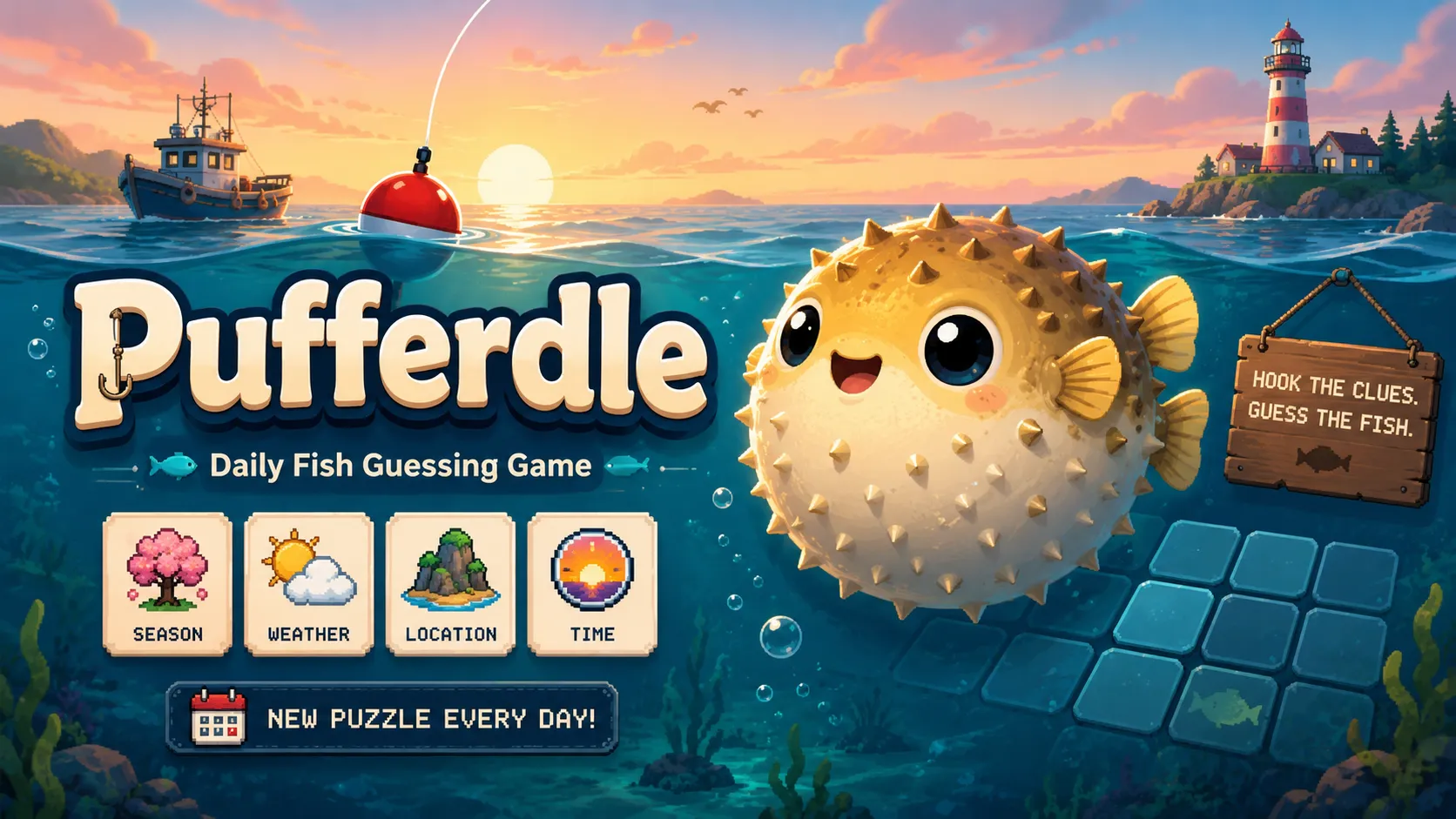
What is pufferdle?
Pufferdle takes one of Stardew Valley's most recognizable minigames and turns it into a deduction battle. Instead of immediately showing you trivia clues, it drops you into a fishing encounter with an unidentified fish. How violently does it move? Does it hover calmly or launch itself across the bar? That struggle is your first clue.
Then the real puzzle begins. You get six attempts to identify the fish, with each wrong guess revealing how its season, weather, location, and catch time compare with the mystery target. Stardew fishing knowledge helps enormously, but careful elimination can rescue you even when the fish's movement pattern leaves you completely fooled.
pufferdle Game Rules (The Catch / The Trap)
The challenge has two connected stages: catch first, deduce second.
🎣 The Catch
You begin with a Stardew Valley-style fishing minigame.
- Click / hold to raise the fishing bar.
- Release to let the bar fall.
- Keep the mystery fish inside the bar long enough to catch it.
- Watch how the fish moves. Its speed and behavior are valuable clues.
- Even if the fish escapes, the guessing round still continues—you must work with what you learned from the fight.
🐟 The Trap
You have 6 guesses to name the mystery fish. After each guess, Pufferdle compares four traits:
Season | Weather | Location | Time
The feedback works like this:
- 🟩 Green — your guessed fish matches the target exactly for that trait.
- 🟨 Yellow — the two fish overlap for that trait, but the match is not exact.
- ⬛ Gray — there is no overlap for that trait.
For example, imagine you guess Pufferfish and receive:
Season 🟨 | Weather 🟨 | Location ⬛ | Time 🟨
That tells you the mystery fish shares at least part of the Pufferfish's seasonal, weather, and time conditions—but it is caught somewhere completely different. Suddenly a huge chunk of the fish list can be thrown overboard.
The final identity itself is separate from those traits: matching every environmental clue does not automatically mean you have named the correct fish.
How To Play pufferdle?
1. Fight the mystery fish
Player Action: Start the daily puzzle and work the fishing bar around the unknown fish.
Game Response: The fish may stay calm, dart suddenly, sink, or repeatedly change direction.
What You Learn: Its movement gives you an initial shortlist before you make a single formal guess.
2. Make an opening guess
Player Guesses: Pufferfish
Result:
Season 🟨 | Weather 🟨 | Location ⬛ | Time 🟨
What This Means: Some conditions overlap, but the target is not found in the same location as a Pufferfish.
3. Test a different habitat
Player Guesses: Largemouth Bass
Result: Suppose Season and Weather turn 🟩 while Time remains 🟨.
Next Constraint: You now know much more about when the target can appear, while the remaining location and time clues become the important separators.
4. Narrow the pool
Player Guesses: Lava Eel
A 🟨 Location result would tell you that at least one of its possible areas overlaps with the mystery fish. Combine that with the previous green and yellow clues instead of treating each row separately.
5. Name the fish
When one candidate fits the fishing behavior plus every accumulated clue, commit to it. Guess correctly before attempt six and the day's fish is yours; otherwise the mystery catch escapes your deduction net.
pufferdle Strategy & Tips
Treat the fishing encounter as evidence, not just an obstacle. Experienced Stardew players can often distinguish an easy lake fish from an erratic high-difficulty catch before the clue grid even appears.
For your first formal guess, choose a fish with useful, distinctive catch conditions rather than simply guessing your favorite. A fish covering multiple seasons or locations can reveal valuable yellow overlaps, while an unusual habitat can quickly produce a decisive gray tile.
Most importantly, read yellow as partial overlap, not 'almost correct.' If two fish can both appear in summer but one also appears in another season, that may be enough to generate yellow feedback. Combine all four columns before eliminating candidates.
If the movement patterns keep destroying you, Pufferdle also includes a Fish Tank practice mode where you can repeatedly practice catching specific Stardew Valley fish and learn how they behave.