
What Is SkyQ?
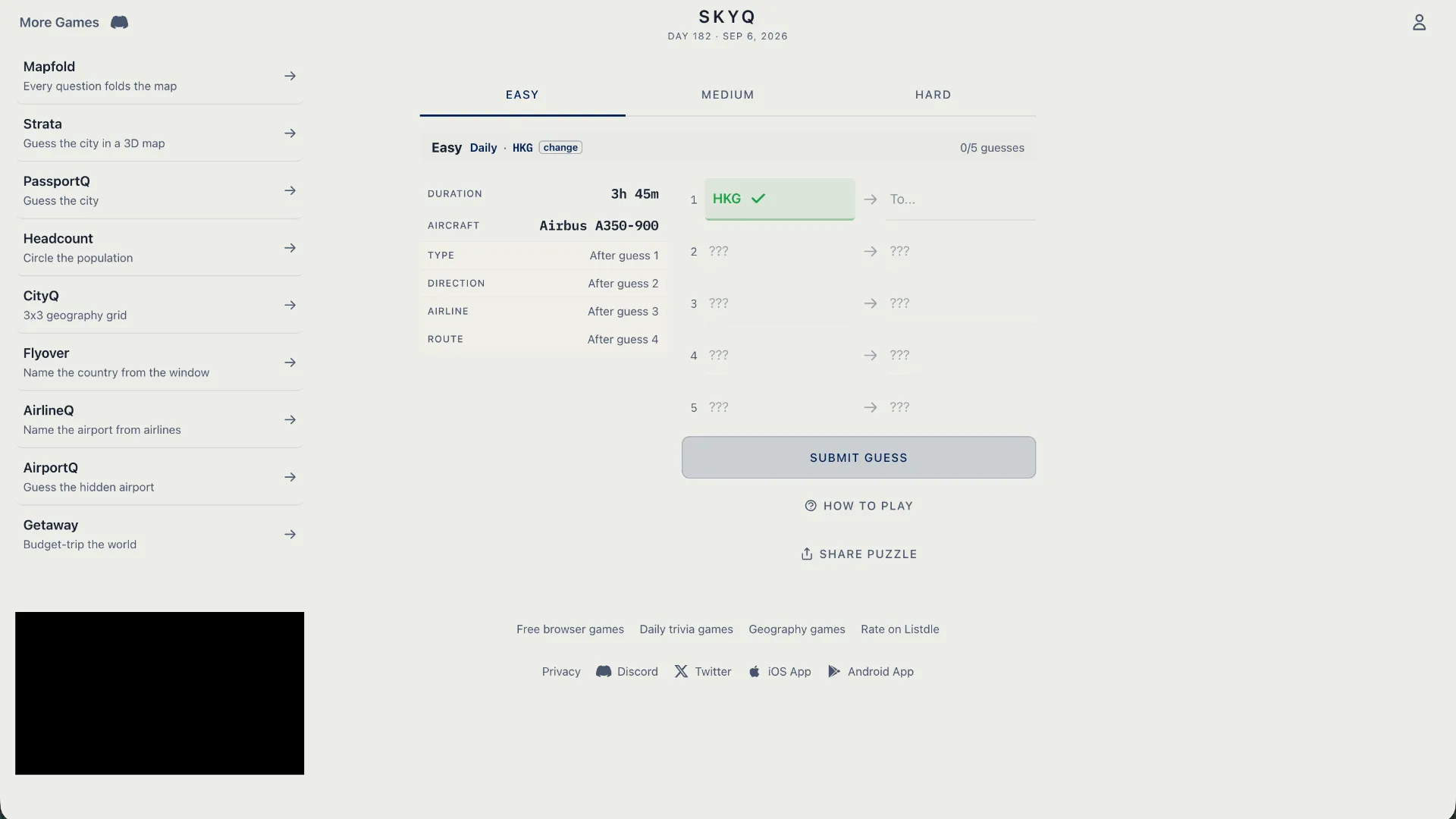
SkyQ is a daily flight-route guessing game from FlightQ that mixes aviation knowledge with world geography. Instead of identifying a country or city from a map, you are trying to determine the departure airport and destination airport of a real scheduled flight.
Each day offers three mystery routes at Easy, Medium, and Hard difficulty. Every route gives you five attempts, so you can play a quick accessible puzzle and then move on to increasingly obscure flights if you want a tougher challenge. ([FlightQ][1])
The game is especially appealing if you already recognize airport codes, airline hubs, aircraft types, or common international routes, but its progressive hints mean you do not need to be an aviation expert to start playing.
Rules and Core Twist
Your objective is to correctly name both ends of the mystery flight within five guesses.
You begin with two important pieces of information:
- Flight duration
- Aircraft type
For example, a puzzle might initially resemble:
Duration: 6h 02m
Aircraft: Airbus A321neo
You then submit a pair of airports:
FROM: JFK
TO: LAX
After an incorrect attempt, SkyQ gives feedback on the airports you entered and progressively reveals additional information. The clue sequence adds details such as whether the flight is domestic or international, its general direction of travel, the operating airline, and eventually the flight path. ([FlightQ][1])
Airport feedback also matters:
- A correct airport in the correct departure or destination position is confirmed.
- A correct airport placed on the wrong end of the route tells you that the airports may be reversed.
- An incorrect airport receives distance and directional feedback showing how far it is from the target airport and in which direction the real airport lies. ([FlightQ][1])
That last mechanic makes SkyQ more than aviation trivia. Even when you do not know the route, you can use geographic triangulation to move toward the correct airports.
How to Play SkyQ
- Choose Easy, Medium, or Hard. Easy favors recognizable major routes, while the harder modes introduce less obvious airport pairs and more specialized aviation knowledge.
- Study the opening clues. Use the flight duration and aircraft type to estimate the likely distance and type of route. A widebody aircraft on a long flight suggests a very different set of possibilities from a narrowbody on a short regional service.
- Guess both airports. Enter your predicted departure and arrival airports. You can search using airport or city information rather than needing to memorize every code.
- Use the new feedback. After a miss, combine airport distance and direction with newly revealed clues such as domestic versus international, travel direction, and airline.
- Identify the complete route before guess five. Both airports must be correct. Once finished, you can move to another difficulty or return for the next daily set.
Reading the Clues
SkyQ rewards combining several clue types rather than relying on a single fact.
Flight duration gives you an approximate geographic radius. A short flight makes distant airport pairs impossible, while a ten-hour route immediately points toward long-haul possibilities.
Aircraft type provides another filter. A Boeing 787 or Airbus A350 is much more likely to appear on long-distance routes, while aircraft such as the 737 or A320 family are common on shorter and medium-range services.
Domestic or international can eliminate huge portions of the search space. If a route is domestic, both airports need to be in the same country.
Direction of travel helps distinguish otherwise plausible routes. Knowing that a flight travels northeast rather than southwest can quickly invalidate one of your candidate airport pairs.
Operating airline is often one of the strongest clues because airlines concentrate flights around their hubs and focus cities.
Strategy Tips
Do not treat the first guess as a random airport pair. Start by estimating what kind of journey matches the duration and aircraft. Even an incorrect but geographically sensible guess can produce useful distance and directional feedback for both endpoints.
Once the airline is revealed, think about its major hubs. If one airport appears likely to be a hub, solving that side of the route can dramatically reduce the possibilities for the other.
Pay attention to route orientation as well as distance. If your departure guess is hundreds of kilometers southeast of the real airport, your next guess should deliberately move northwest rather than simply choosing another famous airport nearby.
Hard mode is best approached as a deduction puzzle rather than pure trivia. Regional airports and less famous city pairs make memorization unreliable, but combining aircraft range, flight duration, airline networks, direction, and geographic feedback can still lead you to the answer.